
 Basiran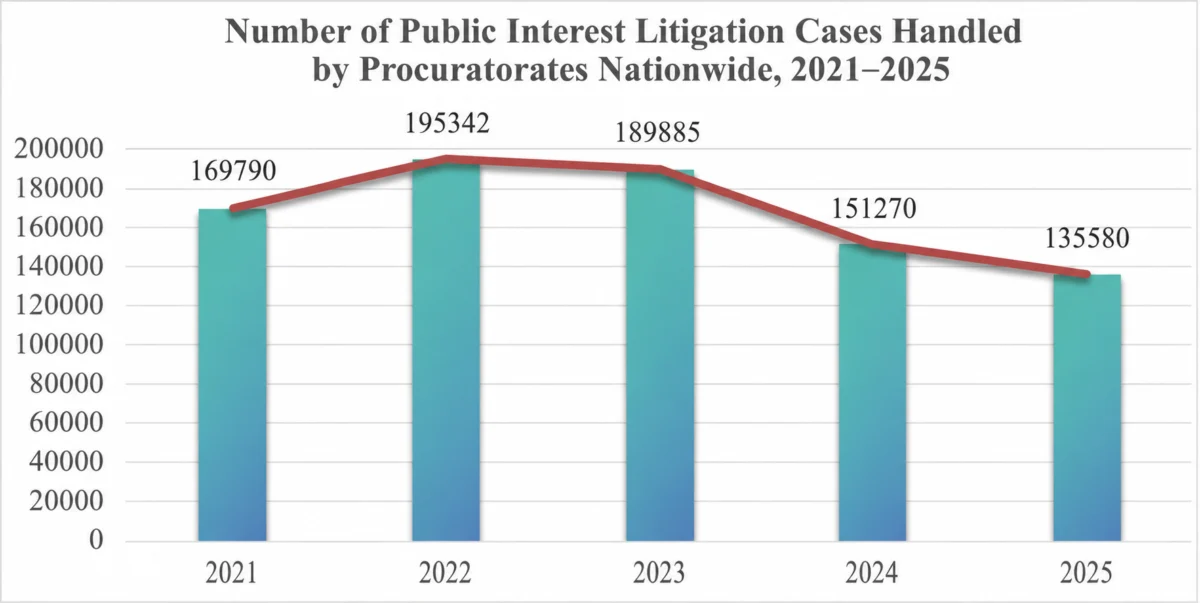
The Standing Committee of the National People’s Congress has officially released the second reading draft of the Law on Procuratorate Public Interest Litigation, marking a significant milestone in the codification of one of China’s most rapidly evolving legal mechanisms. This legislative development follows years of pilot programs and incremental adjustments to the Civil and Administrative Procedure Laws, aiming to consolidate the authority of the People’s Procuratorate—the state’s legal supervisory organ—into a comprehensive, standalone framework. The draft law seeks to clarify the boundaries of state intervention in public interest matters, ranging from environmental protection to the safeguarding of national defense interests and the rights of vulnerable groups.
As China’s legal system matures, the Procuratorate Public Interest Litigation (PPIL) system has emerged as a primary tool for addressing "mass harms"—situations where illegal actions affect a large number of people or the collective interests of the state and society. Traditionally, these issues were difficult to litigate due to the high cost of legal action, the complexity of evidence gathering, and the relative weakness of independent civil society organizations in the country. By empowering the procuratorate to act as the "representative of the public interest," the state has created a centralized channel to handle grievances against both private entities and administrative agencies.
Historical Evolution and the Chronology of the PPIL System
The path toward a standalone PPIL law has been defined by a decade of experimentation and institutional restructuring. To understand the current draft, it is essential to trace the timeline of its development:

- July 2015: The Standing Committee of the National People’s Congress (NPC) authorized a two-year pilot program for the People’s Procuratorate to initiate public interest litigation in 13 provinces and municipalities. This was largely a response to public outcry over recurring food safety scandals and environmental degradation.
- June 2017: Following the success of the pilot program, the NPC formally amended the Civil Procedure Law and the Administrative Procedure Law, granting the procuratorate the permanent power to file public interest lawsuits.
- March 2018: A major institutional shift occurred when the National Supervision Commission was established to take over the procuratorate’s anti-corruption and bribery investigation duties. This left the procuratorate with a need to redefine its core mission, leading to the elevation of "Public Interest Litigation" as one of its "Four Core Areas of Work," alongside criminal, civil, and administrative supervision.
- 2021–2023: The Supreme People’s Procuratorate (SPP) pushed for a specialized law to resolve inconsistencies in the application of PPIL and to expand the scope of protected interests to include data privacy, veterans’ rights, and "heroes and martyrs" protection.
- June 2024: The first reading draft of the Law on Procuratorate Public Interest Litigation was submitted to the NPC.
- July 2026: The second reading draft was released for public comment, incorporating refinements based on judicial practice and feedback from various state stakeholders.
The Dual Nature of PPIL: Administrative vs. Civil Litigation
A central feature of the draft law is the distinction between Administrative Public Interest Litigation and Civil Public Interest Litigation. While both are handled by the procuratorate, their targets and procedural requirements differ significantly.
Administrative PPIL is primarily a tool for "legal supervision." It is initiated when administrative agencies fail to perform their statutory duties, resulting in harm to the national or public interest. According to data from 2025, administrative cases constitute approximately 91% of the total PPIL workload. A critical component of this process is the "pre-litigation" phase. Before filing a lawsuit, the procuratorate must issue a formal "procuratorial suggestion" to the relevant government department, giving them a set period—usually two months—to rectify the illegality. Statistics show that the vast majority of administrative cases are resolved at this stage, with government agencies complying to avoid the reputational damage and legal burden of a public court appearance.
Civil PPIL, by contrast, is directed at private individuals or organizations, including state-owned enterprises (SOEs). These cases are pursued when an entity’s conduct—such as illegal dumping of hazardous waste or the sale of tainted food—infringes upon the public interest. Unlike administrative cases, civil PPIL is more likely to reach the trial stage, as the procuratorate seeks compensation for damages, restoration of the environment, or a public apology.
Statistical Analysis of Case Volumes and Success Rates
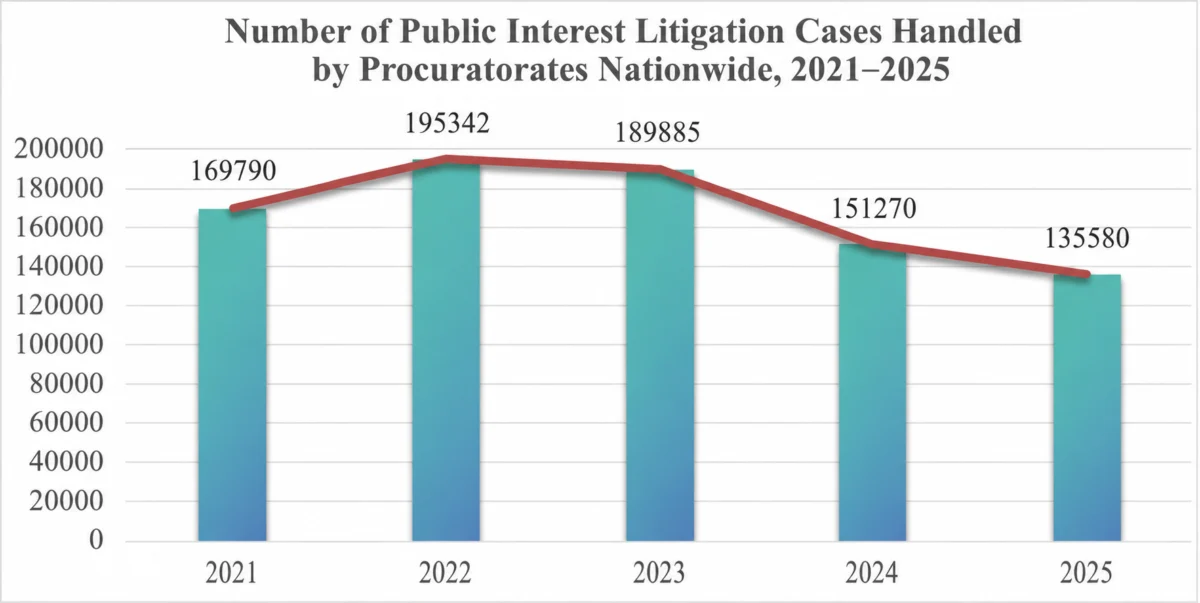
The scale of the PPIL system is reflected in the massive volume of cases handled by Chinese procuratorates in recent years. In 2025 alone, the procuratorate handled 135,580 public interest cases. However, the data reveals a significant disparity between "cases handled" and "lawsuits filed." Out of the 135,580 cases, only 7,305 (approximately 5.4%) actually resulted in a formal lawsuit in court.

This discrepancy highlights the system’s focus on mediation and administrative correction rather than adversarial litigation. The goal is often "governance" rather than "punishment." By resolving 94% of cases through pre-litigation procedures, the procuratorate acts as a mediator that forces regulatory compliance without overwhelming the court system.
In terms of subject matter, environmental protection remains the dominant category, followed closely by food and drug safety. However, the 2026 draft confirms an expanding scope into "new" areas. For example, cases involving the protection of personal information and work safety have seen double-digit percentage growth in the last three years, reflecting the government’s focus on the digital economy and industrial stability.
Expanded Scope and the Venn Diagram of Legal Authority
Article 3 of the second reading draft delineates the specific fields where the procuratorate is authorized to intervene. These fields are categorized by whether they apply to administrative agencies, private entities, or both.
- Shared Jurisdiction (Administrative and Civil): This includes the core pillars of PPIL: environmental and resource protection, food and drug safety, work safety, the protection of rights for vulnerable groups (such as the elderly and disabled), national defense and soldiers’ rights, cultural heritage preservation, and the newly added "ethnic unity."
- Administrative Only: The procuratorate has exclusive oversight over the protection of state-owned assets and state land-use rights. These cases typically involve the recovery of unpaid land-transfer fees or the prevention of the illegal sale of state property.
- Civil Only: Certain areas are reserved for actions against private actors. These include monopolistic conduct (anti-trust), large-scale labor violations, personal information protection (privacy), and the protection of the name, image, and reputation of "heroes and martyrs."
The inclusion of "ethnic unity" in the second draft is particularly noteworthy. It signals a move to use the procuratorate to enforce social harmony and state ideology through the legal system, targeting behaviors that are perceived to undermine national cohesion.

Extraterritoriality and Implications for Foreign Organizations
One of the most debated aspects of the new draft is Article 51, which explicitly addresses the application of the law to foreign entities. The article states that people’s procuratorates may lawfully initiate public interest litigation against foreign organizations and individuals that carry out unlawful conduct infringing on China’s national interests or the societal public interest.
This provision has sparked concerns among international legal analysts and foreign businesses operating in China. Some observers fear that "national interest" and "societal public interest" are sufficiently vague terms that could be used to target foreign firms for political reasons or in retaliation for international disputes. However, legal experts noted that this language is consistent with other recent Chinese legislation, such as the Data Security Law and the Anti-Foreign Sanctions Law, which also contain extraterritorial clauses.
The practical impact on foreigners may be felt most in sectors like environmental compliance and data privacy. A foreign chemical company operating in China could find itself the target of a Civil PPIL if its waste management practices are deemed a threat to local ecosystems. Similarly, a foreign tech company could be sued if it is found to be mishandling the personal information of Chinese citizens on a large scale. While the procuratorate generally prefers targeting domestic actors to set examples, Article 51 provides the necessary legal basis to ensure that foreign entities do not enjoy immunity from public interest mandates.
Institutional Reactions and Expert Analysis
The Supreme People’s Court (SPC) and the Supreme People’s Procuratorate have issued joint statements emphasizing that the new law is intended to "unify the standards of evidence" and "clarify the hierarchy of litigation." Official responses from the SPP suggest that the law will provide a more stable environment for businesses by clearly defining what constitutes an "infringement of public interest," thereby reducing arbitrary enforcement by local officials.

Critics, however, point to the potential for "over-supervision." Some administrative agencies have privately expressed concerns that the procuratorate’s power to issue "suggestions" could interfere with specialized regulatory functions. There is a delicate balance between the procuratorate acting as a supervisor and the procuratorate overstepping into the day-to-day management of government departments.
From a broader perspective, the Law on Procuratorate Public Interest Litigation represents a shift in China’s governance model. It reflects a preference for "state-led" public interest advocacy over the "citizen-led" model common in Western jurisdictions. By channeling public grievances through the procuratorate, the state maintains control over which issues are prioritized and how they are resolved, effectively mitigating the risk of independent social movements while still addressing the underlying causes of public dissatisfaction.
Future Outlook and Conclusion
As the draft moves toward its final reading and eventual enactment, the international and domestic business communities will be watching closely to see how the procuratorate exercises its expanded powers. The final version of the law is expected to include more detailed guidelines on the calculation of damages in civil cases and the specific criteria for "rectification" in administrative cases.
The Law on Procuratorate Public Interest Litigation is more than just a procedural manual; it is a foundational document for the "Rule of Law with Chinese Characteristics." It reinforces the procuratorate’s role as the guardian of the state’s interests and a check on both administrative inertia and corporate negligence. For foreign and domestic entities alike, the message is clear: compliance is no longer just a matter of avoiding fines from regulators; it is a matter of avoiding the scrutiny of the state’s most powerful legal supervisor in the name of the public good.

 Iffa Jayyana
 Suro Senen