Layla Zulfa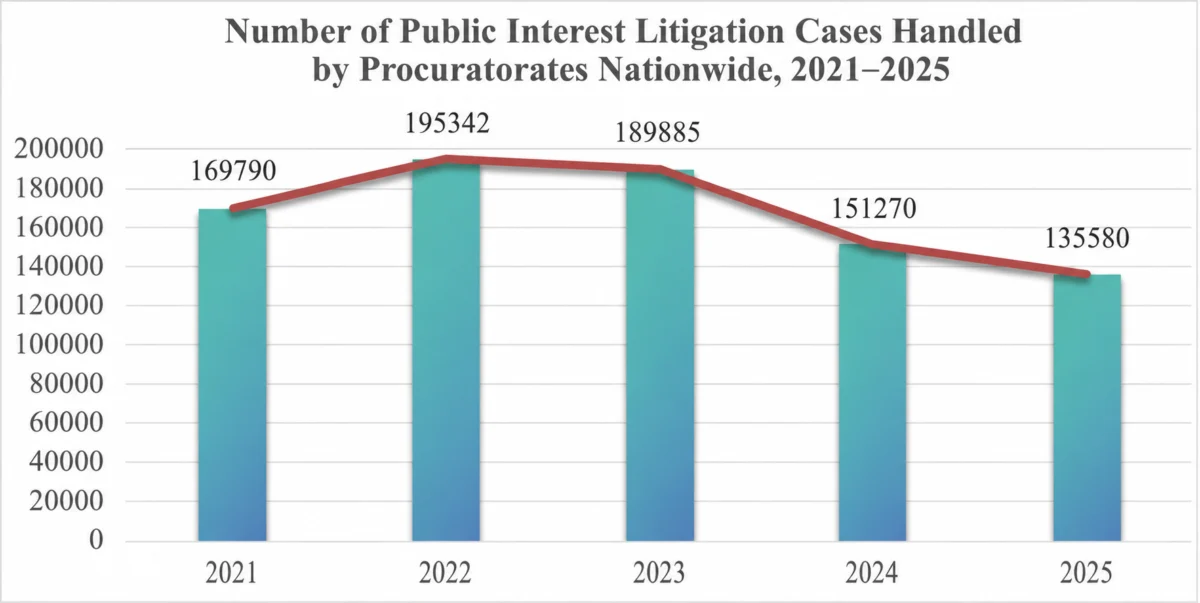
The Evolution and Strategic Shift of the Procuratorate System
The Procuratorate Public Interest Litigation (PPIL) system did not emerge in a vacuum; it was born out of a dual necessity to address mounting social grievances and to redefine the role of the state’s legal supervisors. Historically, the People’s Procuratorate was primarily focused on criminal prosecutions and corruption investigations. However, following the 2018 constitutional amendments and the establishment of the National Supervision Commission, the Procuratorate lost its primary authority to investigate official corruption. This shift necessitated a strategic pivot, leading the agency to elevate public interest litigation as one of its "four core work areas," alongside traditional criminal, civil, and administrative supervision.
The impetus for the PPIL system was a series of high-profile public health and environmental crises in the early 2010s. Recurring scandals involving contaminated food and severe industrial pollution led to widespread public frustration. While China’s Civil Procedure Law and Administrative Procedure Law were amended in 2017 to allow for public interest cases, private citizens and non-governmental organizations (NGOs) faced insurmountable hurdles. These included the immense financial cost of litigating against state-owned enterprises, the complexity of gathering evidence in environmental cases, and a general wariness from the central government regarding organized, independent citizen movements. By empowering the Procuratorate—a well-resourced state organ with "legal supervision" authority—the government created a mechanism to address mass harms without fostering an independent civil society.
Chronology of Legislative Development
The trajectory of public interest litigation in China reflects a cautious, pilot-driven approach to legal reform. The timeline of its development is essential to understanding the current 2026 draft:

- 2015: The Supreme People’s Procuratorate (SPP) launched a two-year pilot program in 13 provinces, authorizing procurators to file public interest lawsuits in specific areas like environmental protection and state asset preservation.
- 2017: Based on the success of the pilots, the National People’s Congress amended the Civil Procedure Law and the Administrative Procedure Law, formally establishing the legal basis for the Procuratorate to file public interest cases.
- 2018-2022: The scope of PPIL was gradually expanded through various "special action" campaigns and judicial interpretations, adding areas such as the protection of heroes and martyrs, consumer rights in the digital economy, and work safety.
- 2023-2024: The first reading draft of a dedicated "Procuratorate Public Interest Litigation Law" was introduced to consolidate these disparate rules into a single, comprehensive statute.
- 2026: The release of the second reading draft, which includes refined language on extraterritorial application and expanded jurisdictional categories.
Statistical Analysis of 2025 Case Handling
The scale of the PPIL system is vast, but a granular look at the data reveals that "litigation" is often a misnomer for how these cases are actually resolved. According to official figures from 2025, the People’s Procuratorate handled a total of 135,580 public interest cases. However, of these, only 7,305 cases (approximately 5.4%) actually resulted in a lawsuit being filed in court.
This discrepancy is explained by the "pre-litigation" procedure that defines the Chinese model. Under the draft law, the Procuratorate is required to first issue "procuratorial recommendations" to the relevant administrative agencies or defendants. In administrative cases, which make up roughly 91% of the total caseload, the vast majority of government agencies choose to rectify their behavior or address the harm immediately upon receiving the recommendation to avoid the embarrassment and legal consequences of a formal court appearance. Consequently, the success of the PPIL system is measured not by court victories, but by the rate of administrative compliance during the pre-litigation phase.
Jurisdictional Scope and the "Ethnic Unity" Expansion
Article 3 of the second reading draft delineates the specific fields where the Procuratorate has the authority to intervene. These categories are divided into those applicable to administrative litigation (against the government), civil litigation (against private entities), and areas where both apply.
The "shared" areas, where both public and private offenders can be targeted, include:

- Environmental and Resource Protection: Air, water, and soil pollution.
- Food and Drug Safety: Quality control and fraudulent labeling.
- Work Safety: Industrial accidents and labor hazards.
- Protection of Vulnerable Groups: Rights of the elderly, disabled, and minors.
- National Defense and Military Interests: Rights of service members and defense infrastructure.
- Cultural Heritage: Protection of historical sites and artifacts.
Notably, the second draft introduces "Ethnic Unity" as a new category for public interest litigation. This addition reflects a broader national policy shift toward the "Sinicization" of ethnic policy and suggests that the Procuratorate will now have the power to sue individuals or organizations perceived to be undermining national cohesion or ethnic harmony. Conversely, certain areas remain restricted: "State-owned Assets" and "State Land-Use Rights" are exclusively administrative domains, while "Personal Information Protection" and "Monopolistic Conduct" are primarily framed as civil matters, though they often overlap with state oversight.
Article 51: Extraterritoriality and Foreign Defendants
One of the most debated aspects of the 2026 draft is Article 51, located in the supplemental provisions. The article states: "The people’s procuratorates may lawfully initiate public interest litigation against foreign organizations and individuals that carry out unlawful conduct that infringes on our nation’s lawful interests or societal public interest."
This provision has sparked concerns among international legal analysts and foreign chambers of commerce. Some observers argue that Article 51 could be used as a "catch-all" tool to target foreign businesses for conduct occurring outside of China, provided that the state deems such conduct harmful to its "societal public interest." The vague definition of "public interest" in the Chinese context—which often encompasses political and ideological stability—heightens these concerns.
However, a more technical reading of the draft suggests that Article 51 is likely intended as a jurisdictional clarification rather than a significant expansion of powers. Under this interpretation, the rest of the law’s procedural requirements and categorical restrictions (Article 3) would still apply to foreign defendants. The article ensures that foreign entities cannot claim immunity from the PPIL system if they are involved in pollution, food safety violations, or data breaches that affect the Chinese public. Nevertheless, the inclusion of "amorphous" categories like ethnic unity or the protection of heroes and martyrs provides the state with a flexible legal instrument that could, in theory, be used to pressure foreign firms over their international corporate social responsibility (CSR) policies or marketing materials.

The Dual Standard of Public Interest
The draft law attempts to define "harm to the national interest or societal public interest" as the core threshold for any case. In guiding cases previously released by the Supreme People’s Procuratorate, the "public interest" is defined not merely as the sum of individual interests but as a collective good that the state has a duty to protect.
For foreign entities, this means that a standard tort or contract dispute would not fall under the PPIL Law. However, if a foreign company’s actions result in a "mass harm"—such as a large-scale data leak of Chinese citizens’ personal information or an environmental disaster—the Procuratorate can step in as the plaintiff. This state-led model differs significantly from the U.S. "class action" system, where private attorneys represent a class of victims. In China, the state is the representative of the "public," and any compensation or remediation is supervised by the Procuratorate.
Implications for Global Governance and Business
The formalization of the Procuratorate Public Interest Litigation Law signals China’s intent to strengthen internal governance through a top-down legal mechanism. For the Chinese government, the system serves as a "safety valve," allowing the state to address public grievances and check the power of local administrative agencies without relinquishing control to independent NGOs or a more litigious citizenry.
For the international community, the law represents the continued "judicialization" of Chinese state power. Foreign companies operating in China must now view the Procuratorate not just as a criminal prosecutor, but as a potential civil litigant with the full weight of the state behind it. The pre-litigation recommendation system means that companies may find themselves in a position where they must negotiate "voluntary" settlements or rectifications with the Procuratorate to avoid a public trial.

As the draft moves toward finalization, the focus will remain on how the "public interest" is defined in practice. If the law is used primarily to address tangible harms like pollution and food safety, it may be welcomed as a step toward a more robust rule of law. However, if the expansive categories of "ethnic unity" and "national interest" are used to target foreign entities for political reasons, the law could become a significant point of friction in China’s international relations. The final version of the law, expected later this year, will provide the definitive framework for this powerful new tool of Chinese legal supervision.


 Asep Darmawan
 Nana Wu