
 Sagoh
Sagoh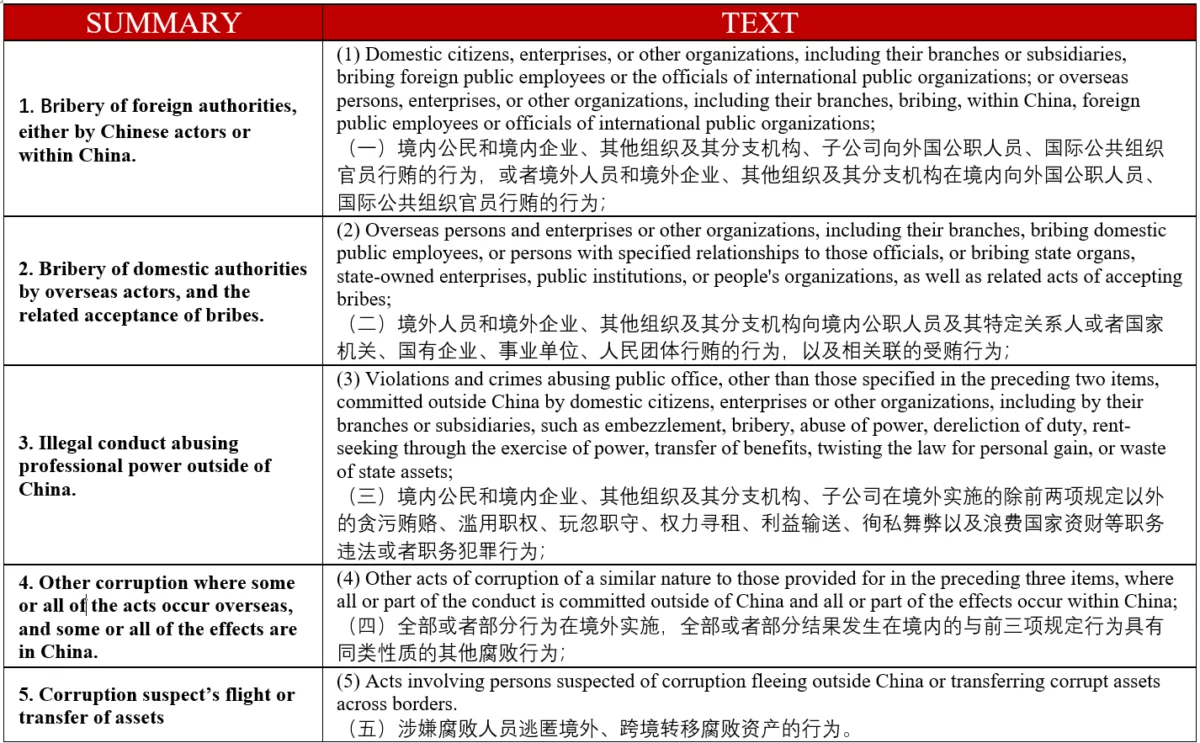
While recent legislative developments in the People’s Republic of China, such as the Ethnic Unity Law and the draft Procuratorial Public Interest Litigation Law, have sparked intense international debate over their extraterritorial reach, a potentially more impactful piece of legislation has remained largely under the radar. The draft Cross-Border Corruption Law (CBCL) represents a significant pivot in China’s legal architecture, specifically designed to address misconduct beyond its borders with a level of granularity and systemic oversight previously unseen. Unlike other laws where overseas application is an ancillary provision, the CBCL is built entirely around the axis of international connectivity. By integrating coordinated investigations, international cooperation frameworks, and mandatory corporate compliance systems, the draft signals Beijing’s intent to formalize its "long-arm" jurisdiction in the global fight against corruption.
The emergence of the CBCL is not an isolated event but the culmination of a decade-long evolution in China’s domestic and international policy. Since 2012, the Chinese leadership has prioritized a sweeping anti-corruption campaign that has transformed from a domestic "tigers and flies" crackdown into a sophisticated institutional framework. The establishment of the National Supervision Commission (NSC) in 2018 and the subsequent updates to the Supervision Law in 2025 have laid the groundwork for this new draft. The CBCL is, in many ways, the international arm of this internal apparatus, seeking to protect the integrity of the Belt and Road Initiative (BRI) and ensure that Chinese enterprises operating globally adhere to domestic standards of conduct.
Chronology of China’s Anti-Corruption Legal Evolution
To understand the weight of the CBCL, it is essential to trace the timeline of the legal milestones that preceded its drafting. The trajectory reflects a steady shift toward extraterritoriality and institutionalized oversight of overseas activities.
In 2018, China passed the International Criminal Judicial Assistance Law, which provided the first formal framework for cooperation with foreign states on criminal matters, including asset recovery and fugitive repatriation. This was followed in 2021 by the Data Security Law and the Anti-Foreign Sanctions Law, both of which asserted Chinese legal authority over entities and data outside Chinese territory. By 2025, the Ministry of Commerce (MOFCOM) released the "Guidelines on Overseas Integrity Compliance," which offered a voluntary blueprint for how Chinese firms should conduct themselves abroad.
The draft CBCL, surfacing in late 2026, transforms these prior guidelines into a binding statutory framework. It moves beyond the advisory nature of the MOFCOM guidelines, introducing hard penalties for compliance failures and establishing a direct link between the National Supervision Commission and the global activities of Chinese subsidiaries and branches.
The Scope of Coverage: Defining Cross-Border Misconduct
At the heart of the CBCL is Article 3, which defines the parameters of "cross-border corruption." Crucially, this article does not establish new criminal offenses. Instead, it serves as a jurisdictional gatekeeper, determining when the law’s provisions regarding prevention, reporting, and international cooperation are triggered. Legal analysts have identified three primary areas of concern within this definition that could significantly alter the risk profile for multinational corporations.
The first issue involves the treatment of subsidiaries. Articles 3(1) and 3(3) explicitly include the "branches and subsidiaries" of domestic Chinese enterprises. This phrasing suggests that a subsidiary incorporated in a foreign jurisdiction—such as a Delaware-based corporation owned by a Chinese parent—could fall under the scope of the CBCL. Even if the subsidiary is staffed by foreign nationals and the alleged misconduct occurs entirely within a foreign country, the Chinese parent company may still be held responsible for failing to maintain oversight. This mirrors aspects of the U.S. Foreign Corrupt Practices Act (FCPA) but applies them through the lens of the Chinese supervisory system.
The second area of ambiguity involves "malfeasance in office." Article 3(3) lists offenses such as embezzlement, bribery, and "rent-seeking through the exercise of power." While these terms are traditionally associated with public officials and state-owned enterprises (SOEs), the draft’s language regarding "enterprises or other organizations" suggests a broader application. If "malfeasance" is interpreted to include private-sector commercial bribery or the misuse of corporate funds by non-state actors, the compliance burden for private Chinese firms and their foreign partners will increase exponentially.
Thirdly, the draft uses the broad term "corruption" in Article 3(5) regarding the flight of suspects and assets. Because this term is not strictly defined, it remains unclear whether it applies only to public sector graft or if it could be invoked in cases of private financial crimes. This ambiguity is particularly relevant given Article 19, which allows for exit restrictions on individuals suspected of "corruption," potentially affecting foreign executives working for Chinese-linked entities.

Mandatory Compliance Systems and Corporate Liability
One of the most transformative aspects of the CBCL is the shift from voluntary to mandatory compliance. Articles 29 through 34 establish a framework that requires enterprises engaged in cross-border operations to implement robust internal controls. These requirements include:
- Risk Identification and Assessment: Companies must regularly evaluate the corruption risks associated with their specific industries and geographic locations.
- Internal Reporting Mechanisms: Mandatory "whistleblower" channels must be established to allow for the reporting of suspected misconduct.
- Third-Party Oversight: Enterprises are held accountable for the conduct of their agents, consultants, and contractors in foreign markets.
- Financial Transparency: The law requires the maintenance of accurate financial records to prevent the "off-the-books" transactions often used for bribery.
Article 45 introduces a significant enforcement mechanism for these requirements. It grants authorities the power to order "rectification" for companies with deficient compliance systems. If a company fails to correct these issues, it faces severe administrative penalties, including the suspension of business operations or the revocation of business licenses. Importantly, these penalties can be applied even if no actual act of bribery has been proven; the failure to maintain the compliance system itself constitutes a violation.
International Cooperation and the UNCAC Framework
The CBCL positions China as a proactive participant in the United Nations Convention against Corruption (UNCAC). The draft outlines a dual-track system for international cooperation. On one hand, it seeks to streamline the process for China to obtain evidence and recover assets from abroad. On the other hand, it establishes strict controls over how Chinese entities interact with foreign investigators.
Similar to the "blocking" provisions found in China’s Data Security Law, the CBCL suggests that Chinese enterprises and individuals may be prohibited from cooperating with foreign anti-corruption probes without prior approval from Chinese authorities. This creates a potential "conflict of laws" for multinational corporations. For example, a company might be required by a U.S. court to provide documents that the Chinese government, under the CBCL, forbids them from releasing. This dynamic reinforces the concept of "legal sovereignty," where Beijing asserts the right to mediate any international legal action involving its domestic entities.
Comparative Analysis: CBCL vs. the FCPA
While the CBCL is clearly inspired by the U.S. FCPA, it possesses distinct "Chinese characteristics" that differentiate its application. The FCPA is primarily focused on the bribery of foreign officials by domestic entities. In contrast, the CBCL appears to encompass a wider range of "malfeasance" that includes internal corporate discipline and the protection of state assets.
Furthermore, the enforcement of the FCPA is handled by the Department of Justice (DOJ) and the Securities and Exchange Commission (SEC) through a judicial process. The CBCL, however, is heavily integrated with the Supervision Law, meaning that the National Supervision Commission—an organ with vast administrative powers that operate outside the traditional court system—will play a central role in investigations. This gives the Chinese state more direct and rapid levers of control over corporate behavior than the purely judicial model used in the West.
Broader Strategic and Geopolitical Implications
The introduction of the CBCL has profound implications for the global business environment. For Chinese SOEs and private firms, the law represents an end to the "wild west" era of overseas expansion. The mandatory reporting requirements in Article 31 mean that firms can no longer turn a blind eye to the conduct of their regional managers or foreign partners.
For foreign governments and multinational corporations, the CBCL adds a new layer of complexity to doing business with China. The law’s extraterritorial reach means that joint ventures and supply chains involving Chinese partners will need to be vetted for compliance with Chinese anti-corruption standards, in addition to local and international laws.
From a geopolitical perspective, the CBCL is a tool for China to project its legal standards globally. By creating a comprehensive system for cross-border enforcement, Beijing is signaling that it will no longer rely solely on international treaties to protect its interests abroad. Instead, it is building its own "legal toolkit" to manage its global footprint. As the draft moves toward finalization, the international community will be watching closely to see how these ambiguous definitions are clarified and how aggressively the National Supervision Commission chooses to exercise its new-found global reach. The era of domestic anti-corruption has ended; the era of globalized Chinese legal oversight has begun.


 Lina Hope




Provisions on Ensuring the Healthy and Safe Use of the Internet by Minors Draft for Soliciting Comments
The Cyberspace Administration of China (CAC) has unveiled a comprehensive draft of the Provisions on Ensuring the Healthy and Safe Use of the Internet by Minors, marking a significant escalation…