Pevita Pearce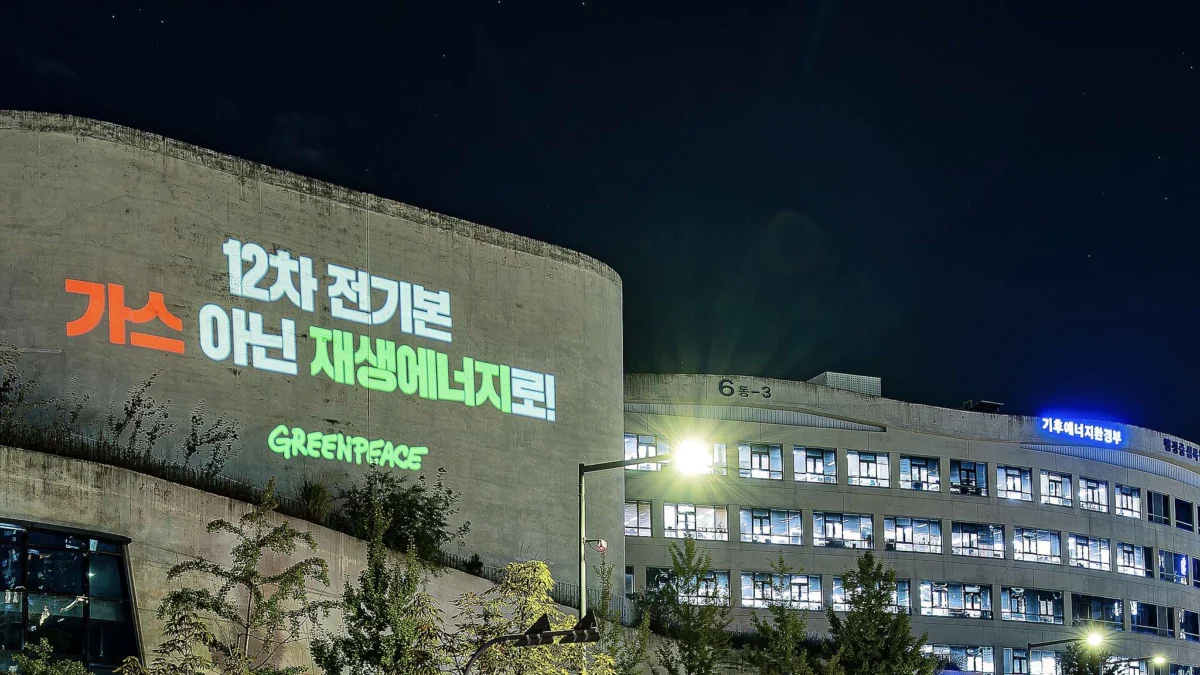
SEOUL – South Korea’s stated ambition to significantly expand its renewable energy capacity to 220 gigawatts (GW) by 2040 faces a formidable challenge, with a new report suggesting that the inclusion of power demand from upcoming industrial mega-projects into the nation’s 12th Basic Plan for Electricity Supply and Demand will make achieving crucial Nationally Determined Contribution (NDC) carbon reduction goals virtually impossible. The findings, released by Greenpeace East Asia and the civil society network Korea Beyond Fossil Fuels (KBF), raise serious concerns about the country’s commitment to its climate targets.
The report, titled Alternative Scenarios for Power Sector Decarbonization, was conducted by the energy research institute PLANIT. Utilizing the open-source Python for Power System Analysis (PyPSA) model, the study meticulously analyzed various power sector pathways. Its core methodology involved assessing emissions impacts based on the projections of the 11th Basic Plan, while crucially optimizing grid operations and buildout costs under different demand scenarios. The research specifically highlights the significant strain that the anticipated power consumption of large-scale industrial developments will place on the nation’s energy infrastructure and its climate commitments.
A central revelation from the analysis is that the integration of these mega-project power demands will push the power sector’s emissions far beyond the NDC target cap of 56 million tonnes of carbon dioxide equivalent (MtCO2e). This alarming outcome persists even under the most optimistic scenario where all coal-fired power plants are completely phased out. The study indicates that to bridge the gap left by retiring coal capacity and to meet the burgeoning demand from these industrial projects, gas power generation would need to be heavily expanded. The PLANIT study modeled two specific demand increases: 20GW and 30GW. These figures directly correspond to the projections made by the 12th Basic Plan Committee in August, which anticipated a demand increase of 26.6 to 26.8GW over prior baselines.
Mega-Project Power Demand Scenarios: A Detailed Look at Gas, Renewables, and Emissions
The comprehensive data presented in the report offers a stark contrast between different energy scenarios. A baseline scenario, termed "Coal Phaseout," assumes no additional mega-project demand and imposes a 15% utilization cap on gas power. In this scenario, South Korea would require 33 GW of gas capacity, generating 44 terawatt-hours (TWh) of electricity. Renewable energy capacity would reach an impressive 249 GW, producing 359 TWh. Crucially, emissions in this scenario would stand at 37 MtCO2e, representing approximately two-thirds of the NDC target.
However, the introduction of industrial mega-projects dramatically alters this picture. Under the "+ 20GW Mega Demand" scenario, gas capacity remains at 33 GW, but gas generation skyrockets to 208 TWh – an increase of approximately 164 TWh compared to the baseline. Despite an increase in renewable capacity to 280 GW, renewable generation only sees a marginal rise to 363 TWh. The consequence is a surge in emissions to 84 MtCO2e, which is 1.5 times the NDC target.
The situation becomes even more dire with the "+ 30GW Mega Demand" scenario. Here, gas capacity remains at 33 GW, but gas generation experiences a nearly fivefold increase, reaching 224 TWh – a substantial jump of 180 TWh from the baseline. Renewable capacity expands further to 344 GW, generating 441 TWh. Despite these advancements in renewables, emissions climb to approximately 90 MtCO2e, a staggering 1.6 times the NDC target. This outcome necessitates lifting the 15% capacity factor restriction on gas power plants to accommodate the immense demand.
Expert Analysis: A Call for Policy Shift on Gas Power
Jahyeon Kim, Energy Transition Team Lead at PLANIT, provided a critical assessment of these findings. "The finding that additional mega-project demand is met primarily by gas power demonstrates that expanding renewables alone won’t deliver real carbon reductions without strict regulations on gas generation," Kim stated. "To prevent the phase-out of aging coal plants from simply leading to reliance on gas – another fossil fuel – a decisive policy shift is urgently required, such as halting the construction of new gas-fired power plants and capping gas utilization rates to redefine gas power strictly as a peaking resource."
Kim’s remarks underscore a significant concern: the potential for a "rebound effect," where the closure of one fossil fuel source (coal) is offset by increased reliance on another (natural gas). This would undermine the very purpose of decarbonization efforts and jeopardise South Korea’s international climate commitments. The study’s reliance on the PyPSA model, a sophisticated tool widely used in energy systems research, lends significant weight to its conclusions. PyPSA allows for the simulation of complex electricity grids, considering factors such as generation costs, transmission constraints, and demand fluctuations, thus providing a robust basis for the projected outcomes.
Environmental Groups Sound the Alarm on Government Stance
Minju Shin, Climate and Energy Campaigner at Greenpeace East Asia, expressed strong criticism of the government’s current approach. "Despite the government’s target of expanding 220GW of renewables by 2040, mega-project demand has flashed a red light for carbon reduction goals," Shin declared. She specifically pointed to remarks made by Climate, Energy and Environment Minister Kim Sung-hwan, who reportedly suggested that gas expansion is "unavoidable." Shin argued that this stance directly contradicts both the 11th Basic Plan’s decision to reduce Liquefied Natural Gas (LNG) reliance from 26.8% to 10.6% and the nation’s own NDC targets.
Greenpeace East Asia and Korea Beyond Fossil Fuels have actively campaigned for a more aggressive renewable energy transition, advocating for policies that prioritize solar and wind power, alongside robust energy storage solutions. Their concerns are amplified by the significant investments being made in large-scale industrial complexes, such as those in semiconductors and electric vehicles, which are projected to consume vast amounts of electricity. The precise nature and location of these "mega-projects" are part of ongoing government planning, but their sheer scale is what has drawn the attention of environmental organizations.

Scrutinizing Demand Forecasts and Exploring Alternatives
Shin further emphasized the need for rigorous scrutiny of the projected demand for these mega-projects. "To prevent the upcoming 12th Basic Plan from deteriorating into a blueprint for megaproject-driven carbon emissions, it is imperative to rigorously examine whether the projected demand for these megaprojects has been overstated," she urged. Shin highlighted the critical need to avoid accepting gas power expansion as a foregone conclusion. This requires a thorough verification of demand forecasts and a comprehensive assessment of alternative scenarios. Such alternatives, she stressed, should prioritize the expansion of renewable energy sources and the strategic deployment of energy storage systems (ESS).
The implications of Shin’s recommendations are far-reaching. A more critical evaluation of industrial energy needs could potentially lead to more energy-efficient industrial designs or a phased development approach. Simultaneously, investing in and integrating advanced battery storage technologies could help manage the intermittency of renewables and provide the grid stability required for industrial operations, thereby reducing the reliance on gas as a backup. The 12th Basic Plan, Shin concluded, must be "thoroughly grounded in actionable pathways for renewable energy expansion and carbon neutrality to ensure the NDC targets are achieved."
Background and Context: South Korea’s Climate Journey
South Korea has publicly committed to ambitious climate goals, including achieving carbon neutrality by 2050 and significantly reducing greenhouse gas emissions by 2030, as outlined in its NDC. The Basic Plan for Electricity Supply and Demand is the cornerstone of the nation’s energy policy, setting targets for generation capacity, fuel mix, and infrastructure development over multi-year periods. The 11th Basic Plan, released in 2020, marked a shift towards a greater emphasis on renewable energy and a gradual reduction in reliance on coal and LNG.
However, the landscape of South Korea’s energy future is increasingly shaped by a burgeoning industrial sector, driven by global demand for advanced technologies like semiconductors, electric vehicle batteries, and hydrogen fuel cells. These industries are inherently energy-intensive, and their expansion plans necessitate a substantial increase in electricity supply. The debate now centers on how to meet this escalating demand without compromising climate objectives.
The environmental organizations’ report comes at a critical juncture, as the government is in the process of formulating the 12th Basic Plan. This plan will dictate the energy mix for the next decade and beyond, and its decisions will have a profound impact on South Korea’s emissions trajectory. The projected growth in renewable energy capacity – from 111GW in 2030 under the 11th plan to 220GW by 2040 – signals a strong intent, but the report argues that this ambition is being undermined by the anticipated energy needs of industrial mega-projects.
Broader Implications and Potential Ramifications
The findings of the Greenpeace and KBF report carry significant implications for South Korea’s energy security, economic competitiveness, and international standing.
- Climate Credibility: Failure to meet NDC targets could damage South Korea’s reputation as a responsible global actor in climate change mitigation. This could lead to increased international scrutiny and potential pressure from trading partners who are increasingly prioritizing emissions reductions in their supply chains.
- Economic Risks: Over-reliance on fossil fuels, particularly natural gas, exposes the economy to volatile global energy prices. Furthermore, a failure to transition effectively to clean energy could make South Korean industries less competitive in a future where carbon pricing and green procurement become more prevalent.
- Public Health and Environment: Continued reliance on fossil fuels, even gas, contributes to air pollution and other environmental degradation, impacting public health and ecosystems. The transition to renewables offers co-benefits in terms of cleaner air and a healthier environment.
- Energy Transition Pace: The report highlights the risk of a stalled or reversed energy transition, where investments in new fossil fuel infrastructure could lock the country into high-carbon pathways for decades, making future decarbonization efforts more challenging and costly.
The international environmental organization Greenpeace East Asia projected a message onto the exterior wall of the Ministry of Climate, Energy and Environment at the Government Complex Sejong, calling for a reduction in gas-fired power generation and an expansion of renewable energy in the 12th Basic Plan for Long-Term Electricity Supply and Demand. This symbolic action underscores the urgency and public nature of the debate surrounding South Korea’s energy future.
As South Korea navigates the complex interplay between industrial growth and climate action, the insights from the Alternative Scenarios for Power Sector Decarbonization report provide a critical roadmap for policymakers. The challenge lies in balancing immediate energy demands with long-term sustainability goals, ensuring that the nation’s pursuit of economic prosperity does not come at the expense of its climate commitments. The decisions made in the formulation of the 12th Basic Plan will be pivotal in determining whether South Korea can successfully chart a course towards a truly decarbonized and sustainable energy future.
Media Inquiries
Euihyun Choi, Communications Officer, Greenpeace Korea, [email protected], +82 10-5950-0369

 Lina Hope
 Laily UPN