Iffa Jayyana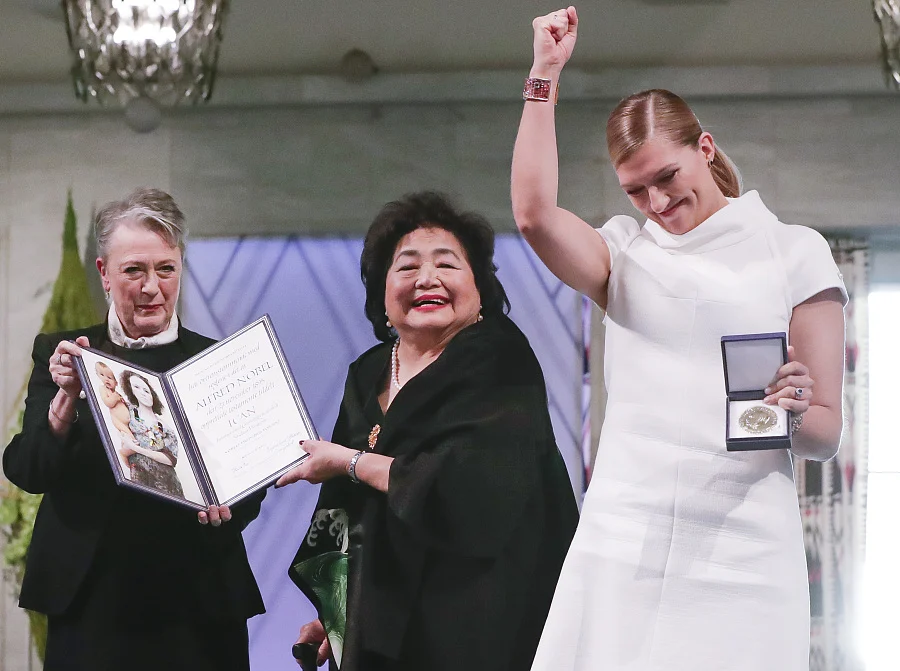
The International Campaign to Abolish Nuclear Weapons (ICAN) was honored with the prestigious 2017 Nobel Peace Prize at a solemn ceremony held at the Oslo City Hall on Sunday, December 10, 2017. The award recognized ICAN’s pivotal role in galvanizing global efforts to achieve a nuclear-weapon-free world, acknowledging its tireless advocacy and its instrumental contribution to the adoption of the Treaty on the Prohibition of Nuclear Weapons.

At the heart of the ceremony, Berit Reiss-Andersen, chairperson of the Norwegian Nobel Committee, formally presented the medal and diploma to Beatrice Fihn, the executive director of ICAN, and to Setsuko Thurlow, a revered survivor of the 1945 atomic bombing of Hiroshima. Their presence underscored the profound human cost of nuclear weapons and the urgent imperative for their eradication.
Reiss-Andersen articulated the committee’s rationale, stating, "ICAN is receiving the award for its work to draw attention to the catastrophic humanitarian consequences of any use of nuclear weapons and for its ground-breaking efforts to achieve a treaty-based prohibition of such weapons." She emphasized that this year’s prize continued a long-standing tradition of Nobel Peace Prize laureates dedicated to nuclear disarmament and the prevention of nuclear proliferation, a lineage that includes prominent figures and organizations that have long campaigned for a world free from the existential threat of nuclear annihilation.

In their joint Nobel lecture, delivered with powerful conviction, Beatrice Fihn and Setsuko Thurlow amplified the call for global action. Fihn issued a stark warning about the escalating risks of nuclear weapon use in the contemporary geopolitical landscape. "The risk for nuclear weapons use is even greater today than at the end of the Cold War," she asserted. "But unlike the Cold War, today we face many more nuclear armed states, terrorists, and cyber warfare." This sobering assessment highlighted the complex and multifaceted nature of the nuclear threat in the 21st century, extending beyond the traditional East-West confrontation to include emerging actors and novel forms of conflict.
Setsuko Thurlow, at 85 years old, offered a deeply personal and harrowing account of her experiences as a 13-year-old girl caught in the inferno of the atomic bombing of Hiroshima on August 6, 1945. She recounted the horrific loss of eight family members and 351 of her schoolmates, a tragedy that has shaped her life’s mission. Her plea was unequivocal: "to forever eradicate the threat of nuclear annihilation." Thurlow’s testimony served as a potent reminder of the unimaginable suffering inflicted by nuclear weapons and the moral urgency of preventing their recurrence.

A Global Coalition for Peace: The Genesis and Evolution of ICAN
The International Campaign to Abolish Nuclear Weapons (ICAN) is not a monolithic organization but rather a dynamic coalition of non-governmental organizations (NGOs) representing approximately 100 countries. Its formal inception took place in April 2007 in Austria, marking a concerted effort to unify diverse advocacy groups under a common banner. The campaign’s operational hub is strategically located in Geneva, Switzerland, a city renowned for its diplomatic significance and its role in international humanitarian efforts.
ICAN’s core mission revolves around advocating for the stigmatization, prohibition, and eventual elimination of nuclear weapons. The organization employs a multi-pronged approach, encompassing public awareness campaigns, policy advocacy, engagement with international bodies, and direct support for victims of nuclear weapons use and testing. Its efforts have been instrumental in building political will and fostering a global norm against these devastating instruments of war.

The Treaty on the Prohibition of Nuclear Weapons: A Landmark Achievement
The awarding of the Nobel Peace Prize to ICAN in 2017 was inextricably linked to its pivotal role in the negotiation and adoption of the Treaty on the Prohibition of Nuclear Weapons (TPNW). This historic treaty, adopted by a vote of 122-1 at the United Nations in July 2017, represents a significant milestone in the long and arduous journey towards nuclear disarmament. It unequivocally prohibits nuclear weapons, defining them as weapons of mass destruction that are contrary to international humanitarian law.
The TPNW is a legally binding international agreement that aims to:

- Prohibit nuclear weapons: Outlawing their development, possession, stockpiling, use, and threat of use.
- Mandate disarmament: Requiring states parties to eliminate their nuclear arsenals and prevent any future acquisition.
- Provide victim assistance: Obligating states parties to assist victims of nuclear weapons use and testing and to contribute to environmental remediation.
The treaty’s adoption was a testament to the sustained advocacy of ICAN and its member organizations, which mobilized civil society, engaged governments, and built a strong coalition of supporting nations. The campaign’s persistent efforts in highlighting the humanitarian consequences of nuclear weapons served as a powerful moral and ethical argument that resonated with a majority of UN member states.
A Timeline of Key Milestones in the Nuclear Abolition Movement
The journey towards nuclear disarmament is a protracted one, marked by periods of intense activism, diplomatic breakthroughs, and frustrating setbacks. ICAN’s Nobel Peace Prize serves as a culmination of decades of sustained effort by a global movement.

- 1945: The atomic bombings of Hiroshima and Nagasaki by the United States, ushering in the nuclear age and demonstrating the catastrophic destructive power of nuclear weapons.
- 1950s-1960s: Growing public concern over nuclear testing and the arms race leads to the formation of various anti-nuclear peace movements worldwide.
- 1968: The Treaty on the Non-Proliferation of Nuclear Weapons (NPT) is opened for signature, aiming to prevent the spread of nuclear weapons and promote disarmament. While a crucial step, it does not prohibit possession.
- 1980s: Renewed activism and the "Second Cold War" fuel a surge in anti-nuclear sentiment, with large-scale demonstrations and protests.
- 1995: The NPT is indefinitely extended, but critics argue this has not led to sufficient progress on disarmament.
- 2000: The NPT Review Conference adopts a 13-point plan on disarmament, but its implementation remains slow.
- 2007: The International Campaign to Abolish Nuclear Weapons (ICAN) is formally launched, aiming to bring nuclear disarmament to the forefront of the global agenda.
- 2010: The Nuclear Security Summit process begins, focusing on securing nuclear materials, but not directly on disarmament.
- 2013: The UN General Assembly convenes the High-Level Meeting on Disarmament, where ICAN plays a significant advocacy role.
- 2015: The Humanitarian Pledge, initiated by Austria, is launched, with states pledging to highlight the catastrophic humanitarian consequences of nuclear weapons. ICAN actively promotes this initiative.
- 2017 (July): The Treaty on the Prohibition of Nuclear Weapons (TPNW) is adopted by 122 UN member states.
- 2017 (December): ICAN is awarded the Nobel Peace Prize for its role in achieving the TPNW.
The Humanitarian Imperative: Data and Consequences
The devastating impact of nuclear weapons is not merely theoretical; it is a stark reality etched in history and a chilling prospect for the future. The scientific and humanitarian data supporting ICAN’s campaign are profound and compelling.
- Hiroshima and Nagasaki: The bombings of these two Japanese cities in 1945 resulted in immediate deaths estimated to be between 130,000 and 226,000 people. Survivors, known as "hibakusha," suffered from severe burns, radiation sickness, increased cancer rates, and genetic abnormalities that affected subsequent generations.
- Global Stockpiles: As of early 2017, an estimated 15,000 nuclear warheads were believed to be in existence, with approximately 90% held by Russia and the United States. These weapons possess a destructive capacity far exceeding that of the bombs dropped on Japan.
- Nuclear Winter: Scientific modeling suggests that even a limited regional nuclear conflict, involving a fraction of the current arsenals, could trigger a "nuclear winter." This phenomenon would involve the injection of vast amounts of soot into the atmosphere, blocking sunlight, causing global temperatures to plummet, and leading to widespread crop failure and famine, potentially threatening human civilization.
- Environmental Catastrophe: The detonation of nuclear weapons would release massive amounts of radioactive fallout, contaminating land, air, and water for decades or even centuries, rendering vast areas uninhabitable and posing severe health risks.
- Accidental Use: The risk of accidental detonation due to technical malfunction, human error, or miscalculation remains a persistent concern, particularly given the heightened tensions and the complex command-and-control systems involved.
ICAN’s consistent emphasis on these catastrophic humanitarian consequences has been a cornerstone of its strategy, shifting the discourse from a purely military or strategic one to a moral and ethical imperative.

Reactions and Implications: A Divided World on Nuclear Weapons
The awarding of the Nobel Peace Prize to ICAN has elicited a spectrum of reactions, highlighting the deeply divided international landscape regarding nuclear weapons.
Support and Celebration:

- Disarmament Advocates and Civil Society: The decision was widely celebrated by disarmament activists, human rights organizations, and many individuals who have long championed the cause of nuclear abolition. They viewed the prize as a validation of their efforts and a powerful endorsement of the TPNW.
- Governments Supporting the TPNW: Many of the 122 states that voted for the TPNW expressed their delight and pride. These nations, predominantly from the Global South, see the treaty as a crucial step towards a more just and secure world, free from the existential threat posed by nuclear-armed states.
- United Nations Officials: Senior UN officials often lauded ICAN’s work, recognizing its instrumental role in advancing the disarmament agenda.
Skepticism and Opposition:
- Nuclear-Armed States: The United States, Russia, China, France, and the United Kingdom – the five recognized nuclear-weapon states – along with other nuclear-armed nations like India, Pakistan, North Korea, and Israel, did not support the TPNW and have largely remained indifferent or critical of ICAN’s efforts. They often cite their reliance on nuclear weapons for deterrence and national security as a reason for not joining the treaty.
- NATO Allies: Many NATO member states, particularly those under the US nuclear umbrella, also abstained from the TPNW negotiations and expressed concerns that the treaty undermines existing non-proliferation and disarmament frameworks like the NPT and could create divisions within the alliance. They often argue that nuclear weapons are essential for maintaining peace and stability through deterrence.
- Conservative Think Tanks and Policy Analysts: Some security analysts and think tanks have questioned the practical impact of the TPNW, arguing that it does not address the security concerns that lead states to possess nuclear weapons and that it could be seen as an attempt to delegitimise nuclear deterrence without offering viable alternatives.
Broader Impact and Implications for Global Security
The Nobel Peace Prize awarded to ICAN carries significant implications for the future of global security and the pursuit of nuclear disarmament.

- Increased Legitimacy for the TPNW: The prize bestows considerable international legitimacy on the Treaty on the Prohibition of Nuclear Weapons. It elevates the treaty from a principled statement of intent to a globally recognized symbol of the aspiration for a world free of nuclear arms. While the treaty does not currently include any nuclear-armed states, its growing number of signatories and the Nobel recognition could exert increasing political and moral pressure on those states to reconsider their positions.
- Shifting the Normative Landscape: ICAN’s success, culminating in the Nobel Prize, signifies a powerful shift in the global normative landscape. The campaign has effectively amplified the humanitarian argument against nuclear weapons, framing them as inherently unacceptable instruments of warfare due to their indiscriminate and catastrophic nature. This normative pressure can influence public opinion, civil society engagement, and, over time, even government policies.
- Strengthening the Disarmament Movement: The award provides a significant boost to the broader disarmament movement. It validates the tireless work of countless activists and organizations and can inspire renewed commitment and participation from new generations. It also serves as a powerful fundraising and advocacy tool for ICAN and its member organizations.
- Challenges and the Path Forward: Despite the celebratory nature of the award, the path to a world without nuclear weapons remains fraught with challenges. The fundamental security doctrines of nuclear-armed states, based on deterrence, are deeply entrenched. The TPNW faces significant hurdles in achieving universal adherence, particularly from states possessing nuclear weapons. Furthermore, ongoing geopolitical tensions and the rise of new security threats can complicate disarmament efforts.
However, the Nobel Peace Prize for ICAN represents a crucial moral victory and a potent reminder that persistent advocacy and a clear articulation of humanitarian principles can drive progress, even in the face of formidable opposition. The campaign’s work underscores the enduring hope that humanity can collectively overcome the existential threat posed by nuclear weapons and build a more secure and peaceful future. The prize is not an endpoint but a powerful impetus for continued action and a testament to the profound impact that dedicated global civil society can have on shaping the international agenda.


 Nana Wu
 Suro Senen