Evan Lee Salim
Southeast Asia’s automotive market is experiencing a profound transformation, with the rapid ascendance of electric vehicles (EVs) fundamentally reshaping a region long dominated by Japanese carmakers. This tectonic shift presents a critical challenge for established manufacturers like Toyota and Honda: can they pivot swiftly enough to maintain their relevance in this evolving landscape? The urgency of this question was underscored on June 24th, when Greenpeace Japan convened an online seminar to dissect the burgeoning EV market in Indonesia and its broader implications for traditional Japanese automakers. The virtual forum brought together key figures to share their perspectives on this dynamic sector.
Indonesian EV Market Surges Ahead, Defying Conventional Adoption Patterns
The accelerated adoption of EVs in Southeast Asia, particularly in Indonesia, is bucking historical trends. Typically, the rollout of clean technologies has begun in wealthier economies before trickling down to middle-income nations. However, Indonesia, a key player in the region’s economic growth, is demonstrating a faster embrace of EVs than many more affluent countries. According to Aditya Mahalana, a senior researcher at the International Council on Clean Transportation (ICCT), this deviation is partly attributable to the absence of deeply entrenched legacy domestic auto industries. In Indonesia, fewer political hurdles and import barriers typically associated with protecting established automotive sectors allow for a more open welcome to affordable green technologies.
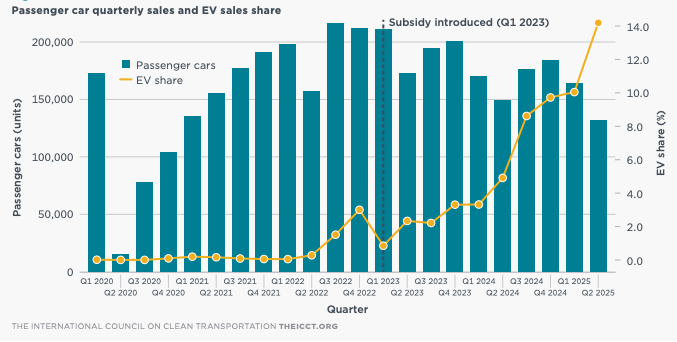
The ICCT’s Market Spotlight report provides compelling data illustrating this dramatic surge. Indonesia’s EV sales have experienced an explosive growth, leaping from fewer than 150 units in 2020 to over 22,000 units by the second quarter of 2025. This remarkable expansion has pushed the nation’s total EV fleet beyond the 100,000-unit mark. By the second quarter of 2025, EVs constituted a significant 15.2% of all passenger car sales in Indonesia, fueled by an astonishing 40% increase in sales from the preceding quarter alone. This trajectory signals a move beyond early adopters and into the mainstream consumer market.
This momentum is significantly bolstered by Indonesia’s abundant natural resources. As the world’s largest producer of nickel, accounting for approximately 40% of the global supply, Indonesia possesses a distinct advantage in the crucial supply chain for EV batteries. Achmad Rofiqi, vice chairman of PR & Education at the Indonesian EV Industry Association (PERIKLINDO), highlighted this strategic resource as a foundational element for the nation’s EV ambitions.
Simultaneously, domestic factors are accelerating EV uptake. The availability of more affordable EV models, coupled with lower running costs and a progressively expanding charging infrastructure, is making electric mobility increasingly attractive to Indonesian consumers. By 2024, Indonesia had established over 2,300 public charging stations spread across 300 cities, a testament to the growing commitment to supporting EV adoption. This infrastructure development is crucial for alleviating range anxiety and encouraging wider consumer confidence.
New Entrants Reshape the Competitive Arena, Challenging Established Players
The rapid electrification of the automotive sector is fundamentally redrawing the competitive map of Southeast Asia. For decades, Japanese brands such as Toyota, Honda, and Nissan enjoyed a near-monopoly in the ASEAN market, built on their reputation for manufacturing prowess, reliability, and deep-seated brand loyalty. While these legacy automakers continue to command a significant share of the market for internal combustion engine (ICE) vehicles, their dominance in the burgeoning EV segment is being rapidly eroded.
The vacuum left by the slower adaptation of traditional players is being filled by new competitors, most notably Chinese automakers. Companies like BYD and SAIC’s Wuling have emerged as formidable forces, now collectively accounting for nearly 60% of all battery electric vehicle (BEV) sales in Indonesia, according to ICCT data. Their competitive edge extends beyond aggressive pricing strategies. These newcomers often possess vertically integrated battery supply chains, enabling cost efficiencies and faster production. Furthermore, they are distinguished by their integration of advanced digital features, catering to the evolving demands of modern consumers, and remarkably agile product development cycles. These manufacturers are frequently bringing new models to market within a swift 12 to 18-month timeframe, a pace that traditional automakers struggle to match.
The Imperative for Japanese Automakers to Accelerate Their EV Transition
The prevailing sentiment among industry experts is clear: the rules of automotive competition are undergoing a radical transformation. "The rules of the competition are evolving. Companies that can adapt quickly will be positioned for long-term success," stated Rofiqi from PERIKLINDO. This sentiment underscores the critical need for established players to embrace agility and innovation.
Japanese companies still possess significant strengths, including world-class engineering capabilities, an impeccable safety record, and decades of accumulated customer trust. However, to remain competitive and relevant in the face of this disruptive wave, these advantages must be leveraged within an electrified framework. The strategy for companies like Toyota needs to shift from defensive lobbying that seeks to delay electrification, towards actively leading the region’s transition to a cleaner automotive future. This pivot requires a strategic focus on several key areas:
- Accelerated EV Model Development and Deployment: A more aggressive timeline for introducing a wider range of appealing and competitively priced EV models is essential. This includes not only passenger vehicles but also commercial and two-wheeler segments, which are also experiencing rapid electrification.
- Investment in Localized EV Ecosystems: Beyond vehicle manufacturing, Japanese automakers must deepen their investment in local battery production, charging infrastructure development, and the training of skilled technicians for EV maintenance and repair. This fosters local economic growth and strengthens supply chain resilience.
- Enhanced Collaboration with Local Stakeholders: Engaging more proactively with governments, local industry associations, and research institutions can foster a more supportive regulatory environment and accelerate the adoption of EVs. This includes sharing technological expertise and supporting policy frameworks that encourage EV uptake.
- Reimagining After-Sales and Service: The shift to EVs necessitates a transformation of after-sales service models. This includes training service personnel on EV-specific diagnostics and repairs, and developing new strategies for battery management and recycling.
- Embracing Digitalization and Connectivity: The next generation of vehicles are increasingly defined by their digital capabilities. Japanese automakers need to prioritize the integration of advanced infotainment systems, driver-assistance technologies, and over-the-air software updates to meet consumer expectations.
Rofiqi concluded, "The opportunity for Japanese automakers remains substantial… But maintaining leadership will require accelerated EV product development, localized strategies, and deeper engagement with the emerging EV ecosystem." He further emphasized a collaborative vision, stating, "The future does not have to be a competition between countries. It can be a collaboration that benefits the entire region."
Greenpeace’s Perspective: Linking Market Dynamics to Climate Imperatives
The rapid market evolution discussed at the Greenpeace-hosted seminar highlights a critical juncture for global climate action. For nations in Southeast Asia, the opportunity to bypass the protracted era of internal combustion engine vehicles offers a powerful mechanism to prevent decades of future carbon lock-in. The International Energy Agency (IEA) global EV forecast reinforces this narrative, projecting that the transition to electric mobility is now an unavoidable global trend. Global EV sales are on track to reach an impressive 23 million vehicles this year, a monumental shift poised to displace up to 5 million barrels of oil per day by 2030, thereby becoming an indispensable element in the global effort to avert a climate crisis.

Erin Eunseo Choi, Climate and Energy Campaigner at Greenpeace East Asia, articulated the environmental organization’s perspective, stating, "Indonesia’s rapid EV adoption proves the market is ready. For legacy brands like Toyota, it exposes the real risk of the slow-walk strategies favored by traditional automakers. Relying on a defensive ‘multi-pathway’ approach that protects combustion engines and hybrids is no longer viable and is already costing them market share to faster competitors." Choi underscored the urgency of decarbonizing the transport sector, particularly in light of geopolitical oil shocks and severe climate events. "Amid geopolitical oil shocks and severe El Niño events this year, decarbonizing the transport sector through battery electric vehicles is urgent. Japanese automakers must accelerate their EV strategies and set ambitious greenhouse gas reduction targets to achieve substantial cuts in total emissions," she urged.
The implications of this EV revolution extend far beyond the automotive industry. It signifies a broader economic reorientation, a recalibration of global supply chains, and a critical opportunity for nations to leapfrog to more sustainable and cleaner technologies. The success of countries like Indonesia in rapidly adopting EVs serves as a potent signal to legacy automakers worldwide that the era of incremental change is over, and bold, swift action is paramount for survival and leadership in the automotive future. The coming years will be a decisive test of adaptability and strategic foresight for automotive giants grappling with this profound and accelerating transformation.


 Lina Hope