Iffa Jayyana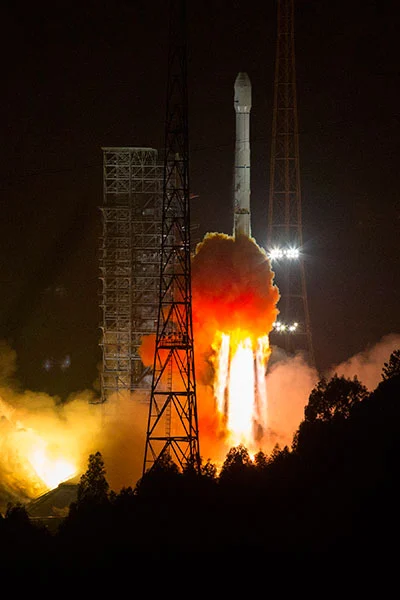
A significant milestone in international space collaboration was reached on Monday, December 11, 2017, as China successfully launched Alcomsat-1, Algeria’s first communications satellite, from the Xichang Satellite Launch Center. This event not only marked Algeria’s entry into the exclusive club of nations operating their own communications satellites but also represented China’s inaugural export of such a sophisticated spacecraft to an Arab nation, underscoring Beijing’s expanding influence and technological prowess in the global space market.
The Launch and Orbital Insertion
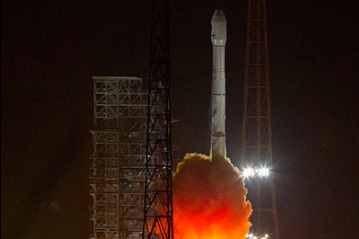
The Long March 3B carrier rocket, a workhorse of China’s space launch fleet known for its reliability in delivering satellites to geostationary transfer orbit (GTO), lifted off precisely at 12:40 AM Beijing time (16:40 GMT on December 10) from its pad in the southwestern province of Sichuan. The launch sequence proceeded flawlessly, with the powerful three-stage rocket ascending into the night sky, carrying its valuable payload. After approximately 26 minutes of powered flight, the Alcomsat-1 spacecraft was successfully injected into its intended geostationary transfer orbit. This elliptical orbit is a crucial intermediate step, from which the satellite will gradually raise itself to a circular geostationary orbit approximately 35,786 kilometers (22,236 miles) above the equator, where it will appear stationary relative to the Earth’s surface. This position allows for continuous communication coverage over a vast geographical area. The successful deployment was confirmed by a news release from China Great Wall Industry Corp (CGWIC), the primary contractor for the project and China’s largest space contractor in the international market.
A Deepening Strategic Partnership: Presidential Acclaim
The successful launch was swiftly followed by an exchange of congratulatory messages between Chinese President Xi Jinping and his Algerian counterpart, President Abdelaziz Bouteflika, on Monday morning. President Xi emphasized that the Alcomsat-1 project served as a powerful testament to the robust and comprehensive strategic partnership between China and Algeria. He highlighted its significance as a prime example of burgeoning space cooperation between China and Arab countries, forecasting its pivotal role in propelling Algeria’s economic and social development. Xi further affirmed China’s commitment to deepening bilateral cooperation across various sectors, aiming to foster mutual benefits for both nations and their peoples.
President Bouteflika, in his message, echoed Xi’s sentiments, hailing Alcomsat-1 as a remarkable achievement born from the close space cooperation between the two countries. He underscored that the project vividly reflected the deep-rooted traditional friendship that has long characterized Sino-Algerian relations. Bouteflika expressed Algeria’s eagerness to continue strengthening this cooperation with China, signaling a shared vision for future joint ventures in high-technology domains.
Chronology of a Collaborative Endeavor
The journey to the Alcomsat-1 launch was a multi-year collaborative effort, beginning with the formal agreement.
- December 2013: The contract for Alcomsat-1 was officially signed between the Algerian Space Agency (ASAL) and China Great Wall Industry Corp. This marked the initiation of the ambitious project, setting the stage for technical specifications, design phases, and manufacturing timelines.
- 2014-2017: Following the contract, a period of intensive design, manufacturing, and testing commenced. Alcomsat-1 was designed and manufactured by the China Academy of Space Technology (CAST), a subsidiary of China Aerospace Science and Technology Corp (CASC). CAST is renowned for its expertise in satellite development, and Alcomsat-1 was built upon the flight-proven DFH-4 (Dongfanghong-4) satellite platform. The DFH-4 platform is a large-capacity, high-power telecommunications satellite platform widely used for both domestic and international projects, capable of carrying a significant number of transponders for various communication services. Throughout this phase, Algerian engineers and technicians were reportedly involved in training programs in China, gaining invaluable knowledge and hands-on experience in satellite operations and ground control. This capacity-building component was a crucial aspect of the technology transfer inherent in the agreement.
- Late 2017: The fully assembled and tested Alcomsat-1 satellite was transported to the Xichang Satellite Launch Center. Concurrently, the Long March 3B rocket underwent its own rigorous pre-launch preparations, including assembly, integration of the satellite fairing, and fuel loading.
- December 11, 2017: The successful launch from Xichang, marking the culmination of years of planning, design, and execution.
- Post-Launch: Following injection into geostationary transfer orbit, the satellite embarked on a series of orbital maneuvers, using its onboard propulsion system to gradually raise its perigee (lowest point) and apogee (highest point) until it reached its designated geostationary slot. This process typically takes several weeks, followed by an in-orbit testing phase to verify the functionality and performance of all its communication payloads.
Technical Specifications and Capabilities
Alcomsat-1 is a sophisticated communications satellite designed to provide a comprehensive suite of services. With a liftoff mass of approximately 5.2 metric tons (5,200 kg) and a robust design life of 15 years, the satellite is engineered for long-term operational reliability. Its reliance on the DFH-4 platform signifies its capability to deliver high-performance communication services. The DFH-4 platform is known for its high power generation (typically 8 to 10 kW) and substantial payload capacity, enabling it to host numerous transponders across various frequency bands (C-band, Ku-band, Ka-band, L-band) to support diverse applications.
Specifically, Alcomsat-1 is equipped to serve a wide array of public services crucial for Algeria’s development:
- Television Broadcasting: Enhancing national TV coverage, especially to remote and underserved areas, ensuring equitable access to information and entertainment.
- Emergency Communications: Providing resilient communication channels for disaster management, search and rescue operations, and rapid response coordination, particularly vital in a country with diverse geographical challenges.
- Remote Education: Bridging the educational divide by enabling distance learning programs, providing internet access to schools in rural areas, and facilitating teacher training, thus expanding access to quality education.
- Satellite-based Signal Augmentation: Improving the accuracy and reliability of navigation systems (like GPS) for various applications, including transportation, logistics, and resource management.
- Broadband Internet Access: Crucially, the satellite will play a significant role in providing broadband internet connectivity across Algeria, addressing the digital divide between urban and rural populations. This is particularly important for a country with vast desert regions where terrestrial infrastructure is difficult and costly to deploy.
- Telemedicine: Facilitating remote medical consultations and data transfer, bringing specialized healthcare services to remote clinics and hospitals, thereby improving public health outcomes.
Fu Zhiheng, vice-president of China Great Wall Industry Corp, confidently stated that Alcomsat-1’s technological sophistication and operational capacity are on par with Western communications satellites, highlighting China’s competitive edge in the high-tech space industry. He also hinted at further contracts with other Arab countries, indicating a growing pipeline of international projects for CGWIC.
Broader Impact and Implications
The launch of Alcomsat-1 carries multi-faceted implications, spanning geopolitical, economic, and technological spheres.
Geopolitical and Diplomatic Significance:
This project is a powerful illustration of China’s "Space Silk Road" initiative, often seen as an extension of its broader Belt and Road Initiative (BRI). By providing advanced space technology and expertise to developing nations, China is forging stronger diplomatic ties and positioning itself as a reliable partner in high-tech infrastructure development. For Algeria, it signifies a strengthening of its comprehensive strategic partnership with China, diversifying its international collaborations beyond traditional European partners. It also enhances Algeria’s strategic autonomy by giving it direct control over its critical communication infrastructure, reducing reliance on foreign-owned satellites. This move is a clear demonstration of South-South cooperation, where developing nations collaborate on advanced technological projects.
Economic Development and Digital Inclusion for Algeria:
Alcomsat-1 is poised to be a transformative asset for Algeria’s national development agenda. With a landmass of over 2.3 million square kilometers, much of which is sparsely populated desert, establishing terrestrial communication networks is a monumental challenge. The satellite will dramatically expand access to telecommunications and internet services, especially in remote regions, thereby reducing the digital divide. This expanded connectivity will stimulate economic activity, support the growth of e-commerce, and facilitate digital governance. By enabling remote education and telemedicine, it will directly contribute to human capital development and improve quality of life across the nation. The estimated 15-year lifespan ensures long-term benefits and a significant return on investment for Algeria.
Technological Advancement and Sovereignty:
For Algeria, owning and operating its own communications satellite is a significant step towards technological sovereignty. It allows the Algerian Space Agency (ASAL) to manage its national communication needs independently, tailoring services to specific national priorities without external constraints. The knowledge transfer and training programs associated with the project also contribute to building Algeria’s indigenous expertise in space technology, laying the groundwork for future advancements.
For China, Alcomsat-1 solidifies its position as a major global player in the commercial satellite market. The DFH-4 platform, having already supported several international clients, demonstrates China’s capability to deliver high-quality, cost-effective space solutions that compete with established Western manufacturers. This success story further opens doors for Chinese space companies to secure more contracts in Africa, the Middle East, and other emerging markets, reinforcing China’s ambition to become a leading space power. The direct comparison by CGWIC’s vice-president to Western satellites indicates China’s confidence in its technological parity and competitive pricing strategies.
Future Outlook
The successful launch of Alcomsat-1 represents not an endpoint, but a new beginning for both Algeria and China in their respective space endeavors. For Algeria, the focus will now shift to the in-orbit testing, commissioning, and full operationalization of the satellite, followed by the rollout of the various communication services. This will involve significant investment in ground infrastructure and service distribution networks. For China, this project reinforces its reputation as a reliable and capable partner in advanced technology exports, paving the way for further collaborations under its ambitious global initiatives. The success of Alcomsat-1 is expected to encourage other developing nations to consider Chinese space technology solutions, further cementing China’s role in shaping the future of global space cooperation. The long-term implications will be observed in how effectively Algeria leverages this new asset to drive its national development goals and how China continues to expand its footprint in the international space arena.


 Sagoh
Sagoh
 Asro
Asro