Raul Delapena Setiawan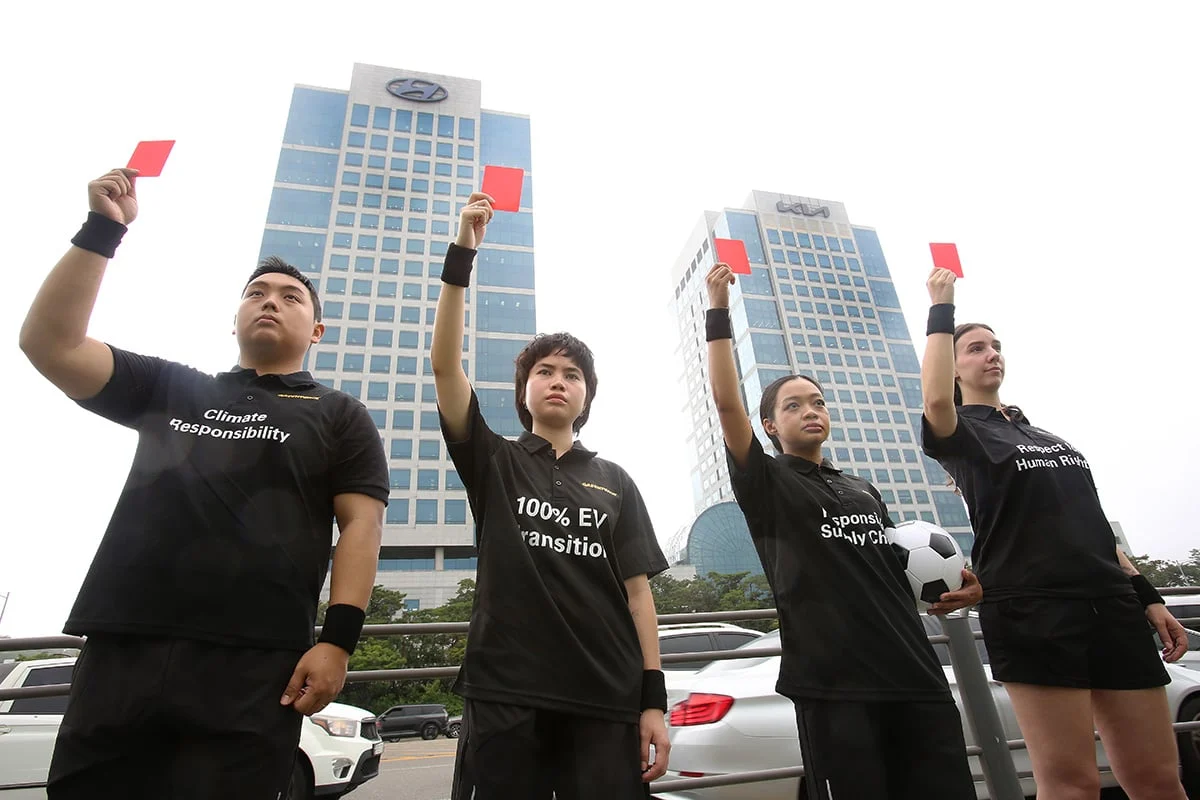
SEOUL – Greenpeace activists unfurled symbolic "red cards" outside the Hyundai Motor Group headquarters today, marking a high-profile protest against the FIFA World Cup sponsor. The action calls for the immediate cessation of alleged severe human rights violations, labor exploitation, and carbon-intensive risks within Hyundai’s global supply chain. Furthermore, the demonstration urges the automotive giant to reverse a recent perceived backtrack on its commitment to electric vehicle (EV) transition.
This Seoul demonstration represents the culmination of a month-long, globally coordinated campaign targeting Hyundai-Kia’s prominent World Cup sponsorship. Spearheaded by Greenpeace East Asia on the ground in South Korea, the international effort is bolstered by a coalition of eleven environmental and human rights organizations. The coalition aims to expose what they describe as a significant disconnect between Hyundai’s public-facing sustainability narratives and the reported harms linked to its supply chain, particularly in the context of its multi-million dollar "eco-friendly" sports marketing initiatives.
The escalating international pressure has coincided with several key FIFA World Cup matches, amplifying the visibility of the campaign. The international coalition previously delivered an Open Letter to Hyundai Executive Chair Euisun Chung. This letter implored the company to leverage its influential position as a premier FIFA sponsor to implement robust climate commitments and enforceable corporate accountability mechanisms.
Market Risk: Hyundai’s Lagging Clean Transition and Supply Chain Governance
While Hyundai Motor Group actively utilizes its FIFA sponsorship to project an image of corporate sustainability, internal combustion engine (ICE) vehicles still constitute a staggering 93% of the company’s 6.8 million annual sales. This reliance on fossil-fuel-powered vehicles translates into a substantial environmental footprint. The group’s combined annual emissions are estimated at 250 million tonnes of CO2 equivalent, a figure comparable to the total national emissions of Spain. Recent independent assessments of automotive sustainability have placed Hyundai significantly behind global competitors such as Tesla, Volkswagen, and Mercedes-Benz, particularly concerning supply chain decarbonization and the rigorousness of its human rights due diligence processes.
The South Korean automaker faces mounting regulatory and reputational pressures to enhance oversight of its extensive manufacturing pipeline and complex sourcing relationships. Independent investigations conducted by organizations including Steel Watch, Mighty Earth, and Jobs to Move America have brought to light serious environmental and labor concerns within segments of the company’s tier-one suppliers. A specific point of contention is Hyundai Steel’s continued reliance on coal-based production methods. This practice has drawn significant scrutiny regarding its contribution to air pollution and the associated billions of dollars in public health costs impacting communities in manufacturing hubs across South Korea and Brazil.
Chronology of Global Actions
The month-long campaign leading up to the Seoul protest involved a series of coordinated actions designed to amplify pressure on Hyundai Motor Group:
- Early Campaign Phase: The global coalition launched its campaign with a focus on raising public awareness through digital platforms and targeted media outreach. This included the release of a comprehensive report detailing alleged human rights and environmental violations within Hyundai’s supply chain.
- Mid-Campaign Mobilization: As the FIFA World Cup progressed, the coalition escalated its activities, organizing smaller-scale protests and online petitions in various countries. These actions were strategically timed to coincide with major World Cup matches, aiming to capture media attention and leverage the global spotlight on the tournament.
- Open Letter Delivery: A critical juncture in the campaign was the formal delivery of an Open Letter to Hyundai Executive Chair Euisun Chung. This addressed specific demands for structural climate commitments and accountability measures, emphasizing the group’s role as a FIFA sponsor.
- Climax in Seoul: The Greenpeace-led protest at Hyundai Motor Group headquarters in Seoul marked the peak of the coordinated global wave of actions, serving as a direct and highly visible demand for change.
Statements from the Global Coalition
The concerns raised by the coalition are articulated by its member organizations, highlighting the multifaceted nature of the allegations against Hyundai Motor Group.
Erin Eunseo Choi, Climate and Energy Campaigner at Greenpeace East Asia, expressed concern over Hyundai’s strategic direction: "Hyundai Motor’s latest sustainability report talks about ‘Electrification and Our Climate Response,’ but quietly dropping its concrete 2030 battery EV sales targets sends a very different signal. By shifting its roadmap to focus heavily on hybrids and Extended-Range EVs (EREVs)—vehicles that still rely on internal combustion engines—Hyundai is pursuing a false transition." Choi elaborated on the risks: "While EREVs may masquerade as electric, they are not a true zero-emission solution; instead, they risk locking in reliance on fossil fuels and diverting vital resources from full battery electrification. When the vehicles Hyundai sells account for 79% of its Scope 3 emissions, slowing electrification is like pulling your striker off the pitch in the middle of a match. As war-driven oil price spikes fast-track the shift toward EVs, any indecision in making a true transition risks a further loss of market share."
Nish Humphreys, Campaign Manager at Ekō, underscored the stark contrast between Hyundai’s public image and its supply chain realities: "Hyundai wants the world watching its Football World Cup ads, not the dark side of its supply chain. On the field, it’s sponsoring kids’ dreams. But behind the scenes, it’s a different game. Public reporting has raised serious concerns about child labor, worker deaths, and injuries, along with the unexplained disappearance of Indigenous activists in Mexico who protected Hyundai’s steel supplier." Humphreys also provided data on public engagement: "Together with the activists on the ground, over 7,400 people have ‘red-carded’ Hyundai in our virtual protest, joining a global crowd of 52,000 citizens, football fans, and Hyundai drivers who have signed the Ekō petition demanding the company clean up its supply chain before the final whistle blows."
Abhilasha Bhola, Climate Campaigns Director at Public Citizen, provided a blunt assessment of the situation: "The record is clear: Hyundai-Kia’s supply chain is marred by documented human rights abuses, environmental destruction, and labor exploitation. The World Cup’s corporate sponsors cannot continue to profit while workers, communities, and our planet bear the deep impacts of corporate misconduct."
Strategic Demands to Hyundai Motor Group
The global coalition has outlined three critical and non-negotiable directives for Hyundai Motor Group’s executive leadership:
- Full Commitment to 100% Electric Vehicle Sales by 2035: The coalition demands a clear and unwavering commitment to achieving 100% sales of zero-emission battery electric vehicles by 2035, with ambitious interim targets to ensure a rapid and decisive transition away from fossil fuel-dependent vehicles. This includes phasing out the production and sale of hybrid and extended-range electric vehicles that still rely on internal combustion engines.
- Robust Supply Chain Transparency and Accountability: Hyundai Motor Group must implement comprehensive due diligence and transparency measures across its entire supply chain. This includes publicly disclosing its suppliers, conducting regular independent audits for human rights and environmental violations, and establishing effective grievance mechanisms for workers and affected communities. The company must commit to addressing and remediating any identified abuses, including child labor, unsafe working conditions, and environmental degradation.
- Meaningful Engagement with Affected Communities and Indigenous Peoples: The coalition calls for genuine engagement with communities and Indigenous peoples impacted by Hyundai’s operations and supply chain. This includes respecting land rights, obtaining free, prior, and informed consent for projects, and providing equitable compensation and remediation for any harms caused. Specific attention must be paid to cases involving the disappearance or silencing of activists who have raised concerns about the company’s operations.
Broader Implications and Market Analysis
The campaign against Hyundai Motor Group highlights a growing trend of heightened scrutiny on corporate sustainability claims, particularly from globally recognized brands associated with major sporting events. As consumers and investors become increasingly conscious of environmental, social, and governance (ESG) factors, companies like Hyundai face significant reputational and financial risks if their actions do not align with their public pronouncements.
Hyundai’s strategic pivot towards hybrids and EREVs, as criticized by Greenpeace, could be interpreted as a pragmatic response to current market demands and the complexities of global EV infrastructure development. However, the coalition argues that this approach delays the inevitable transition to true zero-emission mobility and risks alienating environmentally conscious consumers and investors who are seeking decisive action on climate change.
The documented human rights and labor concerns within Hyundai’s supply chain are not isolated incidents within the automotive industry but reflect broader challenges in global manufacturing. The reliance on complex, multi-tiered supply chains often obscures accountability, making rigorous due diligence and transparency essential for building trust and mitigating risks. The investigation into Hyundai Steel’s coal-based production, for instance, points to the interconnectedness of industrial practices and their impact on local and regional public health, underscoring the need for comprehensive environmental stewardship.
The timing of the protests during the FIFA World Cup is a deliberate strategy to maximize public and media attention. By linking corporate responsibility to a globally popular event, activists aim to exert maximum pressure on sponsors to uphold ethical standards. The success of such campaigns often depends on their ability to mobilize public opinion and influence corporate decision-making through a combination of direct action, media engagement, and consumer advocacy. The ongoing petition efforts, which have garnered tens of thousands of signatures, indicate a significant level of public concern and support for the coalition’s demands.
Hyundai Motor Group has yet to issue a formal, detailed response to the specific demands outlined by the coalition beyond general statements of commitment to sustainability. However, the sustained global pressure and the increasing focus on ESG performance suggest that the company will need to demonstrate tangible progress in addressing these critical issues to maintain its reputation and market standing in the evolving automotive landscape. The "red card" issued today serves as a stark warning, signaling that the window for incremental change is closing, and a fundamental shift in corporate behavior is increasingly expected by stakeholders worldwide.
Media Documentation & Assets:
- High-resolution photographs and video footage of the protest at Hyundai Motor Group headquarters.
- Infographics detailing Hyundai-Kia’s carbon footprint and reliance on ICE vehicles.
- Copies of the Open Letter to Hyundai Executive Chair Euisun Chung.
- Summaries of independent investigations into Hyundai’s supply chain.
Media Contact:
Yujie Xue, International Communications Officer, Greenpeace East Asia, +852 51273416, [email protected]

 Lina Irawan
 Nila Kartika Wati