Suro Senen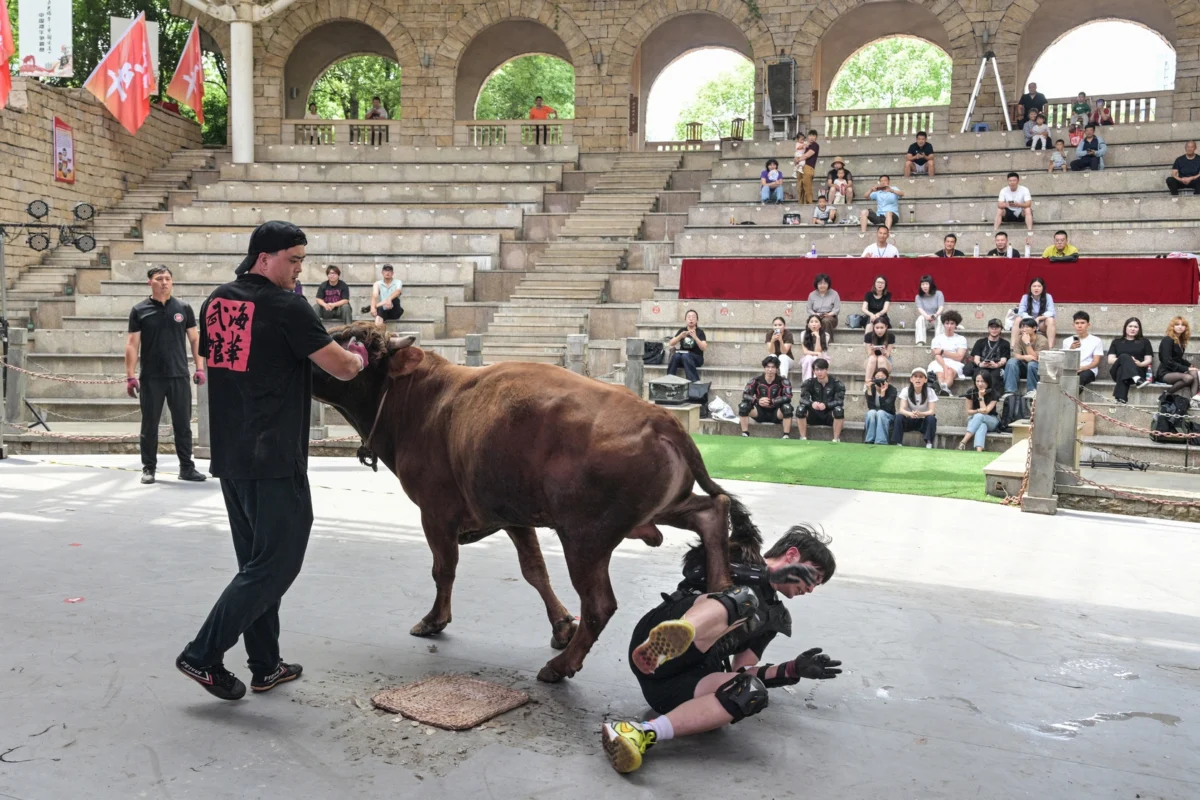
In the weathered, half-covered amphitheatre of Jiaxing, a city steeped in history in eastern China’s Zhejiang province, the raw power of tradition was on display as 20-year-old Wang Shuangshuang, a university student, locked his shoulder against the immense neck of a bull. With a fierce grip on its horns, he wrestled with the animal, a ballet of brute force and refined technique, aiming to bring the powerful beast to its knees. This intense spectacle is the essence of guanniu, Chinese bull-wrestling, a sport that dates back over six centuries but now finds itself in a precarious battle for survival, largely unknown both within China and across the globe. Despite its rich heritage and recent government recognition, guanniu struggles with a profound lack of funding and mainstream exposure, leaving its dedicated practitioners to question its future.
Historical Roots and Cultural Significance
The origins of guanniu are deeply intertwined with the cultural tapestry of the Hui Muslim community in China. It was brought to Jiaxing by Hui migrants centuries ago, evolving from essential herding skills – the ability to control and manage livestock – into a formalized folk competition. Unlike the more widely known and often controversial Spanish bullfighting, guanniu fundamentally distinguishes itself through its non-lethal nature. There are no weapons involved, and the animal is never harmed or killed at the culmination of a bout. Instead, the objective for the wrestler is a display of strength, agility, and precise technique: seizing the bull’s horns and strategically maneuvering it to the ground. Additional points are awarded for daring feats, such as jumping onto the bull’s back or crawling underneath its belly, showcasing a profound respect for the animal and a mastery of control rather than domination. This unique approach aligns with a broader philosophy of coexistence and skill, rather than confrontation to the death, setting it apart from its Iberian counterpart and, indeed, many other global bull-related sports like American rodeo or India’s Jallikattu. The sport embodies a cultural narrative of human-animal interaction rooted in practical necessity and elevated to a form of athletic art.

The Art and Discipline of Guanniu
The mastery of guanniu demands an extraordinary blend of physical prowess, mental fortitude, and an intuitive understanding of animal behavior. Wrestlers like Wang Shuangshuang describe the intricate dance required to subdue an animal weighing hundreds of kilograms. "You have to go with its flow, shift your shoulders constantly to follow its resistance, lock its neck, and then throw it down," Wang explains, underscoring that "strength and technique, neither can be missing." This isn’t merely a test of brute strength; it’s a strategic engagement. Wrestlers must learn to anticipate the bull’s movements, leverage its momentum, and exploit its natural balance points. Training involves rigorous physical conditioning – building core strength, agility, and endurance – coupled with specific drills to practice holds, twists, and throws on simulated or docile animals before facing the powerful competition bulls. The hard, stubby horns of the Jiaxing bulls present a unique challenge, requiring a different approach than the longer, sharper horns of some other breeds. The philosophy extends beyond the physical; it’s about respect for the animal, an almost meditative focus to become one with its power, directing it rather than simply overpowering it. This deep engagement fosters a bond, a mutual understanding between human and beast that is central to the sport’s ethos.
A Champion’s Perspective: Master Han Haihua’s Decades-Long Battle
At 72, Master Han Haihua stands as a living testament to guanniu‘s enduring spirit and its current struggles. A respected figure in Jiaxing, he laments the sport’s precarious state, describing its heritage as "neither dead nor alive." His dedication is unwavering, a lifelong commitment forged in the sport’s heyday. He vividly recalls performing guanniu at a national ethnic-minority sports meet in 1982, a pivotal moment when a senior government official lauded it as "a true Chinese-style bullfight." This recognition propelled guanniu into the national spotlight, with appearances in films and on television, sparking a brief period of prominence.
However, those golden decades have faded. Han’s frustration is palpable as he articulates the core problem: a severe lack of funding. "To bring in talent, you need money," he asserts, his voice carrying the weight of experience. He remains defiantly optimistic, however, proclaiming, "I’m not bragging — give me 30 or 50 kids, train them here for three years, and I’ll make the whole world know about guanniu." His vision is clear: sustained investment in youth training and infrastructure is the only way to revive the sport and ensure its legacy. For Master Han, guanniu is more than just a sport; it’s a vital piece of his community’s identity and a cultural treasure he is determined to safeguard.

The Intangible Heritage Boost and its Limits
The turn of the millennium brought a glimmer of hope for guanniu. In the early 2000s, Xi Jinping, then the provincial party secretary of Zhejiang, spearheaded an initiative to officially list traditional practices like bull wrestling as "intangible cultural heritage." This designation, part of a broader national effort to preserve China’s diverse cultural expressions, typically bestows significant benefits, including official recognition, protective measures, and often, government funding and promotional support. For guanniu, this meant the provision of free venues for competitions and annual subsidies aimed at sustaining regular tournaments. The "China Bullfighting Hall" amphitheatre, whose nameplate was famously inscribed by the revered martial arts novelist Jin Yong – a cultural icon whose approval lends considerable prestige – became the central stage for these events. The designation also helped attract some corporate sponsorship, offering a lifeline to a sport teetering on the edge of obscurity.
Yet, as Master Han and his colleagues attest, these measures, while helpful, have proven insufficient to foster a truly professional sport. The support, though officially extended, falls short in scale and scope. "Our cattle breeding and training spaces are all temporary facilities inside the martial arts school," explains Li Bo, a senior practitioner. This stark reality was evident when AFP reporters visited, noting that the powerful bulls, central to the competition, were being housed in the bathrooms of a nearby residential building for the duration of the event. Such makeshift arrangements highlight the profound infrastructural deficiencies that plague guanniu, preventing it from developing into a modern, professional athletic endeavor with dedicated training grounds, animal care facilities, and a structured league system. The "intangible heritage" label has provided a protective shield, but not the robust foundation needed for growth.
The Next Generation: Aspiring Wrestlers Face Tough Choices
The annual competition at the China Bullfighting Hall draws a handful of participants, primarily university students seeking to test their mettle against the powerful bulls. This year, nine students entered the preliminaries, showcasing impressive strength and technique. Among them were Wang Shuangshuang and Xu Zhiqian, both 20 years old, who made it to the finals. Xu described the sport with youthful enthusiasm: "I think this sport is very youthful, very hot-blooded," he said, reflecting the adrenaline and challenge that draw young people to such a physically demanding pursuit. Both managed to bring their bulls to the ground in the final, watched by a few hundred spectators, a testament to their skill and dedication.

However, the allure of the sport often collides with practical realities. Despite his passion, Xu Zhiqian openly stated his intention to pursue a career in his field of study, prioritizing a stable professional path over the uncertainties of a guanniu career. Wang Shuangshuang, while "considering" continuing with guanniu, also expressed significant doubt about making it a full-time profession. The absence of a clear career trajectory, stable income, and widespread recognition makes it incredibly difficult for young talents to commit fully to the sport. Unlike other sports that offer lucrative professional opportunities and societal prestige, guanniu currently offers little in the way of a secure future, forcing promising athletes to choose more conventional paths.
Li Bo: The Torchbearer and His Burden
Thirty-year-old Li Bo represents a rare exception, one of the very few individuals who has managed to forge a full-time career in guanniu. Drawn to Master Han’s martial arts school as a teenager by his love for kung fu films, Li has dedicated his life to the sport. Master Han now considers him China’s finest guanniu practitioner, a testament to his exceptional skill and unwavering commitment. Yet, Li carries a heavy burden: the profound concern over the sport’s succession crisis. "Nobody wants to do this full-time. That makes our inheritance extremely difficult," Li laments, highlighting the critical challenge of attracting and retaining new talent.
To keep the tradition alive and the school financially solvent, Li and Master Han have had to embrace a range of innovative, albeit often modest, entrepreneurial endeavors. The school stages performances at local tourist sites, offering glimpses of guanniu to visitors. They even operate a halal steamed-bun shop, leveraging the Hui community’s culinary heritage to generate income. Li has also taken on the role of a promoter and publicist, actively reaching out to media outlets, selling souvenirs related to the sport, organizing regular tournaments, and adapting guanniu‘s history into engaging stage shows. These multi-faceted efforts are a desperate attempt to boost the sport’s profile, generate revenue, and cultivate a new generation of practitioners, showcasing the immense personal sacrifice and ingenuity required to sustain a fading cultural practice.

Funding, Facilities, and the Path to Professionalization
The core challenge for guanniu remains fundamentally economic and infrastructural. While the government’s intangible cultural heritage designation provided initial support, it has not translated into the robust financial backing necessary for professionalization. The annual subsidies and free venues are insufficient to cover the escalating costs of maintaining a professional sports enterprise. This includes the significant expense of breeding and caring for high-quality bulls, paying competitive salaries to trainers and athletes, developing state-of-the-art training facilities, and investing in nationwide promotional campaigns. The current "temporary facilities" and the less-than-ideal housing for bulls during competitions underscore a systemic lack of dedicated infrastructure.
For guanniu to move beyond its "neither dead nor alive" state, a more comprehensive and substantial investment strategy is required. This would entail establishing permanent, purpose-built arenas and training centers, complete with proper animal husbandry facilities that meet modern welfare standards. A structured professional league with attractive prize money and clear career progression paths would be essential to entice young talent. Furthermore, a sustained marketing and media strategy, both domestically and internationally, is crucial to raise public awareness and generate commercial interest, potentially attracting larger corporate sponsorships and broadcasting deals. Without these fundamental pillars, guanniu will remain a cherished but marginalized folk tradition, struggling to compete in the modern sports landscape.
Global Context and Animal Welfare Considerations
Globally, bull-related sports often face intense scrutiny, particularly from animal rights activists. Spanish bullfighting, with its inherent violence and lethal conclusion, has been the subject of widespread condemnation and legal challenges across many parts of the world. In contrast, guanniu‘s non-lethal nature positions it uniquely in this global dialogue. The article notes that "no such public controversy has emerged around guanniu in China," a fact that could potentially be leveraged for broader appeal. The emphasis on control, technique, and bringing the bull to the ground without harm could resonate with modern sensibilities that prioritize animal welfare, offering a potential pathway for international recognition without the ethical baggage of more aggressive bull sports.

However, even a non-lethal sport involving powerful animals requires stringent animal welfare protocols. The temporary housing of bulls in residential bathrooms, as observed, suggests that while the intent is not to harm, the conditions might not always meet optimal animal care standards. For guanniu to gain wider acceptance and thrive, transparent and robust animal welfare guidelines, monitored by independent bodies, would be essential. This includes proper nutrition, veterinary care, spacious and appropriate housing, and ethical training methods. By proactively addressing these aspects, guanniu could differentiate itself as a truly humane and skillful bull sport, potentially appealing to audiences beyond China’s borders and securing its place on the global stage.
Conclusion: A Resilient Tradition on the Brink
The story of guanniu in Jiaxing is a microcosm of the broader challenges facing many traditional cultural practices in a rapidly modernizing world. It is a testament to the resilience of dedicated individuals like Master Han Haihua and Li Bo, who, against formidable odds, strive to keep a centuries-old heritage alive. Master Han’s defiant declaration – "I am committed to keeping this tradition alive… I will raise money or borrow money myself to keep it running" – encapsulates the profound dedication that fuels this struggle.
The "intangible cultural heritage" designation by the Chinese government was a vital first step, offering official recognition and a degree of protection. However, the journey from protected heritage to a self-sustaining, vibrant professional sport requires significantly more than symbolic gestures. It demands substantial financial investment, modernized infrastructure, comprehensive talent development programs, and a sophisticated marketing strategy to capture public imagination. If these elements do not materialize, guanniu, despite its unique non-lethal character and deep historical roots, risks fading into an obscure footnote in China’s rich cultural history, a poignant loss not just for the Hui community, but for the world’s diverse tapestry of human endeavor and animal interaction. The coming years will be critical in determining whether this ancient art can grapple successfully with the demands of the 21st century and secure its rightful place in the pantheon of global sports.

 Sagoh
Sagoh
 Asro
Asro