Suro Senen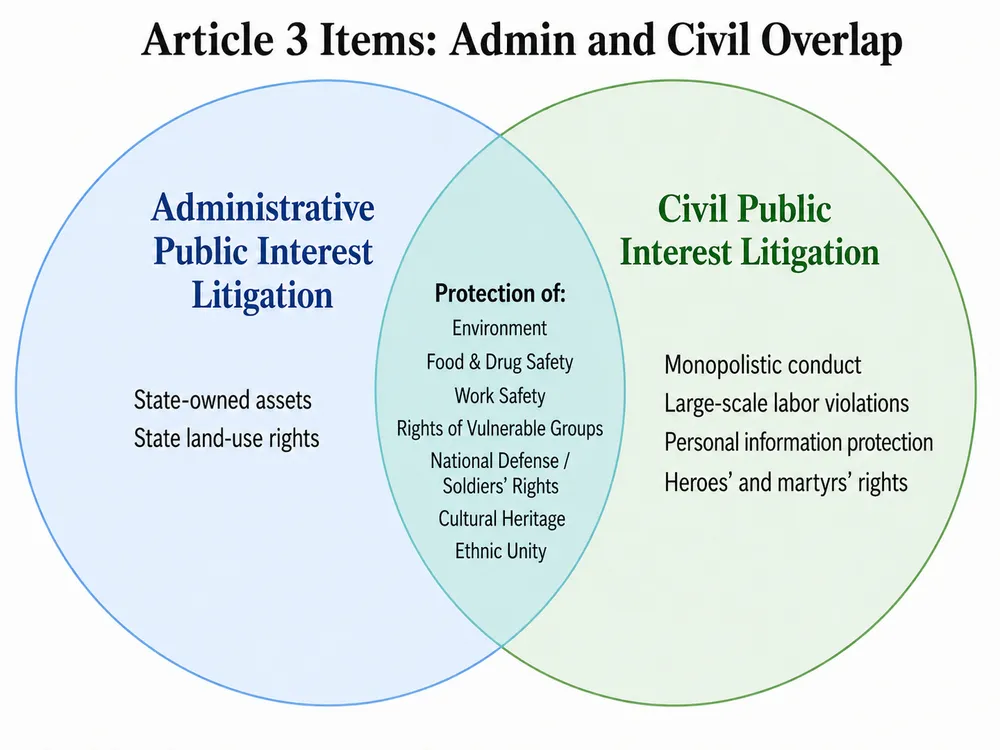
Strengthening the Legal Foundation for Public Interest
The second draft of the Public Interest Litigation Law is structured into six chapters and fifty-two articles, covering general provisions, jurisdiction, case filing and investigation, trial procedures, enforcement, and supplementary provisions. At its core, the law empowers the People’s Procuratorate to act as the "guardian of the public interest," initiating litigation when administrative organs fail to perform their duties or when private entities infringe upon the collective rights of society.
Article 3 of the draft outlines the specific areas where the procuratorate is authorized to intervene. These include traditional sectors such as the protection of the ecological environment and resources, food and drug safety, and the management of state-owned assets. However, the draft also reflects contemporary priorities by including production safety, the protection of vulnerable groups (minors, women, the elderly, and persons with disabilities), national defense interests, and the promotion of ethnic unity. Notably, the inclusion of countering telecommunications fraud and protecting relics and cultural heritage demonstrates a broadening of the scope of "public interest" to include digital and historical assets.
In the civil sphere, the law allows the procuratorate to initiate lawsuits against natural persons, legal persons, or unincorporated organizations for acts that harm the public interest. This includes monopolistic business practices, violations of labor rights affecting a large number of workers, and the mishandling of personal information. Furthermore, the law maintains a strong stance on the protection of the reputation and honor of "heroes and martyrs," a significant cultural and political priority in the Chinese legal landscape.
A Chronology of Legal Evolution
The emergence of the Public Interest Litigation Law is the result of nearly a decade of institutional experimentation and reform. The timeline of this legal evolution highlights the transition from pilot programs to a centralized statutory framework:
- July 2015: The Standing Committee of the National People’s Congress (NPC) authorized the Supreme People’s Procuratorate to launch a two-year pilot program for public interest litigation in 13 provincial-level regions. This was the first formal step in allowing prosecutors to sue administrative organs.
- June 2017: Based on the success of the pilot programs, the Civil Procedure Law and the Administrative Litigation Law were formally amended. These amendments provided a preliminary legal basis for the procuratorate to initiate public interest cases, primarily in the fields of environmental protection and food safety.
- 2018–2021: The scope of public interest litigation was expanded through various "special laws." For instance, the Law on the Protection of Heroes and Martyrs (2018) and the Data Security Law (2021) added new categories to the procuratorate’s mandate.
- 2023: The NPC included the formulation of a dedicated Public Interest Litigation Law in its five-year legislative plan, signaling the move toward a unified code.
- 2024–2026: The first and second drafts of the law were released for internal review and public comment, leading to the current iteration which refines procedural requirements and investigative powers.
Supporting Data and Judicial Trends
The necessity of this law is underscored by the rapid growth of public interest litigation in China. According to data released by the Supreme People’s Procuratorate, the number of public interest cases has seen a steady upward trajectory. In 2023 alone, Chinese procuratorates handled approximately 190,000 public interest litigation cases, a significant increase from the early pilot years.
Environmental and resource protection remains the largest category, accounting for nearly 40% of all cases. Food and drug safety cases follow, making up roughly 25% of the caseload. However, "new areas" of litigation—such as personal information protection and the rights of the disabled—are the fastest-growing segments, reflecting the law’s responsiveness to social changes.
Furthermore, the "pre-litigation" phase has proven highly effective. Data suggests that over 90% of administrative public interest cases are resolved at the "procuratorial recommendation" stage (Article 22), where administrative organs rectify their behavior after receiving a formal notice but before a full court trial is initiated. This "governance-first" approach is a hallmark of the Chinese system, emphasizing efficiency and the immediate cessation of harm over protracted litigation.
Procedural Rigor and Investigative Powers
The second draft provides detailed guidelines on how investigations should be conducted. Articles 13 through 21 grant the People’s Procuratorate the power to collect evidence through questioning, site inspections, and the reproduction of documents. However, the law balances this power by prohibiting "compulsory measures" that restrict physical liberty or the sealing and seizing of assets during the investigative phase of public interest cases.
A critical procedural safeguard is the requirement for "at least two or more procuratorate staff" to be present during evidence collection, with at least one being a formal procurator. This is intended to ensure transparency and prevent the abuse of authority. Additionally, Article 19 mandates that relevant units and individuals must cooperate with investigations, with penalties for those who obstruct the process through violence or threats.

For administrative cases, the draft reinforces the "pre-litigation" procedure. Article 23 requires administrative organs to respond to procuratorial recommendations within a specific timeframe—usually 15 days in emergency situations or within a set correction period. If the organ fails to act or provides an unsatisfactory response, the procuratorate is then mandated to initiate formal litigation (Article 25).
Trial and Enforcement Framework
The trial process for public interest litigation is designed to be rigorous. Article 33 requires that cases be heard by a collegial panel, ensuring that decisions are not made by a single judge. The burden of proof lies with the procuratorate (Article 36), which must demonstrate that an administrative organ acted unlawfully or that a private party caused tangible harm to the public interest.
The draft also introduces flexibility through mediation in civil cases (Article 38), provided that the resulting agreement does not infringe upon the public interest. To ensure transparency, any mediation agreement must be subjected to a 30-day public notice period before it is finalized by the court.
Enforcement remains a key focus of the second draft. If an administrative organ refuses to fulfill a court judgment, Article 46 allows the court to employ measures provided by the Administrative Litigation Law, and the procuratorate may report the failure to higher-level authorities. For civil defendants, Article 49 allows courts to publish effective legal documents in the media at the defendant’s expense if they refuse to issue formal apologies or restore their reputations.
Broader Impact and Global Implications
The formalization of the Public Interest Litigation Law is expected to have a profound impact on China’s domestic governance and its international legal standing. Domestically, the law shifts the balance of power by providing a structured mechanism for oversight. By allowing the procuratorate to challenge administrative inaction, the law serves as a tool for the central government to ensure that local bureaucracies comply with national standards, particularly regarding environmental regulations and safety protocols.
Furthermore, Article 51 of the draft extends the reach of the law to foreign organizations and individuals who carry out unlawful acts that infringe upon China’s national interests or societal public interest. This provision suggests that international entities operating in China or engaging in activities that affect Chinese public interests (such as cross-border data violations or environmental damage) could face litigation initiated by the Chinese state.
Legal analysts suggest that this law represents a unique "Chinese model" of public interest litigation. Unlike Western models, which often rely on class-action lawsuits or private "citizen suits," the Chinese approach centralizes the power of public interest advocacy within the state’s prosecutorial branch. This ensures that litigation aligns with broader national development goals while providing a channel for addressing systemic social grievances.
Official Responses and Stakeholder Reactions
While the draft has been generally welcomed by legal scholars as a necessary step toward the rule of law, some administrative organs have expressed concerns regarding the potential for "over-reach" by the procuratorate. In response, the draft includes Article 5, which explicitly states that the procuratorate "must not interfere with or replace administrative organs’ lawful performance of their duties." This clause is intended to maintain the separation of powers and ensure that the procuratorate acts as a supervisor rather than an administrator.
Civil society organizations and legal practitioners have also pointed to the importance of the public notice period in civil cases (Article 27). This allows other legally-prescribed organizations—such as environmental NGOs—to initiate their own lawsuits before the procuratorate steps in. This "supportive" role (Article 29) ensures that the state does not crowd out private public interest efforts, but rather acts as a backstop when other entities are unable or unwilling to act.
As the Public Interest Litigation Law of the People’s Republic of China Second Draft moves toward final adoption, it stands as a testament to China’s commitment to evolving its judicial system to meet the complexities of the 21st century. By integrating environmental protection, digital rights, and administrative accountability into a single legislative framework, China is setting a new precedent for how the law can be used to safeguard the collective interests of a modern society.


 Neng Nana
 Ammar Sabilarrohman