Nana Wu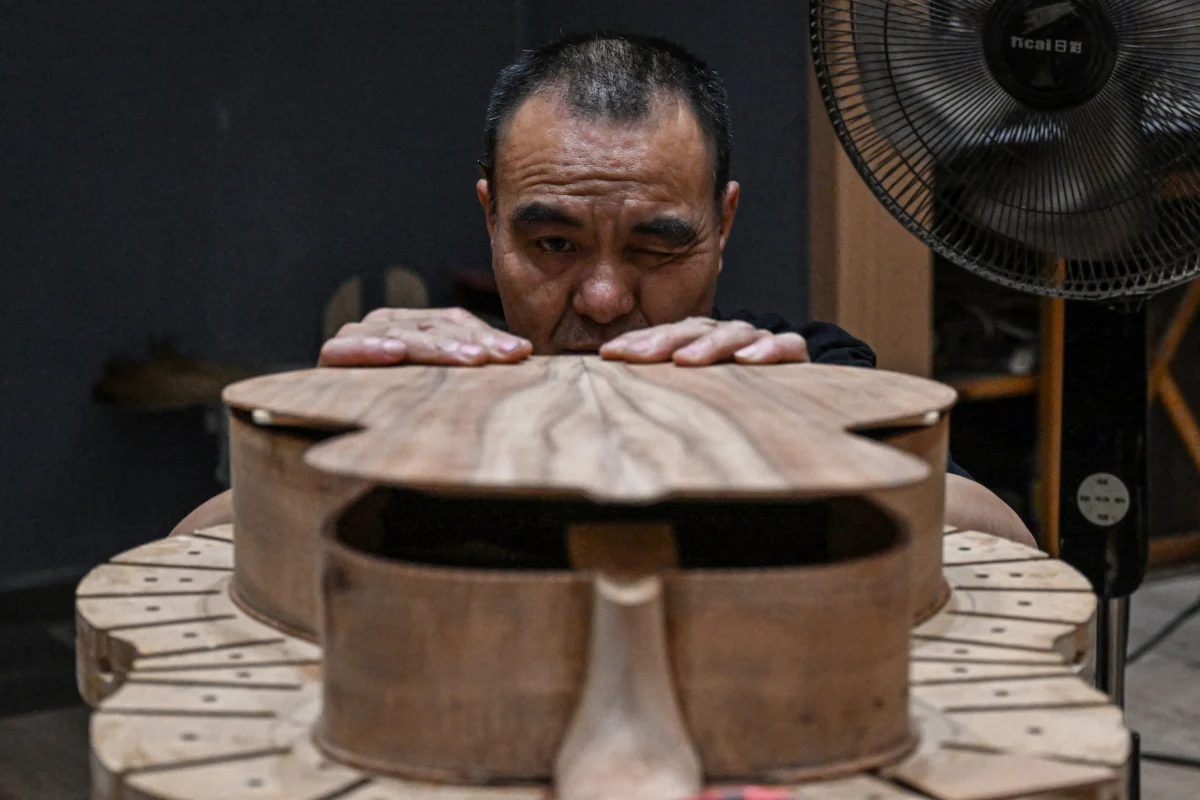
It takes little more than a glance to discern the primary industry of Zheng’an, a town nestled within China’s southwestern province of Guizhou. A colossal guitar sculpture anchors its central square, while vibrant guitar murals adorn building walls and even spill onto pavements. Rubbish bins, far from mundane, are creatively shaped like the very instruments that define the town’s prosperity, creating an immersive, musical landscape for residents and visitors alike. This remarkable transformation has cemented Zheng’an’s status as a global epicenter for guitar production, a testament to China’s targeted industrial development strategies.
A Symphony of Industry: The Visuals of a Guitar Town
The visual omnipresence of the guitar in Zheng’an is more than mere aesthetic; it is a profound declaration of identity. From the moment one enters the town, the motif of the stringed instrument guides the eye, reflecting a deeply ingrained economic reality. The giant sculpture, often a focal point for local gatherings and tourist photographs, symbolizes the town’s pride and ambition. The intricate murals, depicting various stages of guitar craftsmanship or famous musicians, serve as a constant reminder of the community’s collective pursuit. Even the functional elements of urban infrastructure, like the guitar-shaped bins, underscore a comprehensive branding effort that aligns every aspect of the town with its core industry. This deliberate integration creates a unique atmosphere, where the spirit of music and manufacturing intertwine, shaping the daily lives and aspirations of its inhabitants.
From Rural Exodus to Economic Boom: The Genesis of Zheng’an’s Guitar Industry
Just a decade ago, Zheng’an was largely an obscure, economically disadvantaged corner of Guizhou, a province historically known for its rugged terrain and relative poverty compared to China’s bustling coastal regions. The idea of it becoming a significant player in the global music instrument market would have seemed improbable. At that time, its working-age population, much like those in many other underdeveloped rural areas across China, faced limited local opportunities. The prevailing trend was one of outward migration, with residents leaving their homes to seek employment in the burgeoning factories of southern China’s manufacturing heartland, particularly in provinces like Guangdong. These migrant workers often toiled in various industries, gaining skills and experience that would eventually prove invaluable for their hometown’s future.

Among these economic migrants was Zheng Chuanjiu, a visionary who, after years of working in the manufacturing sector, established his own guitar-making business in Guangzhou, Guangdong’s provincial capital. His venture thrived, and crucially, a significant portion of his workforce comprised fellow villagers from Zheng’an, creating an informal network of skilled labor already connected to their hometown. This diaspora of talent, honed in the competitive environment of China’s industrial powerhouses, would later become the cornerstone of Zheng’an’s dramatic reversal of fortune.
The "Return the Phoenix to the Nest" Initiative: A Strategic Repatriation
The turning point for Zheng’an arrived in 2012 with the launch of a highly strategic and aptly named initiative: "Return the Phoenix to the Nest." This program, spearheaded by local authorities, was designed to reverse the tide of outward migration by actively encouraging skilled migrant workers and entrepreneurs to return to Zheng’an and establish businesses. The "phoenixes" were the skilled individuals who had left, gained valuable expertise, and were now being called back to infuse their knowledge and capital into their hometown.
County officials specifically reached out to successful entrepreneurs like Zheng Chuanjiu, recognizing the critical role their experience and existing networks could play. "The county officials reached out to us. They wanted us to come back and develop the industry," Zheng recounted, highlighting the proactive and persuasive nature of the local government’s efforts. Shenqu Guitar, Zheng Chuanjiu’s company, became the inaugural guitar manufacturer to anchor itself in Zheng’an’s newly designated economic zone. This initial success acted as a powerful beacon, drawing others back. "After I’d been working here for a few years, many friends saw how well I was doing and came here to join me to develop the industry," Zheng explained, illustrating the organic growth that followed the initial strategic placement. The initiative leveraged personal connections and a sense of community, transforming individual successes into collective industrial growth. The factory banners proudly proclaiming, "Why go far away to work when home is the best place?" perfectly encapsulated the program’s ethos and its appeal to a population eager to build a future closer to their roots.
Building an Industrial Ecosystem: Government Support and Natural Advantages
The rapid ascent of Zheng’an was not merely a result of returning talent but a calculated combination of robust government support and inherent geographical advantages. Within approximately ten years of the "Return the Phoenix to the Nest" initiative, Zheng’an’s industrial cluster burgeoned, fostering the emergence of 87 home-grown guitar brands. This growth was meticulously nurtured by authorities who deployed comprehensive financial, tax, and employment support packages. Incentives included generous three-year tax exemptions and ten years of free rent for companies willing to relocate and invest in the new economic zone. These measures significantly reduced the initial financial burden for new businesses, making Zheng’an an exceptionally attractive location for manufacturers. Furthermore, streamlining export-rebate procedures provided an ongoing competitive edge, crucial for a town aiming for global market penetration. For example, from January to July 2025 alone, registered local enterprises collectively benefited from 147 million yuan in tax reductions and exemptions, demonstrating the tangible impact of these policies.

Beyond financial incentives, Zheng’an possesses critical natural advantages that are often overlooked but are fundamentally important for guitar manufacturing. Master luthier Zhang Weiyi, who relocated his bespoke guitar business from Guangzhou in 2019, pointed to the area’s climate as ideal. The stable humidity and temperature conditions in Guizhou are crucial for working with wood, preventing warping, cracking, and other issues that can compromise the structural integrity and tonal quality of guitars. This natural endowment, combined with the strategic human and financial capital injections, created a fertile ground for a specialized industry to flourish.
The Master Luthiers and Mass Production: A Dual Approach
Zheng’an’s guitar industry operates on a fascinating dual track, accommodating both large-scale mass production and the meticulous craft of master luthiers. While companies like Shenqu Guitar produce instruments in vast quantities, ready for shipment after final tuning checks, artisans like Zhang Weiyi represent the high-end, custom segment of the market. Zhang, a 50-year-old luthier, embodies the dedication to craft, carefully sanding down a piece of ox bone to fit a custom guitar he was making by hand during AFP’s visit. His focus remains squarely on quality and artistry, serving a niche clientele. "Whether the industry is big or small, whether it’s making an impact, that doesn’t really matter to me," he stated, emphasizing his commitment to his craft over broader market trends. "My clients are all longstanding clients… Plus, as artisans, we don’t really care much about those things." Zhang produces a modest 150 guitars annually, a stark contrast to the town’s overall output.
However, the aggregate figures are staggering. According to local authorities, Zheng’an as a whole manufactures an impressive 2.5 million guitars each year. This volume underscores its dominance in the global market, validating the proud moniker emblazoned on banners throughout the town: "Capital of Guitars, City of Music." This coexistence of mass production and artisanal craftsmanship adds depth and resilience to Zheng’an’s industrial ecosystem, catering to diverse market demands from entry-level instruments to high-end, custom pieces.
Global Reach and Economic Impact: Zheng’an’s Place in the World Market
Zheng’an has not only established itself as a production powerhouse but also as a significant export hub. In 2025, the town exported guitars worth 248 million yuan (approximately $36 million USD) to over 40 countries worldwide. This extensive global reach demonstrates the competitiveness and quality of its products, allowing a remote Chinese town to contribute significantly to the international music instrument trade. The logistical infrastructure required to support such an export volume, from manufacturing and quality control to packaging and international shipping, highlights the sophisticated supply chain developed within the region. The sustained growth in exports also indicates a robust demand for Zheng’an-made guitars, reflecting their market acceptance and value proposition.

The economic ripple effects of this industrial boom are profound. Beyond the direct revenue generated from manufacturing and exports, the industry has created thousands of jobs, significantly boosting local employment rates and increasing household incomes. This newfound prosperity has fueled local consumption, stimulated the service sector, and attracted further investment, creating a virtuous cycle of economic development. The transformation of Zheng’an serves as a compelling case study for regional economic planning, demonstrating how targeted investment and strategic initiatives can unlock the potential of previously marginalized areas.
Broader Implications: China’s Industrial Strategy and Regional Development
Zheng’an’s success story is not an isolated incident but rather a potent illustration of China’s broader industrial strategy, which actively promotes the development of specialized manufacturing towns. Across the country, similar clusters exist, focusing on everything from bicycles to socks, small commodities, and even specific electronic components. This approach aims to leverage local resources and human capital, foster economies of scale, and build resilient supply chains within specific geographic areas. The "distinctive, differentiated development" model advocated by economists like Dong Xuebing of Zhejiang University, finds a vivid example in Zheng’an. Dong argues that such specialization is crucial for preventing population loss to megacities and for fostering development in previously neglected regions. By focusing on unique advantages and industrial foundations, counties can create sustainable economic bases.
However, China’s industrial policies, particularly state subsidies and assistance, have faced criticism from international bodies and countries, notably the United States and Europe. Concerns have been raised regarding potential market distortions and unfair competition, particularly in high-growth sectors like electric vehicles and solar panels. While Zheng’an’s guitar industry might not be at the forefront of these geopolitical debates, its growth is underpinned by the same strategic framework that provides government support and incentives. The argument for these policies within China often centers on fostering innovation, achieving self-sufficiency, and ensuring balanced regional development, as seen in Zheng’an’s case.
A Cultural Transformation: Music Permeates Daily Life
Beyond the economic metrics, Zheng’an’s transformation has brought about a tangible cultural shift, enriching the daily lives of its residents. The pervasive presence of guitars has fostered a deep appreciation for music within the community. Master luthier Zhang Weiyi eloquently described this phenomenon: "I think there’s a really nice atmosphere around it," he noted, detailing how music now frequently fills the main square. This isn’t just background noise; it’s an active engagement. "All over the streets and alleys, you see quite a few people – both adults and kids – carrying guitar cases, probably on their way to guitar lessons."

This observation paints a vivid picture of a town that has embraced its industrial identity not just economically but culturally. The guitar has transitioned from being merely a product to a part of the town’s social fabric. Music schools and workshops have likely proliferated, creating opportunities for residents of all ages to learn and engage with the instruments produced in their hometown. This cultural integration fosters a sense of pride and community, transforming Zheng’an into a place where the sounds of music are as fundamental as the hum of its factories. The cycle is complete: the town makes guitars, and in turn, the guitars make the town a more vibrant, musical place to live.
Challenges and Future Prospects
While Zheng’an’s journey has been overwhelmingly successful, like any rapidly growing industrial hub, it faces potential challenges. Sustaining growth will require continuous innovation in guitar design and manufacturing techniques to remain competitive in a dynamic global market. Diversifying product offerings, exploring new materials, and investing in research and development will be crucial. Furthermore, managing the environmental impact of increased industrial activity, though not explicitly mentioned in the original report, is a common consideration for manufacturing centers. Maintaining the delicate balance between mass production efficiency and the artisanal quality that luthiers like Zhang Weiyi uphold will also be key to preserving the industry’s reputation and appeal.
However, with its established infrastructure, skilled workforce, and ongoing government support, Zheng’an is well-positioned for continued prosperity. Its model offers valuable lessons in rural revitalization and specialized industrial development, showcasing how strategic planning, investment, and a focus on local strengths can transform a community from a place of out-migration into a thriving global industry leader. Zheng’an stands as a powerful symbol of economic ingenuity and cultural integration in modern China, where the strum of a guitar string now resonates with the pulse of a dynamic, globally connected town.


 Jia Lissa
 Evan Lee Salim