Azzam Bilal Chamdy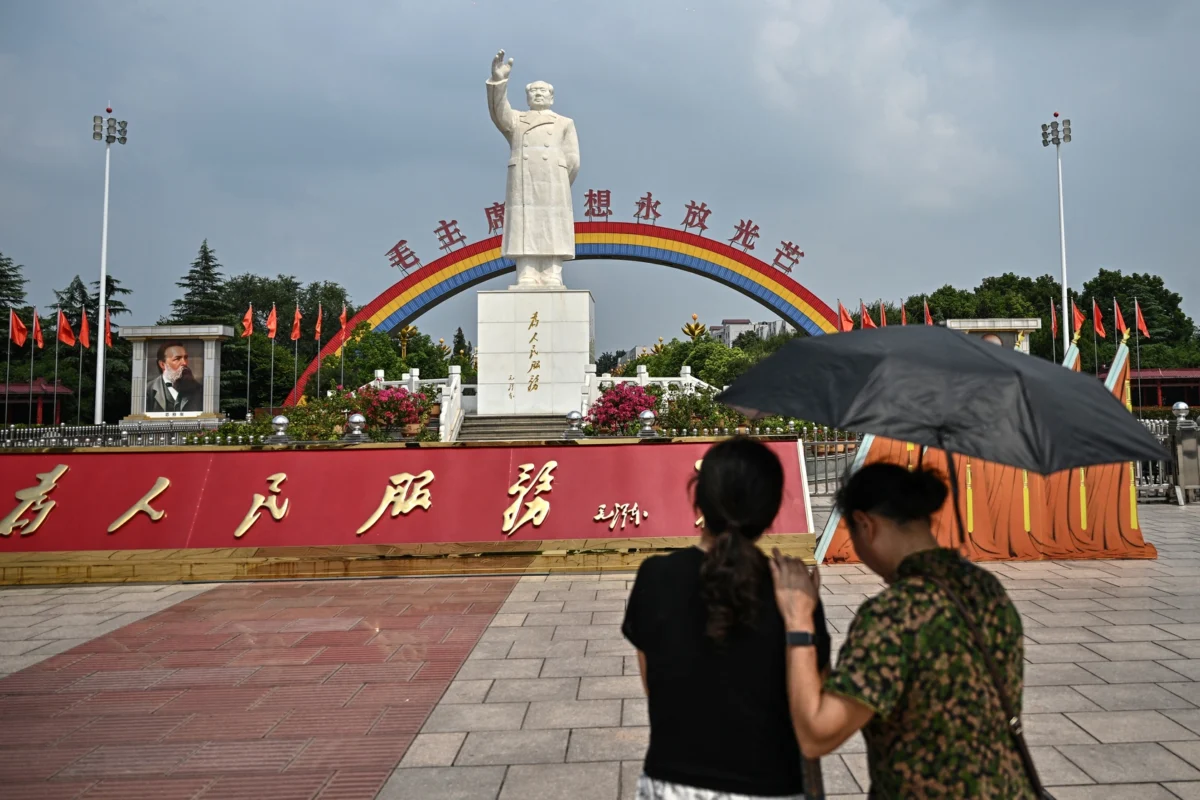
The crimson flags adorning Nanjie village’s iconic "East is Red" Square hang limp in the oppressive summer heat, their vibrant red dulled by the stifling humidity. A sparse trickle of tourists, cameras in hand, gather to capture images with the towering, still-gleaming white statue of Chairman Mao Zedong, a figure whose presence remains powerfully resonant almost 50 years after his death on September 9, 1976. This central Henan province village, frequently dubbed "China’s last Maoist village," stands as a stark, living testament to the complex and often contradictory legacy of the Great Helmsman, whose ideals continue to captivate and divide a nation grappling with its past and future.
Nanjie: A Living Relic of Collectivist Ideals
In Nanjie, the spirit of Mao Zedong is not merely confined to static monuments or historical archives; it is interwoven into the very fabric of daily life. Countless murals depicting the former leader adorn buildings, his revolutionary slogans echo through public spaces, and residents ostensibly live by Maoist principles of shared ownership – a stark contrast to the market-oriented reforms that have transformed the rest of China over the past four decades. This adherence to collectivized living means that essential services like housing, healthcare, and education are provided by the village’s collective enterprises, funded by profits generated through its various industries, which include food processing, pharmaceuticals, and printing. Electric carts, adorned with socialist propaganda, silently whisk visitors past uniform apartment blocks, while guides explain the cooperative model that underpins the village’s unique economic and social structure.
This anachronistic existence draws a particular type of visitor, often those nostalgic for a perceived simpler, more egalitarian past. Xie Kaiyue, a 22-year-old local university student, expresses a deep reverence for Mao, a leader who died decades before her birth. "I still revere him very much," she states, reflecting a sentiment common among some younger generations. "I think young people in the village and, actually, myself, aren’t as strong-spirited as in the past… People were purer." This yearning for a "purer" era speaks to a broader discontent within contemporary China, where rapid economic growth has been accompanied by widening income disparities and intense social competition.
Historical Context: The Architect of Modern China

Mao Zedong’s journey from a peasant revolutionary to the supreme leader of the People’s Republic of China (PRC) is a pivotal narrative in 20th-century history. Born in Shaoshan, Hunan province, in 1893, Mao became a foundational figure in the Chinese Communist Party (CCP) and led the arduous struggle against the Nationalist Kuomintang, culminating in the establishment of the PRC on October 1, 1949. His vision was to transform a war-torn, agrarian society into a powerful, industrialized socialist state.
The early years of the PRC saw significant land reforms, the suppression of perceived counter-revolutionaries, and initial steps towards industrialization. Mao championed collectivized ownership, believing it would drive industrial output and foster national unity. This era, while marked by revolutionary fervor and national pride, also laid the groundwork for policies that would later prove catastrophic.
The Great Leap Forward and Its Catastrophic Aftermath (1958-1962)
One of Mao’s most ambitious, yet devastating, initiatives was the Great Leap Forward, launched in 1958. This campaign aimed to rapidly transform China from an agrarian economy into a socialist society through rapid industrialization and collectivization. Peasants were organized into vast communes, and ambitious production quotas for steel and grain were set, often with little regard for practicalities or scientific principles. Backyard furnaces were established across the country to produce steel, often of inferior quality, diverting labor from agriculture.
The consequences were horrific. Exaggerated harvest reports led to excessive grain requisitions by the state, leaving rural populations with little to eat. Combined with poor agricultural planning, widespread ecological damage, and natural disasters, the Great Leap Forward precipitated one of the deadliest famines in human history. While official Chinese government figures state around 15 million deaths, independent historians and demographic studies estimate the death toll to be significantly higher, ranging from 20 to 43 million people. The period left deep scars on the collective memory of the nation, even as public discourse on it remains tightly controlled.
The Cultural Revolution: A Decade of Turmoil (1966-1976)

Following the failures of the Great Leap Forward, Mao felt his revolutionary authority challenged. In 1966, he launched the Great Proletarian Cultural Revolution, a movement ostensibly aimed at purging remnants of capitalist and traditional elements from Chinese society and reinvigorating revolutionary fervor. In reality, it became a brutal power struggle and a decade-long period of immense social and political chaos.
Intellectuals, perceived "class enemies," party officials, and anyone suspected of harboring bourgeois tendencies were brutally targeted, publicly denounced, humiliated, and often imprisoned, tortured, or killed. Schools and universities were shuttered, sending an entire generation into rural areas for "re-education." Cultural artifacts were destroyed, and traditional practices condemned. The Cultural Revolution brought China’s educational and scientific development to a standstill and fractured social cohesion.
After Mao’s death, the ruling Chinese Communist Party publicly acknowledged the Cultural Revolution as a "grave mistake," a verdict upheld by subsequent leaders, including Deng Xiaoping, who initiated market reforms that dramatically shifted China’s economic trajectory away from Maoist collectivization. Deng famously declared that Mao was "70 percent right and 30 percent wrong," an attempt to balance Mao’s indispensable role in founding the PRC with the catastrophic errors of his later years.
Dazhai: From Model Commune to Tourist Destination
Approximately 500 kilometers north of Nanjie, in Shanxi province, lies Dazhai, another village deeply embedded in Mao’s legacy. Dazhai was once promoted by Mao as a national model during the Great Leap Forward and Cultural Revolution for its collective spirit and ingenuity, where locals famously "terraformed" arid hills into productive, irrigated fields. Today, Dazhai also thrives on revolutionary tourism, albeit with a different focus than Nanjie’s ongoing collective economy.
Tourists visiting Dazhai reminisce about an era when Mao Zedong dominated political and social life. Li, a 64-year-old retiree from Xi’an, recalls his childhood. "People didn’t have enough to eat or to wear," he admits, acknowledging the hardships. "But… the whole country was full of vigor, and there was a spirit of struggling with heaven, earth, and people to change every aspect of China. Of course, I miss it." This sentiment highlights a selective memory, often overlooking the suffering while cherishing the perceived unity and purpose of the Mao era.

Dazhai’s economy is now bolstered by shops overflowing with items supporting Mao’s personality cult: posters, playing cards, crockery emblazoned with his image, and copies of the "Little Red Book" of his quotations. The village’s transformation into a tourist site illustrates the Party’s careful management of Mao’s image – promoting his revolutionary heroism while carefully sanitizing the more challenging aspects of his rule.
Mao’s Enduring Presence in Modern China and the Party Line
Despite the official acknowledgment of his "grave mistakes," Mao Zedong’s image and legacy remain central to the Chinese Communist Party’s legitimacy. His face graces all Renminbi banknotes, his colossal portrait overlooks Tiananmen Square, and his embalmed body is preserved in a mausoleum, drawing millions of visitors annually. State media consistently produces new movies and television shows dramatizing Mao’s life, invariably portraying his "great deeds" and leadership in a heroic light, reinforcing his status as the indispensable founder of modern China.
This carefully curated public narrative is a cornerstone of the Party’s political stability. To fully denounce Mao would be to undermine the very foundation of the PRC and the CCP’s authority. Instead, the Party navigates a delicate balance: acknowledging historical errors (particularly the Cultural Revolution) while simultaneously lionizing Mao as a revolutionary genius who united China and laid the groundwork for its current prosperity.
Censorship and "Historical Nihilism" Under Xi Jinping
Public discussion of the darker chapters of Mao’s decades in absolute power is tightly censored. In museums, any mention of the Cultural Revolution might be crudely scraped off signage, as noted by observers. This strict control over historical narratives has intensified under current leader Xi Jinping, who frequently warns against "historical nihilism" – a term used to condemn any narrative that contradicts the Party’s official version of history.

Scholar Xu Chenggang, who was targeted as a child during the Cultural Revolution because his father was labeled a "rightist," explains the pervasive nature of this control: "Everything you see in the public domain… is the party line. No one is allowed to deviate from this." He adds, "The Communist Party told people there were mistakes, but what’s the meaning of ‘mistake’? No one knows." This deliberate ambiguity allows the Party to maintain control over interpretation, ensuring that critical analysis of Mao’s policies remains largely absent from mainstream discourse.
Youth and Nostalgia: A Search for Ideals Amidst Modern Pressures
The sanitization of history has created a vacuum, allowing for romanticized interpretations of the Mao era, particularly among younger generations. These youths, often grappling with the intense pressures of long working hours (the "996" culture), fierce competition in education, and a challenging job market, sometimes look back to a perceived period of idealism and collective purpose.
In December, a viral video series on Bilibili, a popular platform among those under 30, provocatively argued that the 2017 movie "Youth," which depicts young performers in a military dance troupe during the 1970s, was a subtle ode to the Cultural Revolution. These videos, which praised Mao and blamed "capitalist elites" for crushing the movement, rapidly accumulated over 35 million views in less than a week before being removed by censors.
Kerry Brown, head of the Lau China Institute in London and author of a recent book on Mao, notes this phenomenon: "Today, there is more of a sense that the Cultural Revolution was a period of idealism, where society was fired by ideals and not by the relentless pursuit of money and material goods." He is quick to add, "This is, of course, a total fabrication," emphasizing the selective amnesia inherent in such romanticized views. This nostalgia often stems from a desire for a collective identity and purpose, contrasting sharply with the individualistic, consumer-driven society they inhabit.
Economic Disparities and the Call for Egalitarianism

The resurgence of interest in Maoist ideals is not merely an abstract historical fascination; it is often linked to contemporary socio-economic grievances. China’s economic reforms, while lifting hundreds of millions out of poverty and creating immense wealth, have also led to significant income inequality. The Gini coefficient, a measure of income disparity, has risen sharply since the 1980s, placing China among the more unequal societies globally. A slowing economy, particularly post-pandemic, coupled with high youth unemployment rates, exacerbates these frustrations.
For some, Mao’s vision of egalitarianism and collective ownership offers an attractive alternative to the perceived injustices of modern capitalism. They credit Mao with laying the foundation for China’s rise. Mobo Gao, a professor of Chinese studies at Adelaide University who lived through the Mao era in rural Jiangxi province, articulates this perspective: "They ask, where did (today’s China) come from? It came from the establishment of the PRC. Who was the one who really established the PRC? It must be Mao."
In Shijiazhuang, an industrial city of seven million northeast of Dazhai, 20-year-old Wang Zhihao and his classmates posed with a giant Mao statue opposite the municipal government. "We admire and revere Chairman Mao very much. He is a great figure," Wang stated, as elderly residents nearby sang songs praising the Communist Party. "He led the founding of New China." This sentiment underscores the widespread belief that Mao’s leadership was indispensable to China’s modern nationhood, even among those who know little of the specific hardships of his rule.
Broader Implications and The Party’s Dilemma
The enduring veneration of Mao Zedong, particularly in places like Nanjie and Dazhai, presents a complex dilemma for the Chinese Communist Party. On one hand, Mao’s image is an irreplaceable symbol of revolutionary legitimacy and national unity. His role in establishing the PRC and ending a century of humiliation is non-negotiable for the Party’s narrative of progress and resilience. On the other hand, the explicit romanticization of his more disastrous policies, like the Cultural Revolution or the Great Leap Forward, poses a threat to the current economic and political order, which has largely moved away from those models.
The Party must carefully manage this legacy, promoting Mao as a heroic founder while simultaneously ensuring that any nostalgia for his era does not translate into calls for radical change or a questioning of the current leadership’s legitimacy. The increasing inequality and social pressures in modern China, however, mean that the echoes of Mao’s egalitarian ideals will continue to resonate, forcing the Party to constantly recalibrate its relationship with the ghost of the Great Helmsman. The crimson flags in Nanjie, though limp in the heat, symbolize a past that, for many in China, is far from settled history.

 Sagoh
Sagoh
 Asro
Asro