Pevita Pearce
The automotive landscape of Southeast Asia is undergoing a profound and rapid transformation, signaling a critical juncture for established Japanese manufacturers like Toyota and Honda. For decades, these giants have held an almost unassailable position in the region, their internal combustion engine vehicles synonymous with reliability and widespread appeal. However, the burgeoning electric vehicle (EV) sector is dramatically reshaping this familiar terrain, posing an urgent question: can these legacy automakers adapt quickly enough to remain relevant in this electrified future? This seismic shift was the focus of a recent online seminar hosted by Greenpeace Japan on June 24, which delved into the dynamic growth of Indonesia’s EV market and its far-reaching implications for traditional Japanese automotive players.
The seminar convened key experts to dissect the evolving market: Aditya Mahalana, a senior researcher at the International Council on Clean Transportation (ICCT), and Achmad Rofiqi, vice chairman of Public Relations & Education at the Indonesian EV Industry Association (PERIKLINDO). Their insights provided a comprehensive overview of Indonesia’s burgeoning EV ecosystem and its broader significance for the entire ASEAN region.
The Unprecedented Surge of Indonesia’s EV Market
Contrary to historical patterns where clean technology adoption typically begins in wealthier nations, Southeast Asia, particularly Indonesia, is bucking the trend. Middle-income economies are embracing EVs at a pace that outstrips many developed countries. Mahalana of the ICCT explained that this accelerated adoption in nations like Indonesia is partly due to the absence of entrenched, legacy domestic auto industries. This lack of a powerful incumbent sector often translates to fewer political hurdles and import barriers, creating a more conducive environment for the influx of affordable green technologies.
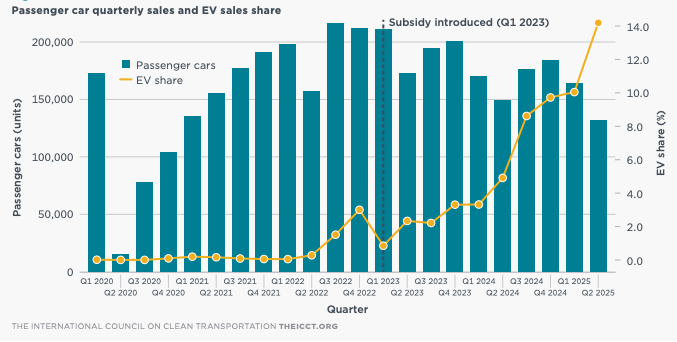
The data vividly illustrates this dramatic shift. According to an ICCT Market Spotlight report, Indonesia’s EV sales have experienced an explosive surge, escalating from fewer than 150 units in 2020 to over 22,000 units by the second quarter of 2025. This remarkable growth has propelled the country’s total EV stock beyond the 100,000-unit mark. By the second quarter of 2025, EVs constituted an impressive 15.2% of all new passenger car sales, a figure bolstered by a staggering 40% increase in sales from the preceding quarter alone. This trajectory suggests that the region is leapfrogging traditional automotive development stages, moving directly into the electric era.
This momentum is significantly fueled by Indonesia’s strategic natural resources. As the world’s largest producer of nickel, accounting for approximately 40% of the global supply, Indonesia possesses a critical advantage in the manufacturing of EV batteries. Rofiqi highlighted this intrinsic advantage, noting that abundant domestic nickel reserves provide a strong foundation for building a robust EV battery supply chain.
Furthermore, domestic adoption is being accelerated by a confluence of factors including increasingly affordable EV models, lower operational costs compared to gasoline-powered vehicles, and the rapid expansion of charging infrastructure. By 2024, Indonesia boasted over 2,300 public charging stations strategically located across 300 cities, according to Rofiqi. This widespread availability of charging points signifies a crucial step in moving EV adoption from early adopters to the mainstream consumer market, dismantling a significant barrier to widespread uptake.
New Competitors Redefining the Automotive Playbook
The rapid transition to electric mobility is fundamentally altering the competitive dynamics within the Southeast Asian automotive sector. For decades, Japanese brands such as Toyota, Honda, and Nissan have enjoyed market dominance, built on a reputation for manufacturing excellence, robust engineering, and deep-rooted brand loyalty. While these strengths continue to serve them well in the market for conventional gasoline-powered vehicles, the EV segment presents an entirely different competitive landscape.
The ascendancy of Chinese automakers is a defining feature of this new era. Companies like BYD and SAIC’s Wuling now command a significant share of Indonesia’s BEV market, collectively accounting for nearly 60% of all battery electric vehicle sales, as reported by the ICCT. Their competitive edge extends far beyond aggressive pricing strategies. These manufacturers have established vertically integrated battery supply chains, enabling cost efficiencies and greater control over production. Moreover, they are integrating advanced digital features into their vehicles and demonstrating remarkably agile product development cycles, often bringing new models from concept to market in as little as 12 to 18 months. This speed and integration present a formidable challenge to the more traditional, often slower, development processes of established automakers.
The Imperative for Japanese Automakers to Accelerate Their EV Transition
"The rules of the competition are evolving. Companies that can adapt quickly will be positioned for long-term success," stated Rofiqi from PERIKLINDO, underscoring the urgency of the situation. While Japanese companies still possess formidable strengths, including world-class engineering capabilities, an established reputation for safety, and generations of consumer trust, their continued leadership in the EV era is far from guaranteed.
To remain competitive and relevant, these legacy automakers must fundamentally shift their strategies. Instead of defensive lobbying tactics aimed at delaying the transition to electrification, they have a critical opportunity to lead the region towards a cleaner automotive future. This requires a proactive approach focused on several key areas:
- Accelerated EV Product Development: A significant increase in the pace and volume of EV model introductions is crucial. This includes developing a diverse range of vehicles catering to different market segments and price points, not just niche or premium offerings.
- Localized Market Strategies: Understanding and responding to the specific needs and preferences of Southeast Asian consumers is paramount. This involves tailoring vehicle features, pricing, and marketing strategies to local market conditions, rather than adopting a one-size-fits-all global approach.
- Deepened Ecosystem Engagement: Collaborating with local governments, battery manufacturers, charging infrastructure providers, and technology partners is essential for building a comprehensive EV ecosystem. This collaborative approach can accelerate innovation and market penetration.
- Investment in Battery Technology and Supply Chains: To compete with the vertically integrated models of Chinese competitors, Japanese automakers must make substantial investments in securing battery raw materials, developing advanced battery technologies, and establishing localized battery manufacturing capabilities within the region.
- Clearer Electrification Roadmaps: Transparent and ambitious timelines for phasing out internal combustion engine vehicles and fully embracing electrification are needed to reassure consumers and investors of their commitment to a zero-emission future.
Rofiqi concluded, "The opportunity for Japanese automakers remains substantial. But maintaining leadership will require accelerated EV product development, localized strategies, and deeper engagement with the emerging EV ecosystem. The future does not have to be a competition between countries. It can be a collaboration that benefits the entire region." This sentiment highlights the potential for a cooperative approach that benefits all stakeholders and accelerates the regional transition to sustainable mobility.

Greenpeace’s Perspective: Linking Market Growth to Climate Action
The rapid market shift discussed at the Greenpeace Japan seminar underscores the critical timeline for global climate action. For ASEAN nations, the opportunity to bypass decades of reliance on internal combustion engines represents a powerful chance to prevent long-term carbon lock-in. The International Energy Agency (IEA) global EV forecast indicates that the transition to electric mobility is now an unavoidable global trend, with worldwide EV sales projected to reach 23 million vehicles this year alone. This monumental shift is expected to displace up to 5 million barrels of oil per day by 2030, positioning electric mobility as an indispensable tool in the urgent fight against climate change.
Erin Eunseo Choi, Climate and Energy Campaigner at Greenpeace East Asia, emphasized the significance of Indonesia’s rapid EV adoption, stating, "Indonesia’s rapid EV adoption proves the market is ready. For legacy brands like Toyota, it exposes the real risk of the slow-walk strategies favored by traditional automakers. Relying on a defensive ‘multi-pathway’ approach that protects combustion engines and hybrids is no longer viable and is already costing them market share to faster competitors."
Choi further elaborated on the urgency, noting the geopolitical implications of oil dependency and the increasing severity of climate-related events. "Amid geopolitical oil shocks and severe El Niño events this year, decarbonizing the transport sector through battery electric vehicles is urgent. Japanese automakers must accelerate their EV strategies and set ambitious greenhouse gas reduction targets to achieve substantial cuts in total emissions." This call to action highlights the dual imperative of economic competitiveness and environmental responsibility, urging Japanese manufacturers to align their business strategies with the urgent need for climate mitigation. The rapid evolution of the Southeast Asian market serves as a clear indicator that the era of internal combustion engine dominance is drawing to a close, and adaptation is not merely an option, but a necessity for survival and future success.


 Ali Ikhwan
 Reynand Wu