Suro Senen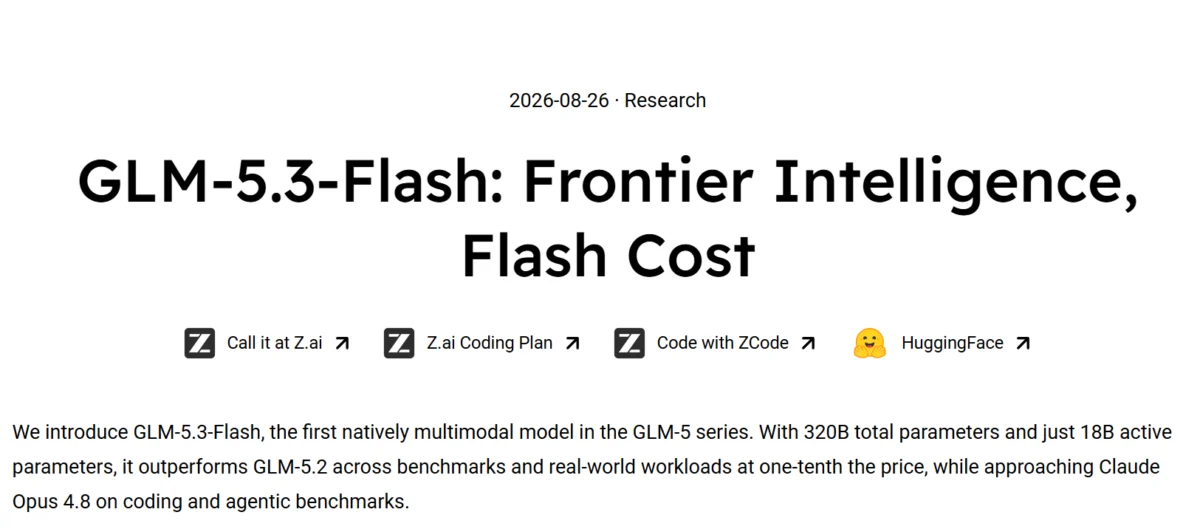
Zhipu AI, a prominent player in the global artificial intelligence landscape, has officially released its latest foundational model, GLM-5.3-Flash, alongside making its model weights publicly available. This significant announcement confirms widespread industry speculation that the high-performing model previously tested anonymously under the moniker "Ox Alpha" is indeed part of Zhipu’s acclaimed GLM series. The newly unveiled model boasts an impressive architecture featuring 320 billion total parameters, with 18 billion active parameters, marking a crucial step forward in efficient and powerful AI development.
The Unveiling of Ox Alpha: A Pre-Release Mystery Solved
For weeks leading up to its official release, the AI community had been abuzz with discussions surrounding a mysterious new model known only as "Ox Alpha." This model had been anonymously evaluated on popular platforms like OpenRouter and OpenCode, where it consistently demonstrated remarkable performance across a variety of tasks. These platforms, known for providing neutral ground for testing and comparing large language models, allowed developers and enthusiasts to interact with the model without foreknowledge of its origin, thus fostering unbiased assessment. The consistent high scores and advanced capabilities exhibited by Ox Alpha generated significant anticipation and curiosity, with many speculating about its developer and underlying architecture. The revelation that Ox Alpha is, in fact, GLM-5.3-Flash not only validates the model’s pre-release performance but also solidifies Zhipu AI’s position as a leading innovator capable of competing with global AI giants. This strategic pre-release testing allowed Zhipu to gather invaluable feedback and build organic community excitement before the formal launch, a tactic increasingly employed by leading AI labs to validate their models in real-world scenarios.
Architectural Prowess: Decoding GLM-5.3-Flash’s Parameters
The technical specifications of GLM-5.3-Flash highlight a sophisticated architectural design. The model’s 320 billion total parameters signify an immense capacity for knowledge storage and intricate pattern recognition, enabling it to process and generate highly complex information. More critically, the 18 billion active parameters point to an efficient Mixture-of-Experts (MoE) architecture. In an MoE setup, only a subset of the model’s parameters is activated for any given input, significantly reducing the computational load during inference while still leveraging the vast knowledge base stored across all parameters. This design choice is pivotal for achieving a balance between computational efficiency and high performance, making GLM-5.3-Flash particularly appealing for applications requiring both speed and advanced reasoning capabilities. The "Flash" designation in its name likely refers to this optimized inference speed, crucial for real-time applications and scalable deployments. This architectural innovation positions GLM-5.3-Flash as a powerful tool for developers, offering a robust foundation for building advanced AI applications without incurring prohibitive operational costs associated with models that activate all parameters for every task.
Embracing Multimodality: A New Frontier for GLM
A defining feature of GLM-5.3-Flash is its status as the first natively multimodal model within the GLM-5 series. This signifies a profound leap from purely text-based understanding to a comprehensive grasp of various data types. The model natively supports text, images, videos, visual documents, and interleaved multimodal inputs. This means GLM-5.3-Flash can seamlessly interpret and generate content across these diverse modalities. For instance, it can analyze an image to answer questions, summarize a video, extract information from a complex chart or infographic, and even engage in conversations where inputs dynamically switch between text, images, and video clips.
The significance of native multimodality cannot be overstated. In an increasingly digital world, information rarely exists in a single format. Humans naturally process information from multiple senses simultaneously, and multimodal AI aims to replicate this capability. Applications range from enhanced customer service chatbots that can understand user queries incorporating screenshots, to advanced educational tools that explain concepts using text, diagrams, and video snippets, to sophisticated content creation platforms that generate narratives incorporating visual and auditory elements. The ability to handle "interleaved multimodal inputs" is particularly cutting-edge, allowing for dynamic, context-aware interactions where users can fluidly combine different media types within a single conversation or task, mimicking natural human communication patterns more closely. This capability sets GLM-5.3-Flash apart, positioning it at the forefront of AI models capable of truly understanding and interacting with the complex, multi-faceted information of the real world.
Zhipu AI’s Journey: From Research to Global Contender
Zhipu AI, headquartered in Beijing, China, has rapidly emerged as a formidable force in the global AI race. Spun out of Tsinghua University, one of China’s most prestigious academic institutions, Zhipu AI has a deep foundation in fundamental AI research. Its journey began with a strong focus on large-scale pre-trained models, culminating in the development of the General Language Model (GLM) series. Previous iterations, such as GLM-1, GLM-2, GLM-3 Turbo, and GLM-4, have progressively advanced the state-of-the-art in language understanding and generation, earning Zhipu AI recognition within the academic and industrial communities.
The GLM series has consistently aimed to build powerful, general-purpose AI models, often incorporating innovations in efficiency and scalability. With significant backing from investors and a strategic focus on both proprietary development and contributions to the open-source community, Zhipu AI has positioned itself as a key competitor to Western AI powerhouses like OpenAI, Google, and Meta. Their commitment to releasing model weights, as seen with GLM-5.3-Flash, is a testament to their dual strategy of driving innovation while fostering broader ecosystem development. This approach not only enhances their credibility but also accelerates the adoption and integration of their technologies across various industries, from finance and healthcare to education and creative arts.
The Strategic Imperative of Open-Sourcing
The decision to make GLM-5.3-Flash’s weights available through Hugging Face, a leading platform for machine learning models and datasets, is a strategic move with far-reaching implications. Open-sourcing powerful foundational models has become a growing trend, championed by companies like Meta with its Llama series. This approach offers several critical advantages:
- Democratization of AI: By making advanced AI accessible, Zhipu AI empowers a wider range of developers, researchers, and startups to build upon its technology. This lowers the barrier to entry for innovation, fostering a more diverse and dynamic AI ecosystem.
- Accelerated Research and Development: When model weights are open, the global research community can scrutinize, experiment with, and improve upon the model. This collaborative environment often leads to faster identification of bugs, development of novel applications, and advancements in AI techniques that might not occur within a closed, proprietary system.
- Community Engagement and Feedback: An open-source model naturally attracts a large community of users who provide invaluable feedback, contributing to the model’s robustness, performance, and ethical considerations.
- Market Penetration and Adoption: Releasing weights can lead to broader adoption of Zhipu’s technology. As more developers integrate GLM-5.3-Flash into their projects, it strengthens Zhipu’s brand and establishes its models as a standard in various application domains.
- Competitive Edge: In a rapidly evolving landscape, open-sourcing can be a competitive differentiator. While some companies guard their models closely, others find that the network effects and rapid innovation spurred by open-sourcing outweigh the risks, ultimately leading to a stronger market position.
The availability of GLM-5.3-Flash on Hugging Face ensures that researchers and developers worldwide can download, fine-tune, and deploy the model for their specific needs, accelerating the pace of AI innovation across various sectors.
The Evolving Landscape of Multimodal AI
The release of GLM-5.3-Flash comes at a time when multimodal AI is experiencing explosive growth and becoming a central focus for leading AI labs globally. The ability of AI systems to process and integrate information from diverse modalities—text, images, audio, video—is seen as a critical step towards achieving more human-like intelligence. Google’s Gemini, OpenAI’s GPT-4o, and Meta’s Llama 3-V are notable examples of other multimodal models pushing the boundaries.
The market demand for multimodal AI is surging across industries. In healthcare, multimodal models can analyze medical images, patient records, and genomic data simultaneously to aid in diagnosis. In education, they can create interactive learning experiences by combining textual explanations with visual aids and video demonstrations. For e-commerce, they can provide more accurate product recommendations based on image analysis of user preferences and textual reviews. In robotics, multimodal understanding is essential for robots to perceive and interact with the physical world effectively. The challenges in developing robust multimodal AI include aligning different data representations, handling complex interdependencies between modalities, and ensuring coherent and contextually relevant outputs across all input types. Zhipu AI’s GLM-5.3-Flash directly addresses these challenges, offering a sophisticated solution for real-world multimodal applications.
Industry Reactions and Expert Perspectives
While Zhipu AI has not yet released specific statements from its leadership regarding the broader market implications, industry analysts are already weighing in on the significance of GLM-5.3-Flash. Dr. Chen Wei, a prominent AI researcher specializing in large models, commented, "The confirmation that Ox Alpha is GLM-5.3-Flash, combined with its native multimodal capabilities and open-source weights, marks a pivotal moment. It demonstrates Zhipu AI’s technical prowess and strategic vision. The MoE architecture with 18 billion active parameters is particularly noteworthy, suggesting a strong focus on practical deployability without sacrificing performance."
Developers on platforms like OpenRouter and Hugging Face are expressing enthusiasm, with many eager to experiment with the model’s multimodal features. The general sentiment points towards a heightened level of competition in the multimodal AI space, with Zhipu AI now firmly established among the frontrunners. This competition is widely viewed as beneficial for the entire AI ecosystem, driving faster innovation and leading to more powerful and accessible AI tools for everyone.
Implications for the AI Ecosystem and Beyond
The introduction of GLM-5.3-Flash carries significant implications across several dimensions:
- For Zhipu AI: This release solidifies Zhipu AI’s position as a top-tier global AI company, capable of developing cutting-edge foundational models. Its commitment to open-sourcing will likely attract a larger developer community, strengthening its ecosystem and accelerating the adoption of its technologies.
- For the Global AI Race: Zhipu AI’s latest offering intensifies the competition among leading AI labs worldwide. As more powerful multimodal models become available, the pace of innovation is expected to accelerate, pushing the boundaries of what AI can achieve. This healthy competition will ultimately benefit end-users with more sophisticated and versatile AI solutions.
- For Multimodal AI Development: GLM-5.3-Flash sets a new benchmark for natively multimodal models, particularly with its efficient MoE architecture and support for interleaved inputs. It will likely inspire further research and development in areas such as efficient multimodal learning, cross-modal reasoning, and human-AI interaction.
- For Open-Source AI: Zhipu AI’s decision to release the model weights reinforces the growing trend of powerful AI models becoming open-source. This democratization of AI technology will empower a broader range of developers and researchers, fostering collaborative innovation and accelerating the development of novel applications across various industries.
- Societal Impact: The enhanced capabilities of multimodal AI, as demonstrated by GLM-5.3-Flash, hold the potential to revolutionize numerous sectors. From creating more accessible educational content to enabling advanced diagnostics in medicine, and facilitating more natural human-computer interfaces, these models promise to reshape how we interact with information and technology. However, like all powerful AI, careful consideration of ethical implications, bias mitigation, and responsible deployment will be paramount.
In conclusion, Zhipu AI’s release of GLM-5.3-Flash is a landmark event in the artificial intelligence domain. By confirming the identity of the highly anticipated "Ox Alpha" and offering a natively multimodal model with an efficient architecture and open-source weights, Zhipu AI has not only showcased its formidable technical capabilities but also made a strategic move to democratize advanced AI. This development is poised to significantly impact the trajectory of multimodal AI research and application, further accelerating the global AI revolution and fostering a new era of intelligent systems that can truly understand and interact with the complexity of human experience.



 Nana Muazin