Asro
Asro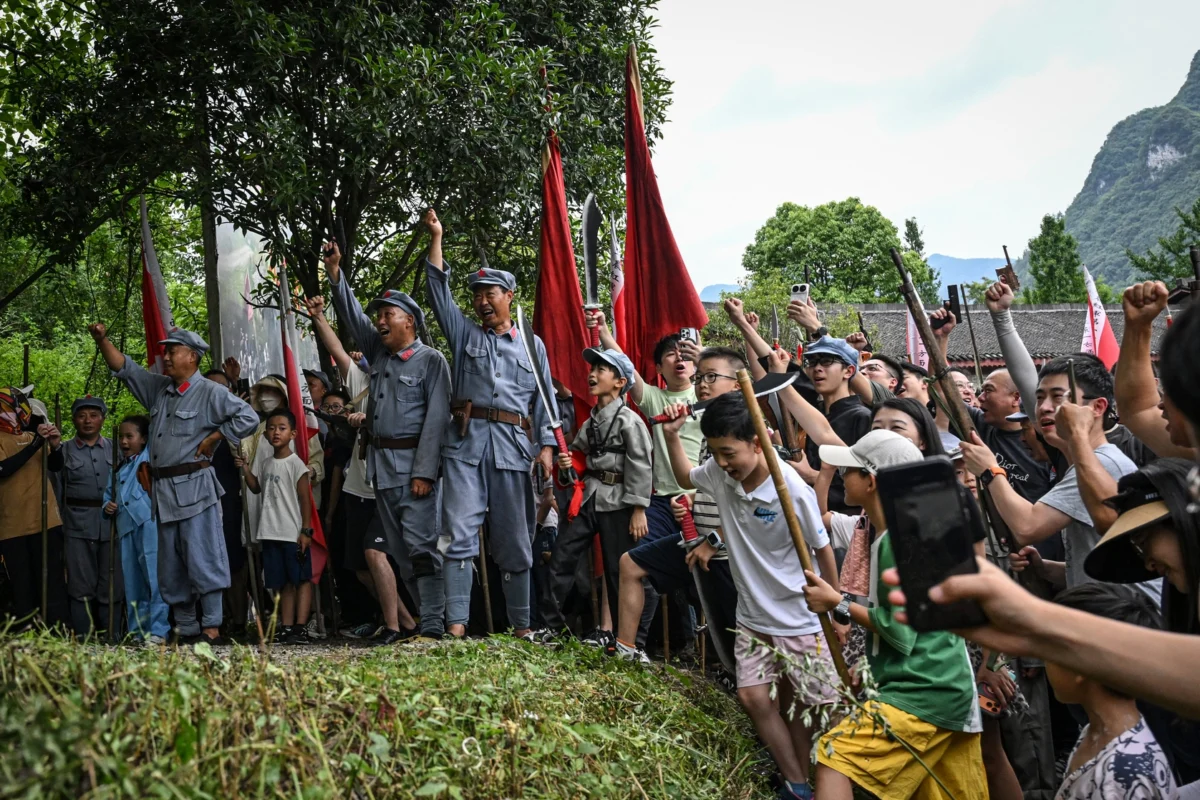
Dressed in authentic-looking Red Army uniforms and waving prop weapons, scores of tourists enthusiastically stormed a strategic mound in southwestern China’s Loushan Pass as dazzling pyrotechnics lit up the hillside, vividly reenacting a pivotal historic battle. This immersive spectacle, held on July 25, 2026, transformed the rugged terrain of Guizhou province into a living history lesson, drawing over a thousand participants and spectators eager to relive the dramatic 1935 conflict between Chinese Communist and Nationalist forces. The event has since garnered significant attention on Chinese social media platforms, with videos and testimonials circulating widely, highlighting its profound impact on those who experienced it firsthand.
The Spectacle Unfolds: A Journey Back to 1935
The Loushan Pass reenactment, meticulously choreographed to recreate the intensity of the original battle, saw participants, including a platoon of squealing children as young as five, don miniature Red Army costumes. Armed with toy swords and bright red flags, they charged up the hill with palpable enthusiasm, aiming to "capture" positions notionally held by the Nationalist Kuomintang (KMT) forces. The air was thick with theatrical smoke, and simulated "bombs" detonated nearby, adding a layer of realism and sensory engagement to the experience. The cheers of "victory" as the red flags were triumphantly raised symbolized the historical success of the Red Army, resonating deeply with the participants.

Jiang Jun, a 40-year-old tourist present at the event, articulated the powerful emotional connection fostered by the reenactment, telling AFP, "It was truly awe-inspiring – it felt as though I was actually right there in the thick of the battle. I felt as though I could experience what those martyrs must have felt back then." This sentiment underscores the core appeal of such events: to bridge the gap between abstract historical knowledge and visceral, personal experience, allowing participants to feel a direct connection to the sacrifices and triumphs of the past. The meticulous attention to detail, from period costumes to the simulated battlefield environment, is designed to maximize this immersive effect.
Historical Significance: The Battle of Loushan Pass and The Long March
To fully appreciate the gravity of the Loushan Pass reenactment, it is essential to understand its historical context within the epic saga of the Long March. The Long March (1934-1936) was a monumental military retreat undertaken by the Red Army of the Communist Party of China to evade the pursuit of the Nationalist Kuomintang army. It involved a series of arduous treks by various Communist armies, covering thousands of kilometers through some of China’s most inhospitable terrains, ultimately leading to the consolidation of Mao Zedong’s leadership within the Party.
The Battle of Loushan Pass, fought in February 1935, was a critical engagement during the Long March. Following the pivotal Zunyi Conference in January 1935, where Mao Zedong’s influence significantly grew, the Red Army was attempting to break free from the KMT’s encircling forces. Loushan Pass, a strategically vital mountain pass in northern Guizhou, presented a formidable natural barrier. Its capture was crucial for the Red Army to secure a safe passage and re-establish its operational freedom.

Mao Zedong himself immortalized the victory at Loushan Pass in his renowned poem, "Loushan Pass" (《忆秦娥·娄山关》), which captures the stark beauty of the landscape and the fierce determination of the Red Army: "West wind strong, wild geese crying in the sky. The morning moon is like a hook. The morning moon is like a hook, the horse’s hooves are clattering, and the bugle sounds low." The poem vividly paints a picture of the harsh conditions and the spirit of perseverance, reinforcing the pass’s legendary status in revolutionary lore. The recapture of Loushan Pass marked the Red Army’s first major victory after the Zunyi Conference, significantly boosting morale and demonstrating the strategic acumen of the newly solidified Communist leadership under Mao. This tactical success was not merely a military gain but a psychological turning point, proving that the Red Army could indeed overcome the formidable KMT forces led by Chiang Kai-shek.
The Evolution of "Red Tourism" in China
The Loushan Pass reenactment is a prime example of China’s decades-long and increasingly sophisticated push to develop "red tourism" (红色旅游). This state-backed initiative encourages domestic travel to sites with significant historical relevance to the Communist revolution, aiming to educate citizens, particularly younger generations, about the Party’s foundational struggles and triumphs. The concept of "red tourism" officially gained prominence in the early 2000s, with significant government investment channeled into preserving revolutionary sites, developing infrastructure, and promoting themed travel packages.
The objectives of red tourism are multi-faceted:

- Patriotic Education: To instill a sense of national pride and loyalty to the Communist Party by showcasing its heroic past and the sacrifices made for the "new China."
- Historical Preservation: To safeguard and restore historical landmarks associated with key revolutionary events, ensuring their continued relevance and accessibility.
- Economic Development: To stimulate local economies in often rural or historically disadvantaged areas where many revolutionary sites are located, creating jobs and attracting investment.
- Cultural Identity: To reinforce a shared national narrative and collective memory, fostering unity and a common understanding of China’s modern origins.
Beyond Loushan Pass, numerous other sites across China form the backbone of the red tourism network. These include Jinggangshan in Jiangxi province, considered the cradle of the Chinese revolution; Yan’an in Shaanxi province, the Communist base during the Second Sino-Japanese War and the Civil War; and the site of the Zunyi Conference itself, also in Guizhou, where Mao Zedong’s leadership was cemented. Each site offers a unique perspective on different phases of the revolutionary struggle, from early guerrilla warfare to the establishment of the People’s Republic.
Data from the China National Tourism Administration (now part of the Ministry of Culture and Tourism) consistently shows a robust growth in red tourism. While specific figures for 2026 are yet to be released, pre-pandemic trends indicated that red tourism sites collectively attracted hundreds of millions of visitors annually, generating billions of yuan in revenue. For instance, in 2019, red tourism sites received over 1.4 billion visits, contributing significantly to local economies. This growth trajectory is expected to continue, especially with innovative approaches like immersive reenactments that appeal to a broader demographic.
Economic and Social Implications of Red Tourism
The Loushan Pass reenactment, like other red tourism initiatives, carries significant economic and social implications. Economically, it provides a substantial boost to the local economy of Zunyi city and Guizhou province. The influx of over 1,000 visitors for a single weekend event translates into increased spending on accommodation, food, transportation, and souvenirs. This directly supports local businesses, creates employment opportunities for tour guides, performers, and hospitality staff, and encourages investment in tourism-related infrastructure such as hotels, restaurants, and transport links.

Local government officials, though not quoted directly in the initial report, would likely emphasize the dual benefit of such events: promoting historical education while simultaneously driving economic prosperity in a region that has historically sought to leverage its unique revolutionary heritage for development. The Ministry of Culture and Tourism, at the national level, consistently champions red tourism as a key component of sustainable regional development strategies.
Socially, the reenactment serves as a powerful tool for national identity formation and intergenerational transmission of historical narratives. Xu, a participant who traveled from neighboring Guangxi province, articulated this sentiment clearly: "If Mao’s forces had not broken through nationalist lines at Loushan Pass, we wouldn’t have the new China that we have today and our standard of living wouldn’t be so good." This statement reflects a commonly held belief that the sacrifices of the revolutionary era directly led to the nation’s current prosperity and stability. By making history tangible and engaging, these events aim to foster a sense of gratitude, patriotism, and collective responsibility among citizens. For younger participants, particularly the children involved, it offers a memorable and interactive way to learn about a foundational period in Chinese history, potentially shaping their understanding of national identity from an early age.
Broader Impact and Future Outlook
The success of the Loushan Pass reenactment highlights a growing trend in China’s cultural tourism sector: the innovative integration of historical education with entertainment. This approach, which moves beyond static museums and monuments, seeks to create dynamic, participatory experiences that resonate deeply with modern audiences. The use of pyrotechnics, costumes, and active roles for tourists transforms passive observation into active engagement, making historical events feel more immediate and relevant.

Looking ahead, the red tourism sector is likely to continue evolving. We can anticipate further integration of digital technologies, such as augmented reality (AR) and virtual reality (VR), to enhance immersive experiences. There may also be a diversification of offerings, including themed accommodation, culinary experiences tied to the revolutionary era, and more personalized tour packages. The balance between historical accuracy and popular appeal will remain a crucial consideration for organizers, ensuring that while the events are engaging, they also convey an authentic and respectful representation of history.
While such reenactments primarily focus on celebrating Communist Party achievements, they also implicitly contribute to a broader public discourse about China’s past. They serve as a powerful reminder of the civil war that shaped modern China, acknowledging the immense human cost and the eventual consolidation of power by the Communist Party. The narratives presented are, of course, from the perspective of the victors, emphasizing themes of perseverance, sacrifice, and the ultimate triumph of the revolutionary cause. This continuous engagement with history through popular culture and tourism underscores the enduring importance of these foundational stories in contemporary Chinese society.
The Loushan Pass reenactment stands as a testament to the enduring power of historical memory and the innovative ways in which nations seek to connect their present to their past. By allowing citizens to step into the boots of their revolutionary ancestors, China’s red tourism initiatives aim not just to entertain, but to educate, inspire, and solidify a collective national identity for generations to come.


 Evan Lee Salim
 Jia Lissa