Muslim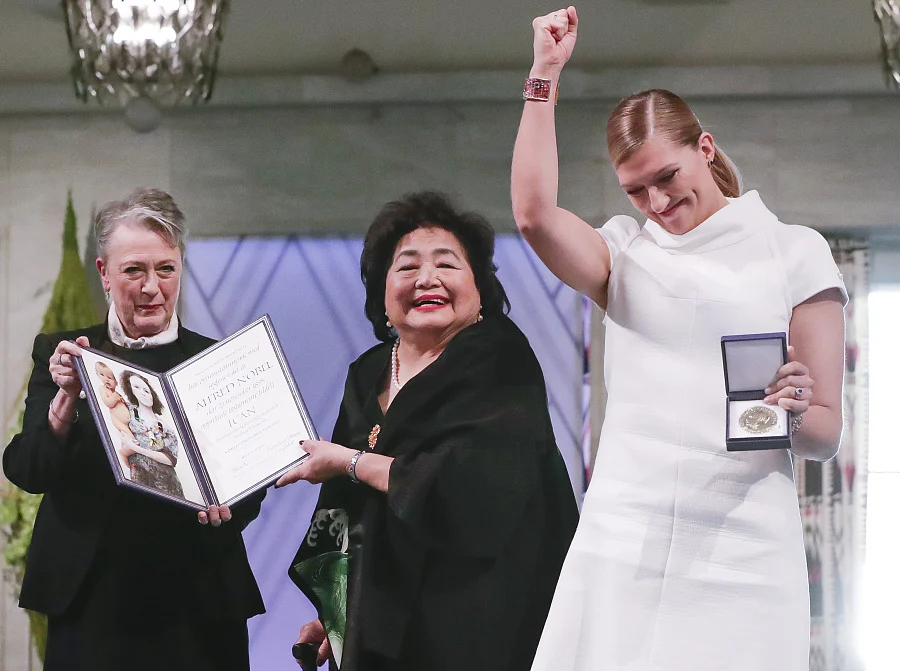
The International Campaign to Abolish Nuclear Weapons (ICAN) was awarded the prestigious 2017 Nobel Peace Prize on Sunday, December 10, 2017, in Oslo, Norway, recognizing its tireless efforts to draw global attention to the catastrophic humanitarian consequences of nuclear weapons and its instrumental role in achieving a treaty-based prohibition of these devastating arms. The award ceremony, held at the Oslo City Hall, marked a significant moment for the global disarmament movement, celebrating years of advocacy and mobilization aimed at a nuclear-weapon-free world.
A Landmark Achievement for Disarmament Advocacy
At the solemn ceremony, Berit Reiss-Andersen, the chairperson of the Norwegian Nobel Committee, formally presented the medal and diploma to Beatrice Fihn, the executive director of ICAN, and Setsuko Thurlow, a distinguished survivor of the 1945 atomic bombing of Hiroshima. Reiss-Andersen articulated the committee’s rationale, emphasizing ICAN’s success in "giving new impetus to the efforts to achieve a world free from nuclear weapons." She highlighted that the prize followed a tradition of Nobel Peace Prize recognitions for individuals and organizations dedicated to nuclear disarmament and non-proliferation, underscoring the enduring global concern over these weapons of mass destruction.
The Nobel Committee’s decision acknowledged ICAN’s crucial role in the adoption of the Treaty on the Prohibition of Nuclear Weapons (TPNW) in July 2017. This treaty, a landmark achievement negotiated under the auspices of the United Nations, represents the first legally binding international agreement to comprehensively prohibit nuclear weapons, covering their development, testing, production, stockpiling, stationing, transfer, use, and threat of use. The TPNW, though not yet universally ratified, signifies a powerful normative shift and a moral imperative against nuclear armament.
Voices of Experience and Urgency
In their joint Nobel lecture, Beatrice Fihn and Setsuko Thurlow delivered powerful messages that resonated with the gravity of their cause. Fihn underscored the escalating risks associated with nuclear weapons in the contemporary geopolitical landscape. She pointed out that the current global security environment is more perilous than during the Cold War, characterized by a larger number of nuclear-armed states, the persistent threat of terrorism, and the burgeoning complexities of cyber warfare, all of which amplify the potential for accidental or intentional nuclear conflict. Her call for all nations to contribute to the "end of nuclear weapons" served as a direct appeal to the international community to embrace the TPNW and work towards its universal implementation.

Setsuko Thurlow, an 85-year-old survivor of the Hiroshima bombing, offered a deeply personal and harrowing account of her experiences. At the age of 13, she witnessed firsthand the unimaginable devastation wrought by the atomic bomb dropped on her city on August 6, 1945. She recounted the loss of eight family members and 351 schoolmates, a stark testament to the indiscriminate and horrific nature of nuclear warfare. Thurlow’s plea to "forever eradicate the threat of nuclear annihilation" was not merely a plea for peace but a demand for justice and a profound commitment to ensuring that no future generation would suffer the same fate. Her presence and testimony served as a living embodiment of the humanitarian imperative driving ICAN’s mission.
The Genesis and Evolution of ICAN
The International Campaign to Abolish Nuclear Weapons (ICAN) is a global coalition of non-governmental organizations (NGOs) operating in approximately 100 countries. Its journey towards receiving the Nobel Peace Prize began with its formal launch in Vienna, Austria, in April 2007. Since its inception, ICAN has dedicated itself to raising public awareness about the devastating humanitarian consequences of nuclear weapons and advocating for their prohibition and elimination. Its operational hub is strategically located in Geneva, Switzerland, a city renowned for its role in international diplomacy and humanitarian initiatives.

ICAN’s strategy has been multifaceted, encompassing grassroots activism, public education campaigns, lobbying governments, and building a broad coalition of civil society actors. The organization has been instrumental in mobilizing public opinion, particularly in countries that do not possess nuclear weapons, to support disarmament efforts. Its work has focused on highlighting the illegitimacy and immorality of nuclear weapons, framing them not as instruments of deterrence but as weapons of mass destruction that pose an existential threat to humanity.
The path to the TPNW was a testament to ICAN’s sustained advocacy. The treaty negotiations, which culminated in its adoption, were largely driven by the persistent engagement of ICAN and its member organizations, who provided crucial expertise, mobilized civil society support, and exerted pressure on states to negotiate and sign the treaty. The TPNW is often referred to as the "ICAN Treaty" due to the campaign’s central role in its conception and realization.

The Broader Context of Nuclear Disarmament
The award to ICAN comes at a time when the global nuclear disarmament landscape is fraught with challenges. Despite decades of efforts, several nations continue to possess and modernize their nuclear arsenals. The existing frameworks for arms control, such as the Nuclear Non-Proliferation Treaty (NPT), while significant, have faced strains due to geopolitical tensions and a perceived lack of progress on disarmament commitments by nuclear-weapon states.
The 2017 Nobel Peace Prize for ICAN can be seen as a powerful endorsement of the humanitarian approach to disarmament. It signals a recognition that the threat posed by nuclear weapons is not merely a strategic or political issue but a fundamental humanitarian crisis that demands urgent action. By focusing on the catastrophic human cost of nuclear war, ICAN has effectively shifted the discourse, compelling a wider audience to confront the moral and ethical dimensions of nuclear weapons.

Global Reactions and Implications
The awarding of the Nobel Peace Prize to ICAN elicited a range of reactions from governments, international organizations, and civil society groups. Many nations that have ratified the TPNW hailed the award as a significant recognition of their commitment to nuclear disarmament and a boost to global efforts to achieve a world free of these weapons. They viewed the prize as a validation of the humanitarian approach and a catalyst for further action.
However, nuclear-weapon states and some of their allies, who did not participate in the negotiations for the TPNW and have expressed reservations about its effectiveness, offered more muted responses. Some acknowledged ICAN’s dedication but reiterated their belief that existing security frameworks and disarmament strategies, which often involve a gradual, step-by-step approach, remain the most effective path forward. These reactions underscore the deep divisions that persist within the international community regarding nuclear disarmament.

The implications of ICAN’s Nobel Peace Prize are far-reaching. Firstly, it elevates the profile of the anti-nuclear weapons movement globally, potentially attracting more public support and political attention. Secondly, it places increased moral and political pressure on nuclear-armed states to reconsider their positions and engage more constructively with the TPNW. Thirdly, it strengthens the normative framework against nuclear weapons, reinforcing the idea that their possession and use are increasingly unacceptable in the international arena.
A Chronology of Key Events
- 1945: Atomic bombings of Hiroshima and Nagasaki by the United States, marking the first and only use of nuclear weapons in warfare.
- 1968: Signing of the Nuclear Non-Proliferation Treaty (NPT), aimed at preventing the spread of nuclear weapons and promoting nuclear disarmament.
- 1985: Launch of the International Year of Peace, which saw increased global activism for disarmament.
- 2007 (April): Formal launch of the International Campaign to Abolish Nuclear Weapons (ICAN) in Vienna, Austria.
- 2010: ICAN adopts a strategy to advocate for a new international treaty to prohibit nuclear weapons.
- 2017 (July 7): The Treaty on the Prohibition of Nuclear Weapons (TPNW) is adopted by 122 UN member states at the United Nations Headquarters in New York.
- 2017 (October 6): The Norwegian Nobel Committee announces that the 2017 Nobel Peace Prize has been awarded to ICAN.
- 2017 (December 10): ICAN receives the Nobel Peace Prize at a ceremony in Oslo, Norway.
Supporting Data and Analysis
The threat posed by nuclear weapons remains a stark reality. As of recent estimates, there are approximately 14,900 nuclear warheads in the world, held by nine countries. While this number has decreased significantly since the peak of the Cold War, the existence of these weapons continues to cast a shadow over global security. The potential humanitarian consequences of even a limited nuclear exchange are catastrophic, leading to widespread destruction, mass casualties, and long-term environmental damage, including nuclear winter scenarios.

ICAN’s advocacy has been crucial in highlighting these devastating humanitarian impacts. By framing nuclear weapons as a violation of international humanitarian law and a threat to human survival, the campaign has resonated with a broad spectrum of society, from survivors of nuclear attacks to humanitarian organizations and concerned citizens worldwide. The TPNW, a direct result of this advocacy, provides a legal framework to stigmatize and ultimately eliminate these weapons.
However, the path to a world free of nuclear weapons is complex and faces significant geopolitical hurdles. The strategic doctrines of nuclear-armed states, often based on deterrence theory, remain a formidable obstacle. The ratification and universal implementation of the TPNW will require sustained diplomatic efforts, public pressure, and a fundamental shift in the security perceptions of key global actors. The Nobel Peace Prize for ICAN is a powerful recognition of the progress made and a potent reminder of the work that still lies ahead. It is a call to action for all nations to embrace the vision of a world where nuclear weapons are relegated to history, replaced by a commitment to lasting peace and human security.


 Nana Wu
 Suro Senen