Evan Lee Salim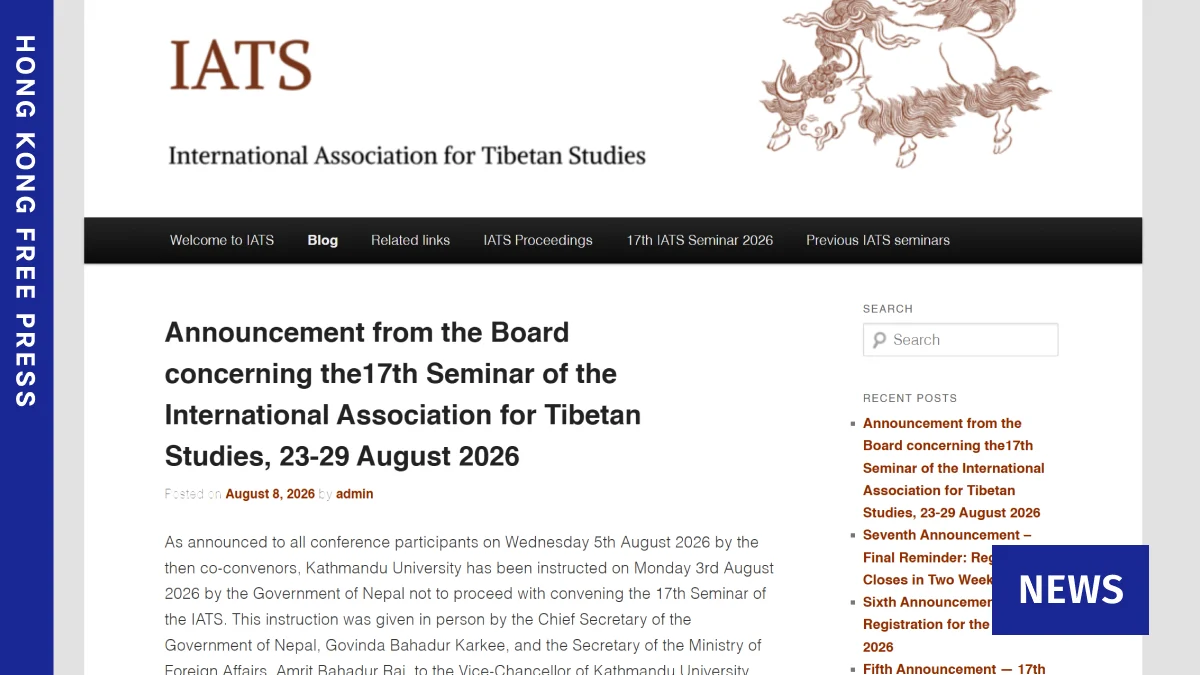
An international academic conference dedicated to the study of Tibet, originally scheduled to convene in Nepal this month, has been abruptly shifted to an online format. Organizers have voiced deep concern over this development, citing it as a "worrying" departure from their initial plans. While Nepal’s government has formally denied issuing any direct orders for the change, the decision has ignited speculation about potential pressure exerted due to the highly sensitive geopolitical context surrounding Tibet and its relationship with China, Nepal’s influential northern neighbor.
The International Association for Tibetan Studies (IATS), a globally recognized body for scholarly research on Tibet, had selected Kathmandu University as the venue for its quadrennial conference. The event, slated to run from August 23rd to August 29th, was anticipated to draw a significant number of leading scholars from across the globe. These academics were set to converge in Nepal’s capital to engage in critical discussions and presentations covering a wide spectrum of Tibetan life, including its rich history, diverse cultural heritage, complex religious traditions, and evolving societal structures. The shift to a virtual platform, however, has significantly altered the intended scope and impact of this important academic gathering.
A "Regrettable and Worrying Development"

Francoise Robin, the acting president of IATS and a distinguished professor of Tibetan studies at France’s National Institute for Oriental Languages and Civilizations, articulated the profound disappointment felt by the association. In a statement to Agence France-Presse (AFP), Robin described the forced relocation as a "very regrettable and worrying development." She emphasized that while the conference would proceed, its transition to an online-only format was not by choice.
The immediate impetus for the change appears to have originated from Kathmandu University, the host institution. Sagar Raj Sharma, a professor at the university and the convener of the conference, revealed that organizers were informed of the need to withdraw from hosting the physical event. "We had been planning this conference for a long time, but we received a request from the government not to hold it, so we are not doing it," Sharma stated. He further elaborated on the communication received, noting that the government had conveyed that "this is not an appropriate time to conduct this conference." This assertion from Sharma directly contradicts the official stance issued by the Nepalese government.
Conflicting Accounts: Government Denies Direct Intervention
In response to inquiries regarding the conference’s relocation, Hem Raj Aryal, a spokesperson for the prime minister’s office in Nepal, asserted that the government had not issued any instructions to cancel or postpone the event. "Nepal’s government has not given any instructions to cancel it," Aryal told AFP. "Neither have we sent a letter nor given verbal instructions to stop it. They postponed it on their own." This conflicting narrative has fueled further questions about the behind-the-scenes dynamics influencing the decision.

The IATS, established in 1979 at the University of Oxford in Britain, has consistently maintained its apolitical stance. Its stated mission is to foster and promote the academic study of Tibet, free from political affiliations or agendas. However, the geopolitical realities of the region, particularly China’s assertive stance on Tibet, cast a long shadow over such academic pursuits.
Geopolitical Sensitivity: Tibet and China’s Sovereignty
The People’s Republic of China officially incorporated Tibet into its territory in 1950, following military intervention. Beijing has since consistently opposed any international activities or discourse that it perceives as challenging its sovereignty over the vast high-altitude plateau, which it considers an integral part of China. This long-standing policy of asserting control and suppressing dissent has made any discussion of Tibet on an international platform a delicate matter, particularly for countries that share borders with China or maintain significant economic ties with Beijing.
Nepal, a landlocked nation nestled between India and China, finds itself in a particularly precarious geopolitical position. The country hosts a significant population of Tibetan refugees, many of whom arrived following the 1959 Tibetan Uprising. Furthermore, vast stretches of Nepal’s northern Himalayan region share deep cultural, linguistic, and religious ties with Tibet. This geographical and cultural proximity, coupled with Nepal’s economic dependence on its giant northern neighbor, makes the nation acutely aware of the sensitivities surrounding Tibet. China is Nepal’s second-largest trading partner after India, according to World Bank figures, underscoring the economic leverage Beijing possesses.

Historical Context: IATS and Previous Challenges
The International Association for Tibetan Studies has a history of navigating complex political landscapes. Its conferences are designed to be pivotal moments for the exchange of knowledge and the advancement of research in Tibetan studies. The decision to move online, particularly at short notice, undoubtedly disrupts the intended benefits of face-to-face interaction, networking, and the immersive experience of holding such a conference in a region deeply connected to Tibetan culture.
While the specific reasons for the alleged government "request" in Nepal remain unstated, it is widely understood within academic and diplomatic circles that Beijing often applies pressure, through various channels, to discourage events that might be perceived as critical of its policies in Tibet. This can range from diplomatic demarches to economic leverage. For Nepal, balancing its economic interests with its humanitarian obligations and its desire to maintain academic freedom presents a persistent challenge. The relocation of the IATS conference underscores the enduring influence of these geopolitical considerations on scholarly endeavors.
Implications for Academic Freedom and Tibetan Studies

The shift to an online format, while allowing the conference to proceed, inevitably diminishes its potential impact. In-person gatherings foster deeper intellectual engagement, spontaneous collaborations, and the opportunity for scholars to connect with the broader Tibetan diaspora and local communities. The lack of these elements may hinder the organic growth of research and the formation of new academic networks.
Furthermore, the incident raises broader questions about the state of academic freedom in countries navigating complex international relations. The perceived pressure, whether direct or indirect, on Kathmandu University to withdraw from hosting the IATS conference suggests a climate where scholarly discourse on sensitive topics can be influenced by political considerations. This can have a chilling effect on researchers and institutions, potentially leading to self-censorship or a reluctance to engage with politically charged subjects.
The International Association for Tibetan Studies, with its long-standing commitment to scholarly integrity, will undoubtedly strive to make the online conference a success. However, the circumstances surrounding its relocation serve as a stark reminder of the challenges faced by those who study Tibet in an era of heightened geopolitical tensions. The incident highlights the delicate balance that nations like Nepal must strike between fostering academic exchange and navigating the intricate diplomatic and economic relationships that shape their foreign policy. The "worrying development" in Kathmandu is not merely an inconvenience for academics; it is a symptom of broader global dynamics that can impact the free flow of ideas and knowledge.
Broader Impact on International Academic Cooperation

The relocation of the IATS conference to an online format also has implications for international academic cooperation in general. It underscores the vulnerability of academic events to external pressures, particularly when they touch upon politically sensitive issues. This can create a precedent where similar events might face similar challenges, potentially leading to a fragmentation of academic discourse and a reluctance for institutions to host international gatherings on contested topics.
The IATS has a robust history of organizing successful conferences, with previous editions held in various locations globally, including the United States, China (in Dharamsala, India, for the first time in 2016), and Europe. Each location has brought its own unique context and challenges, but the move to a purely virtual format due to unspecified government concerns marks a significant departure. It raises questions about the future viability of in-person international conferences on subjects that might be deemed sensitive by powerful nations.
Looking Ahead: The Future of Tibetan Studies
Despite the challenges, the commitment of scholars to the field of Tibetan studies remains strong. The IATS’s decision to proceed online demonstrates resilience and a dedication to ensuring that scholarly exchange continues. However, the incident in Nepal serves as a potent case study on the interplay of geopolitics, national interests, and academic freedom. As the international community continues to engage with the complex issue of Tibet, the ability of scholars to freely convene and share their research will remain a crucial barometer of academic integrity and the pursuit of knowledge. The long-term implications for the field of Tibetan studies will depend on how academic institutions and international bodies navigate these sensitive geopolitical landscapes in the future. The hope remains that such conferences can eventually return to in-person formats, fostering the rich intellectual exchange that only physical gatherings can truly provide, without undue external interference.


 Ammar Sabilarrohman
 Nana Wu