Suro Senen
A recent captivating video featuring Israeli we-media producer Yoav Vollansky’s affectionate interactions with strangers in Harbin, the capital of Northeast China’s Heilongjiang province, has rapidly garnered widespread attention online. The video, characterized by Vollansky’s heartfelt hugs and fluent command of Dongbeihua, or Northeastern Mandarin, serves as a poignant testament to his deep appreciation for the city and its unique historical ties to the Jewish community. Updated on December 11, 2017, this story, originally reported by Tian Xuefei and Zhou Huiying for chinadaily.com.cn, illuminates a powerful narrative of cultural exchange, historical remembrance, and profound gratitude.
The Genesis of a Viral Phenomenon: A Bridge Through Hugs and Dialect
The video that propelled Yoav Vollansky into the spotlight presented a simple yet profound premise: a young foreign man traversing the streets of Harbin, offering warm, unsolicited hugs to the local populace. This act, while seemingly spontaneous, was imbued with a deeper meaning, conveying his personal love and gratitude for the city. What truly captivated online audiences was not just the cross-cultural warmth, but Vollansky’s remarkable fluency in Dongbeihua, the distinctive dialect spoken in China’s northeastern region. This linguistic prowess allowed him to connect with Harbin residents on a uniquely personal and authentic level, breaking down typical barriers and fostering genuine human connection.
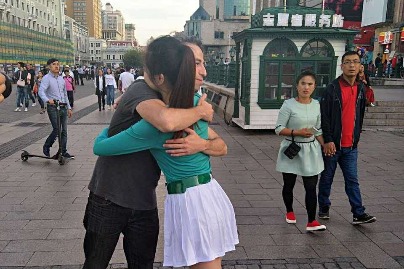
Vollansky, who had been living in China for seven years prior to the video’s creation, identifies as a we-media producer dedicated to fostering cultural communication between China and Israel. His September 2017 visit to Harbin was not merely for leisure but for a specific, deeply meaningful project: to produce a video that would shed light on the special significance Harbin holds for Jewish people globally. This mission underscores a deliberate effort to use modern digital platforms to bridge historical understanding and contemporary cultural exchange. The video, thus, transcended a simple act of affection, becoming a powerful symbol of historical memory and contemporary goodwill.
Harbin’s Enduring Legacy for the Jewish Diaspora: A Sanctuary in the East
Vollansky’s journey to Harbin was motivated by a profound historical awareness. He articulated, "As I know, 90 years ago, there were many Jews who lived in Harbin and built a life here. While in other places around the world Jews had suffered discrimination and violence, the Chinese people have always accepted us and treated us as equals. I went to shoot a video that conveys this information as well as to personally thank and show my appreciation for that." This statement encapsulates the core of Harbin’s unique position in Jewish history.
The late 19th and early 20th centuries witnessed significant waves of Jewish migration, often driven by persecution, economic hardship, and political instability in Eastern Europe and Russia. As pogroms intensified in the Russian Empire, many Jewish families sought refuge and new opportunities. Harbin, then a rapidly developing city due to the construction of the Chinese Eastern Railway (CER) by Imperial Russia, emerged as an unexpected sanctuary. The CER project, initiated in 1897, transformed Harbin from a small fishing village into a bustling international hub, attracting engineers, merchants, and laborers from various nationalities, including a substantial number of Jews.

By the 1920s, the Jewish population in Harbin is estimated to have peaked at around 20,000 to 25,000, making it one of the largest and most vibrant Jewish communities in the Far East. This community was not merely tolerated; it thrived. Jewish immigrants played a crucial role in the city’s economic, social, and cultural development. They established banks, department stores, factories, and various commercial enterprises, contributing significantly to Harbin’s prosperity. Beyond commerce, they built synagogues, schools (including the Harbin Jewish Middle School), hospitals (like the Harbin Jewish General Hospital), and cultural institutions, creating a self-sufficient and integrated community.
This period stands in stark contrast to the rampant antisemitism and systematic discrimination faced by Jews in many parts of Europe and Russia. In Harbin, and indeed across China, Jewish people found an environment free from official persecution. Chinese society, guided by principles of hospitality and non-discrimination, welcomed them, allowing them to practice their religion, maintain their cultural identity, and contribute fully to the fabric of the city. This historical fact is a cornerstone of the deep connection felt by many Jewish individuals, including Vollansky, towards Harbin.
Yoav Vollansky’s Personal Connection and Mission: Bridging Generations and Cultures
Vollansky’s initiative is not just about historical acknowledgment but also about generational education. He observed, "In my country, some young people know little about the history. Therefore, I also hope my video can help more of them know about the city, which had been the homes of our older generations." This highlights a critical aspect of his work: the preservation and transmission of historical memory to a new generation that might be disconnected from the experiences of their ancestors. By producing accessible and engaging video content, Vollansky aims to bridge this knowledge gap, ensuring that the legacy of Harbin’s Jewish community is not forgotten.

His embrace of Dongbeihua is another testament to his commitment to cultural immersion and genuine connection. Before his visit, he diligently learned the dialect with the help of friends from Northeast China. He confessed, "To be honest, I didn’t know much of it before I came to Harbin, but I was always curious about it. I love Chinese dialects in general because they carry an interesting flavor that doesn’t always exist in Putonghua. I always heard that Dongbeihua has lots of characteristics, and only when I started learning it I had a bit of a feel to it." Dongbeihua is renowned for its directness, humor, and expressive vocabulary, often perceived as a more vibrant and less formal variant of Mandarin. Vollansky’s effort to master it demonstrates a profound respect for local culture and an understanding that language is a powerful tool for forging deeper bonds. This linguistic effort undoubtedly contributed to the warmth with which his hugs were received, transforming strangers into temporary confidantes.
Vollansky’s connection to Harbin predates his viral video. He fondly recalled his first visit in 2015. "It was in the winter, so I had an opportunity to enjoy the famous Ice and Snow Festival and of course the pleasure of eating a popsicle in -20 C." This memory paints a picture of someone who has genuinely experienced and appreciated the unique charm of Harbin, beyond its historical significance. His willingness to brave the harsh winter climate, a hallmark of Harbin’s identity, further solidifies his authentic engagement with the city. This personal experience of Harbin’s cultural offerings, combined with his historical mission, makes his narrative particularly compelling.
The Decline and Preservation of a Legacy: Remembering the Past
While the Jewish community in Harbin flourished for several decades, its presence began to decline after World War II. The establishment of the State of Israel in 1948 offered a new homeland, prompting many Harbin Jews to emigrate. Geopolitical shifts, including the rise of communism in China and the changing dynamics of international relations, also contributed to the community’s gradual departure. By the 1950s, the vast majority had left, scattering across Israel, the United States, Australia, and other parts of the world.

Despite the physical departure of its Jewish inhabitants, Harbin has made significant efforts to preserve and commemorate this unique chapter of its history. The former Harbin Jewish New Synagogue, a grand architectural edifice built in 1907, has been meticulously restored and now serves as the Harbin Jewish History and Culture Exhibition Hall. This museum houses artifacts, photographs, and documents that tell the story of the Jewish community, their contributions, and their life in Harbin. Other historical sites, such as the General Jewish Hospital and various former residences, stand as tangible reminders of a vibrant past. These preservation efforts are crucial for maintaining the historical narrative and serving as a focal point for descendants of Harbin Jews who often visit to reconnect with their heritage. They also serve as educational resources for local Chinese residents and international visitors, fostering a broader understanding of Harbin’s multicultural past.
Broader Implications: Cultural Diplomacy, Historical Memory, and Digital Engagement
Yoav Vollansky’s viral video and his broader mission carry significant implications for cultural diplomacy and historical memory. In an increasingly interconnected world, individual initiatives like his play a vital role in shaping international perceptions and fostering mutual understanding. By highlighting a positive, yet often overlooked, aspect of Sino-Israeli relations, Vollansky contributes to a narrative of shared history and friendship. This grassroots approach to cultural exchange complements official diplomatic efforts, demonstrating the power of personal stories and digital media to bridge divides.
The video also underscores the enduring power of historical memory. In an era where historical narratives can be contentious, Harbin’s story stands as a beacon of tolerance and acceptance. It serves as a reminder that amidst periods of global turmoil and widespread prejudice, there were places where humanity prevailed, offering refuge and equality. This historical context is particularly relevant in contemporary discussions about multiculturalism and international relations. Harbin’s legacy as a haven for the Jewish diaspora offers a powerful lesson in cross-cultural harmony and mutual respect.

Furthermore, Vollansky’s use of we-media exemplifies the evolving landscape of cultural communication. His ability to produce engaging, personal content for a global audience demonstrates how individuals can become powerful agents of cultural exchange, bypassing traditional media channels. This approach makes historical narratives more accessible and relatable, especially to younger generations who consume information primarily through digital platforms. His invitation for anyone willing to teach him more Dongbeihua to join him for coffee in Beijing, as told to China Daily, further illustrates his commitment to ongoing engagement and cultural learning, transforming a viral moment into a sustained dialogue.
Harbin’s identity as a city has been profoundly shaped by its multicultural history. Its European-influenced architecture, its diverse culinary traditions, and its reputation as an international city are all testaments to the various communities that have called it home. The story of the Jewish community is an integral part of this rich tapestry, adding depth and complexity to Harbin’s self-perception and its image on the global stage. Efforts to celebrate and preserve this history, both by the city itself and by individuals like Yoav Vollansky, ensure that Harbin continues to be recognized not just for its ice sculptures, but also for its enduring spirit of openness and acceptance. This ongoing dialogue between past and present, facilitated by digital media and personal passion, promises to keep Harbin’s unique historical narrative alive for generations to come.


 Asep Darmawan
 Jia Lissa