Suro Senen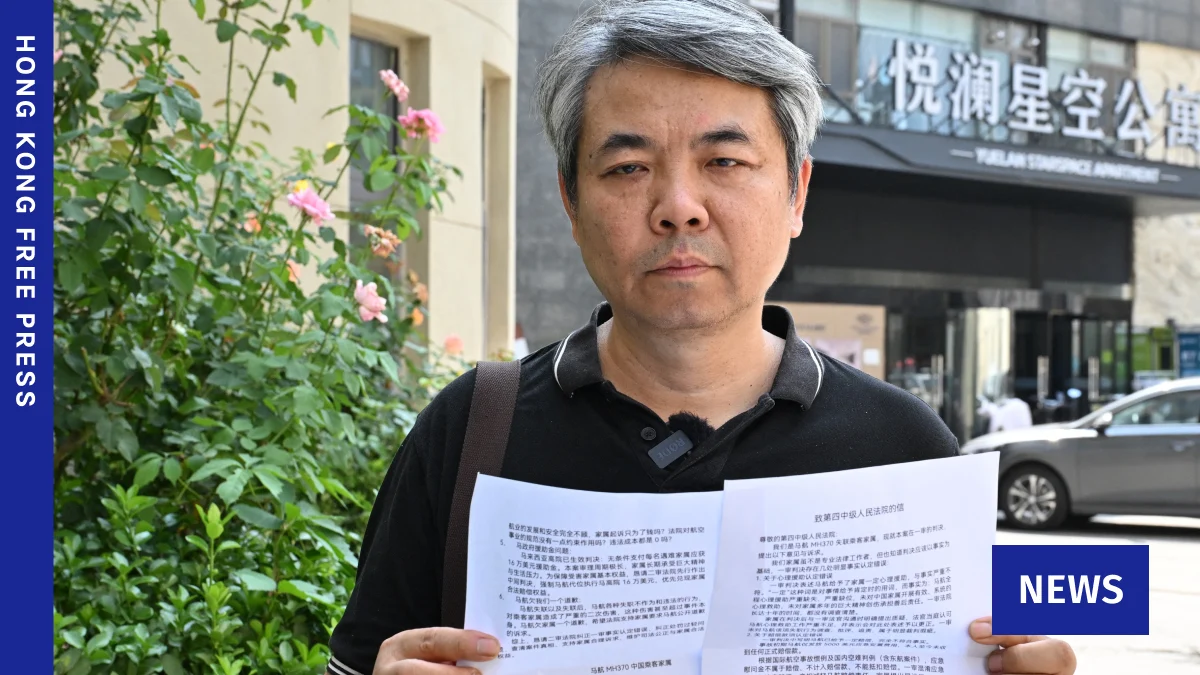
Relatives of Chinese passengers aboard Malaysia Airlines Flight MH370, which vanished without a trace 12 years ago in one of aviation’s most profound and enduring mysteries, converged on a Beijing court on Tuesday, July 28, 2026, to demand more than just financial compensation: they seek answers, accountability, and the establishment of facts surrounding the tragedy. Their appearance marked the commencement of an appeal against an earlier court ruling that awarded monetary damages but, according to the families, failed to address the fundamental questions that have haunted them for over a decade.
The appeal hearing unfolds against a backdrop of unwavering grief and frustration among the next-of-kin, many of whom have dedicated their lives to uncovering the truth behind the disappearance. The Boeing 777-200ER, carrying 239 individuals – 153 of whom were Chinese nationals, representing two-thirds of those on board – vanished from radar screens on March 8, 2014. The flight, MH370, was en route from Kuala Lumpur to Beijing when it inexplicably deviated from its planned course, initiating a sequence of events that would baffle aviation experts and leave a permanent scar on the global consciousness. Despite an unprecedented international search effort, the aircraft, its passengers, and the crucial black boxes containing flight data and cockpit voice recordings have never been recovered, leaving an agonizing void of certainty for those left behind.
Background to the Legal Battle
The current legal proceedings in Beijing represent a crucial juncture in the families’ protracted struggle for justice. In December 2025, a Beijing court issued a first-instance ruling, ordering Malaysia Airlines to pay eight families of Chinese passengers 2.9 million yuan (approximately $410,000 USD) each. While seemingly substantial, this compensation was deemed insufficient and, more critically, dismissive by many relatives who view their loss as far more profound than a mere monetary figure can represent. Two families, acting as plaintiffs in this appeal, have lodged their challenge, arguing that the initial judgment failed to adequately investigate the circumstances of the plane’s disappearance or hold the airline accountable for what they perceive as inaction and a lack of transparency.

Li Eryou, 69, whose son was a passenger on the ill-fated flight, expressed his profound disappointment outside the courthouse. "When I received the judgment and read the first-instance ruling, my first thought was that the court was insulting the families of the passengers, that it was mocking us," he told Agence France-Presse (AFP). His sentiments encapsulate the widespread feeling among the relatives that the court treated the case with a lack of gravity befitting an international aviation disaster. "This is an international case… but the first-instance judge treated it like nothing more than an ordinary local traffic accident, which is why the compensation amount ended up being so pitifully small."
The closed-door nature of the hearing further amplified the families’ sense of being marginalized, as the media was barred from attending. This lack of transparency, they argue, mirrors the broader challenges they have faced in obtaining credible information about the fate of their loved ones. "In 12 years, no one has ever apologised to us. I feel immense anger," Li Eryou stated, highlighting the emotional toll of a decade-long wait for answers.
The Enduring Mystery of MH370: A Chronology of Disappearance and Search
The saga of MH370 began on March 8, 2014, when the flight took off from Kuala Lumpur International Airport at 12:41 AM local time, bound for Beijing. At 1:19 AM, the aircraft’s transponder, which communicates its position to air traffic control, ceased functioning. Shortly after, at 1:21 AM, the aircraft’s Aircraft Communications Addressing and Reporting System (ACARS), which transmits technical data, also went offline. The plane vanished from civilian radar screens as it crossed from Malaysian to Vietnamese airspace. Military radar, however, tracked the aircraft making an abrupt westward turn, flying back across the Malaysian Peninsula, and then turning northwest over the Strait of Malacca. The final radar contact occurred at 2:22 AM over the Andaman Sea.
Crucially, "handshake" signals exchanged between the aircraft and an Inmarsat satellite over the Indian Ocean continued for several hours after its disappearance from radar. Analysis of these faint pings, which provided only distance information, led investigators to conclude that the plane had flown south for many hours, eventually running out of fuel and crashing into the remote southern Indian Ocean, along an arc later dubbed the "seventh arc."

The initial search efforts, involving multiple nations, focused on the South China Sea, where the plane was last seen on civilian radar. However, as the Inmarsat data became available, the focus dramatically shifted to a vast, hostile, and largely unexplored expanse of the southern Indian Ocean, thousands of kilometers off the coast of Western Australia.
- March 2014 – May 2015: The first phase of the deep-sea search, led by Australia, covered approximately 120,000 square kilometers using specialized sonar equipment and Autonomous Underwater Vehicles (AUVs). This unprecedented operation, costing hundreds of millions of dollars, yielded no trace of the main wreckage.
- July 2015: A flaperon (a wing part) was discovered on Reunion Island, thousands of kilometers west of the primary search area. Subsequent analysis confirmed it belonged to MH370, providing the first definitive physical evidence of the plane’s fate. Other pieces of debris, later confirmed or highly likely to be from MH370, were found along the coasts of Mozambique, Tanzania, and Mauritius.
- January 2017: After nearly three years and covering a vast area, the official, government-led search was suspended, citing the low probability of finding the aircraft in the remaining unexplored areas. This decision was met with profound disappointment and anger by the families.
- January – June 2018: Private firm Ocean Infinity launched a new search operation under a "no find, no fee" contract with the Malaysian government. Utilizing advanced AUVs, they scoured an additional 112,000 square kilometers but also returned empty-handed.
Investigations and Competing Theories
The absence of the main wreckage and the black boxes has left investigators with only circumstantial evidence, leading to numerous theories about what transpired on board MH370. These theories, often contradictory, highlight the immense difficulty in piecing together the narrative of an event without direct evidence.
One prominent theory suggests deliberate human intervention, possibly pilot suicide or hijacking. Proponents point to the deliberate turning off of communications systems and the sharp change in course, which required manual input. Another theory posits a catastrophic technical malfunction, such as a fire in the electronic components bay, leading to smoke that incapacitated the crew and passengers. In this scenario, the plane would have continued flying on autopilot until it ran out of fuel, a phenomenon sometimes referred to as a "ghost flight." Other, less substantiated theories have included missile fire or a structural failure, though no evidence has emerged to support these.
The official Malaysian investigation report, released in July 2018, concluded that the aircraft’s diversion was due to manual input and that the flight path was manually altered. However, it stated that the team was "unable to determine the real reason for the aircraft’s diversion" or to identify the party responsible, leaving the ultimate cause of the disappearance unresolved. This inability to establish definitive facts remains the core grievance of the grieving families.

Families’ Unwavering Quest for Truth
For the families, the compensation ruling, while providing some financial relief, falls woefully short of their primary objective: understanding. Jiang Hui, a media coordinator for the Chinese passengers’ families, whose mother was on the plane, articulated this sentiment clearly. "The main reason why some families are appealing is that the first-instance court did not clearly establish the facts of the case, nor did it criticise or correct Malaysia Airlines’ inaction since 2014," he told AFP.
Jiang emphasized that the court had "merely ruled on the amount of compensation, which is not everything we, the families, are looking for." He underscored the profound psychological and emotional burden of not knowing, a burden that financial recompense cannot alleviate. "What matters to us is the establishment of the facts. That’s our biggest demand." This demand for truth, for a clear narrative of the events, reflects a universal human need for closure in the face of tragedy, particularly one so shrouded in ambiguity. The families are not just seeking justice in a legal sense, but an acknowledgment of their suffering and a definitive account of their loved ones’ final moments.
The Ongoing Search and Future Prospects
The hope for finding MH370 was reignited recently with Malaysia’s announcement in June 2026 that the search for the flight would be extended through June 2027. This renewed effort is once again being led by the private firm Ocean Infinity. The most recent phase of their search operation commenced in March 2025 and involved two stages, yet the firm returned empty-handed, much like its previous attempt in 2018.

Jiang Hui expressed gratitude to the Malaysian authorities for the extension, acknowledging the financial and logistical commitment involved. However, he also voiced a plea for greater involvement from the families themselves, requesting that they be allowed to organize their own search missions if feasible. "The plane isn’t going to rise to the surface all on its own," he remarked, highlighting the proactive stance many families feel compelled to take. "Only by searching would we be able to find it." This desire to participate directly in the search underscores their deep personal investment and their belief that every possible avenue must be explored.
The search for MH370 remains one of the most technologically challenging and expensive undertakings in aviation history. The deep-sea environment, characterized by extreme pressures, rugged topography, and vast distances, poses immense obstacles. The use of advanced autonomous underwater vehicles (AUVs) equipped with high-resolution sonar has allowed for mapping of the ocean floor with unprecedented detail, yet even with these tools, locating small pieces of debris or the aircraft itself in such a massive area is akin to finding a needle in a colossal haystack.
International Implications and Legal Complexities
The MH370 tragedy transcended national borders from the moment of its disappearance. Nationals from 14 countries were on board, including 50 passengers and crew members from Malaysia. This international dimension has complicated legal and investigative efforts, requiring extensive cooperation and navigation of different legal systems. While the current appeal is being heard in a Beijing court, reflecting the significant number of Chinese victims, Malaysia, as the flag carrier’s home nation, also bears significant responsibility. Notably, there are currently no pending cases against Malaysia Airlines in Malaysian courts, suggesting different legal approaches and outcomes in various jurisdictions.
The case also raises fundamental questions about international aviation law, particularly concerning liability, compensation, and the duties of airlines and states in the event of an unexplained disappearance. The lack of wreckage and definitive answers complicates the application of standard legal frameworks, often designed for accidents where the cause is established. The families’ insistence on "establishment of facts" challenges the purely compensatory approach, pushing for a broader interpretation of justice that includes transparency and accountability.

Broader Impact and Future of Aviation Safety
The disappearance of MH370 has had a profound impact on the global aviation industry, prompting intense discussions about enhancing flight tracking and improving the resilience of aircraft data recorders. Calls for real-time tracking of commercial flights have grown louder, with many advocating for technologies that would continuously transmit an aircraft’s position, even in remote areas. Furthermore, the incident spurred innovations in black box technology, with proposals for deployable recorders that would float to the surface in the event of a crash, making them easier to locate.
However, despite these discussions and some incremental improvements, the fundamental challenge of locating an aircraft that vanishes without a trace in vast, remote regions persists. The MH370 mystery serves as a stark reminder of the limits of current technology and the unpredictable nature of complex systems.
The psychological toll on the families extends beyond the immediate grief. The absence of a grave, a definitive resting place, or even a clear explanation for their loved ones’ fate perpetuates a state of ambiguous loss, making the grieving process uniquely challenging. Their continued legal battles and advocacy efforts are not just for themselves but for all future victims of aviation disasters, pushing for higher standards of accountability and a commitment to truth from airlines and governments worldwide.
As the Beijing court prepares to deliberate on the appeal, the world watches, reminded of the enduring human cost of the MH370 mystery. For the families, this is more than just a legal proceeding; it is a desperate, decade-long plea for the truth, a quest for closure that remains as urgent and heartbreaking today as it was 12 years ago when Flight MH370 disappeared into the vast unknown. Their unwavering determination ensures that the memory of those lost will not fade, and the search for answers will continue, both in the courtroom and across the silent depths of the ocean.


 Muslim
 Laily UPN