
 Pevita Pearce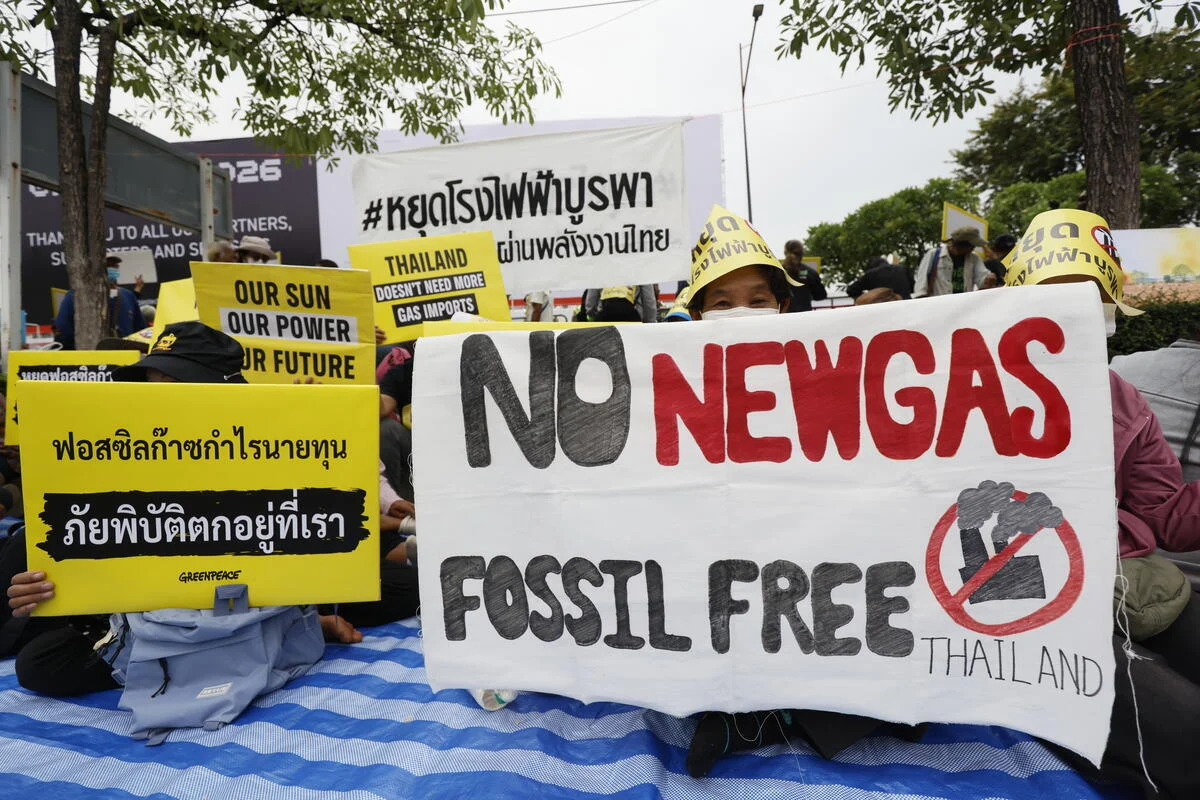
BANGKOK, THAILAND (15 September 2026) — Greenpeace East Asia has issued a strong condemnation of Japan’s stated commitment to fossil gas and fossil-fueled vehicles as pillars of regional economic growth and energy security. The environmental organization’s rebuke follows speeches delivered today by Japanese government officials, including Tetsuya Azuma, Director at Japan’s Ministry of Economy, Trade and Industry (METI), at the prestigious Japan Energy Summit held concurrently with Gastech 2026 in Bangkok. Greenpeace argues that these initiatives, such as Prime Minister Sanae Takaichi’s “POWERR Asia” (Partnership on Wide Energy and Resources Resilience Asia) strategy, and the continued subsidization of internal combustion engine (ICE) vehicles, represent a perilous climate trap. This strategy, they contend, actively jeopardizes global decarbonization targets and contravenes Japan’s international commitments under the Paris Agreement.
The Gastech Summit: A Platform for Contention
The annual Gastech conference, a premier global event for the oil and gas industry, serves as a crucial platform for energy ministers, industry leaders, and international organizations to discuss the future of energy. This year’s summit in Bangkok has been dominated by discussions on energy security, the transition to cleaner fuels, and the role of traditional energy sources in a rapidly evolving global landscape. It was against this backdrop that Japanese officials articulated their nation’s energy strategy, highlighting perceived vulnerabilities and proposing solutions that have drawn sharp criticism from environmental groups.
Japan’s Stated Vulnerabilities and Proposed Solutions
During the summit, Japanese government representatives candidly acknowledged significant energy vulnerabilities. They noted Japan’s extreme reliance on crude oil shipments traversing the Strait of Hormuz, with approximately 93% of its supply passing through this critical chokepoint. Furthermore, officials highlighted severe market disruptions affecting downstream products like naphtha and the necessity of subsidizing transport costs to circumvent supply bottlenecks originating from the Middle East.
Despite these admitted fragilities, and in a move that has surprised and dismayed environmental advocates, the Japanese government reaffirmed its commitment to the “POWERR Asia” initiative. This program aims to expand overseas oil stockpiles and bolster fossil gas infrastructure. Concurrently, while acknowledging the global surge in electric vehicle (EV) adoption across China, Southeast Asia, and Europe, Japanese officials defended their domestic policy of promoting combustion engine vehicles. They also advocated for biofuels as a climate solution, a stance Greenpeace decries as a false premise.
Greenpeace’s Accusations: A Climate Trap and Economic Recklessness
Greenpeace East Asia argues that Japan’s strategy is fundamentally flawed and politically motivated, rather than being guided by environmental science or sound economic principles. The organization asserts that the combination of expanding overseas fossil fuel infrastructure and a slow approach to EV electrification is driven by short-term industrial politics and the vested interests of corporations. By choosing to export its reliance on fossil fuels and delay the decarbonization of its automotive sector, Japan, according to Greenpeace, risks exacerbating global emissions, entrenching developing economies in the perils of stranded assets, and hindering the worldwide transition away from fossil fuels.
“METI’s vision locks Japan and the entire Asia region into expensive, imported gas at the exact wrong time,” stated Kazue Suzuki, Climate & Energy Campaigner at Greenpeace Japan. “With supply routes through the Middle East becoming increasingly unstable, the plan raises energy bills and multiplies risk for households and businesses. Gas is not a bridge to growth but a financial trap. Nuclear power is costly and unsafe, and technologies like ammonia co-firing and CCUS are distractions. Japan needs to stop financing fossil gas overseas and put its money into solar and wind that actually deliver energy independence. Ultimately, the country needs a swift, decisive phaseout of all fossil fuels, starting with coal.”
A Chronology of Japanese Fossil Fuel Finance
Greenpeace’s criticism is underpinned by substantial data regarding Japan’s financial commitments to the fossil fuel industry. From 2013 to 2024, Japan has been one of the world’s largest public financiers of fossil fuels, channeling an estimated $93 billion into overseas oil and gas projects. This figure dwarfs the $24.5 billion allocated to clean energy initiatives during the same period. Alarmingly, gas-only projects accounted for a significant 60% of the total fossil fuel financing.
Public financial institutions, such as the Japan Bank for International Cooperation (JBIC), are identified as key players in this financial landscape. Reports indicate that emissions attributable to JBIC’s financing activities exceed 400 million metric tons of carbon dioxide equivalent annually, a volume larger than the national emissions of countries like the United Kingdom or France. This highlights the substantial climate impact of Japan’s public finance policies.
Domestic Vulnerabilities Exposed
The article also delves into Japan’s domestic energy situation, emphasizing the severe economic vulnerabilities stemming from its extreme dependence on imported fossil fuels. As the world’s fifth-largest energy market and the second-largest importer of Liquefied Natural Gas (LNG), Japan imported nearly 65 million tonnes of LNG in 2025 alone. The precariousness of this reliance is further amplified by the fact that approximately 90-95% of Japan’s crude oil originates from the Middle East. A staggering 70-93% of these shipments traverse the Strait of Hormuz, leaving the Japanese economy exceptionally exposed to supply shocks, currency depreciation, and imported inflation.
Southeast Asia’s Perspective: A Call for Renewables
The implications of Japan’s energy policies extend beyond its borders, particularly impacting Southeast Asia. Manun Wongmasoh, Climate and Energy Campaigner at Greenpeace Thailand, voiced concerns specific to the region: “Southeast Asia does not need more fossil gas or Japanese financing for new gas infrastructure. Thailand and Japan should end their LNG cooperation MOU and avoid locking the region into decades of fossil fuel dependence. Our region has abundant renewable energy potential. What we need is investment in renewables, not new pipelines and LNG terminals that lock countries into volatile fossil fuel prices and risk becoming stranded assets. Doubling down on gas and nuclear, including Small Modular Reactors (SMRs) in the name of ‘energy security’ is reckless. It makes energy more expensive and leaves countries exposed to global market shocks, and leaves people across Southeast Asia to pay the price.”
This statement underscores a growing sentiment in Southeast Asia, where many nations are seeking to harness their vast renewable energy resources. The fear is that Japan’s continued promotion of fossil gas infrastructure could undermine these efforts and trap developing economies in long-term, high-cost energy contracts.
The Illusion of Energy Security
Despite the Japanese government’s attempts to frame initiatives like regional oil stockpiling, downstream subsidies, and unproven solutions such as biofuels as pathways to enhanced energy resilience, Greenpeace remains unconvinced. The organization argues that a strategy predicated on doubling down on imported fossil fuels, pursuing nuclear restarts, and perpetuating the use of polluting combustion vehicles is not only unsafe but actively damaging on a global scale.
The reliance on nuclear power, while presented by some as a low-carbon alternative, is fraught with its own set of challenges, including significant costs, safety concerns, and long-term waste management issues. Furthermore, emerging technologies like ammonia co-firing and Carbon Capture, Utilization, and Storage (CCUS) are often viewed by environmental groups as potential distractions from the urgent need for a fundamental shift towards renewable energy sources.
A Global Call to Action
In light of these concerns, Greenpeace East Asia has issued a clear call to action. The organization urges the Japanese government and its financial institutions to immediately cease all public financing for overseas fossil gas and oil infrastructure. They also demand a phased withdrawal of support for internal combustion engine vehicles and a firm commitment to a just energy transition globally, one that is unequivocally led by renewable energy sources and the widespread adoption of electric vehicles.
The organization’s stance reflects a broader global movement advocating for a rapid and equitable energy transition. The scientific consensus on the urgent need to limit global warming to 1.5 degrees Celsius, as outlined in the Paris Agreement, necessitates a significant and swift reduction in fossil fuel reliance. Greenpeace argues that Japan’s current trajectory is fundamentally at odds with these global imperatives, posing a significant risk not only to its own future energy security but also to the global effort to avert the worst impacts of climate change. The coming years will likely see continued pressure on Japan to align its energy policies with international climate goals and the evolving demands of a sustainable global economy.
Supporting Data and References
[1] Solutions For Our Climate, “Billions Off Course: Japan’s Oil and Gas Financing Fueling Climate Breakdown” (3 August 2026).
[2] Friends of the Earth Japan, “New Report on Climate Impacts of Japan’s Public Finance” (5 November 2025).
[3] Energy Connects, “The market outlook for gas and LNG in Asia” (8 June 2026).
[4] International Energy Agency (IEA), “Strait of Hormuz” (10 July 2026).
Media Contact
Yujie Xue, International Communications Officer, Greenpeace East Asia, +852 5127 3416, [email protected]


 Suro Senen
 Muslim