Muslim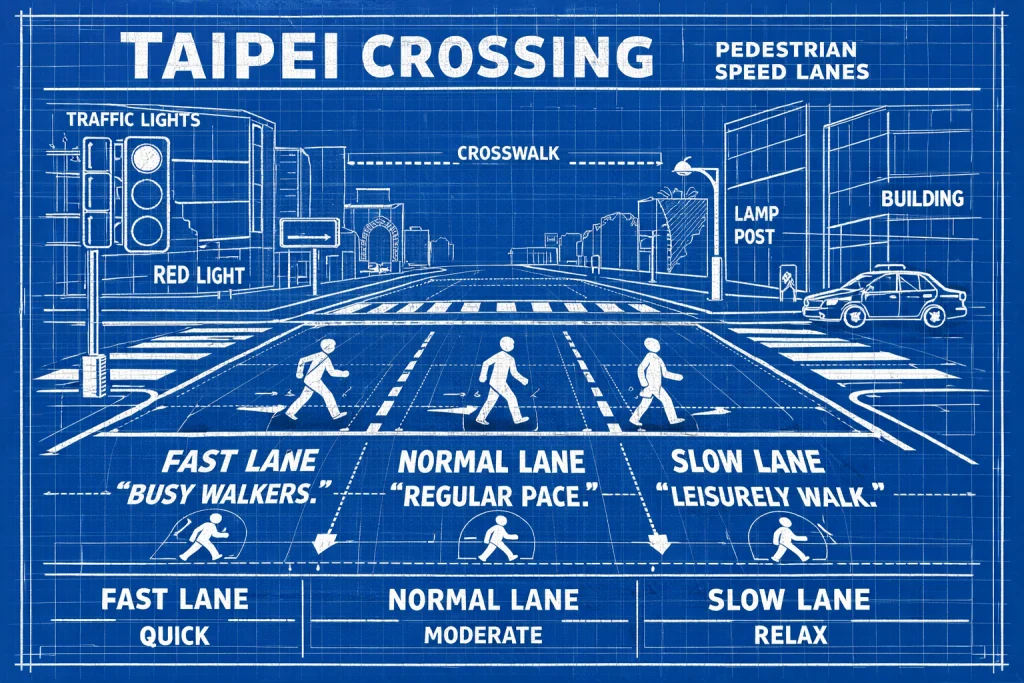
The Taipei City Government has officially inaugurated a sweeping pilot program designed to overhaul the city’s pedestrian infrastructure, introducing a series of unconventional traffic regulations aimed at "optimizing pedestrian flow in the era of digital distraction." Announced early this week, the initiative represents a radical shift in urban planning, as officials attempt to reconcile the increasing prevalence of smartphone usage among commuters with the city’s broader goals of maintaining traffic efficiency and enhancing Taiwan’s international competitiveness. The program, which includes the implementation of dedicated lanes for distracted walkers and significantly altered signal timings, has sparked intense debate among residents, urban planners, and the international community.
According to a representative from the Taipei Department of Transportation (DOT), the initiative was born out of a realization that traditional traffic management models are no longer sufficient for a population that is increasingly "offline" in spirit while remaining physically present on the streets. The government’s move to categorize and physically segregate different types of pedestrians marks one of the most aggressive attempts globally to manage the behavioral shifts caused by ubiquitous mobile technology.
The Evolution of the Phone Zombie Lane
At the heart of the pilot program is the introduction of dedicated lanes for what the city government now officially terms "phone zombies." For years, the Taiwanese public has used the slang term dītóuzú (head-down tribe) to describe individuals preoccupied with their devices. However, the Taipei DOT argues that this terminology has become insufficient. Following internal sociological reviews, the department has transitioned to the more descriptive jiāngshī dītóuzú (phone zombies) to characterize pedestrians who are entirely detached from their immediate physical surroundings.
To accommodate this demographic, the city has begun painting specialized icons at high-traffic intersections in the Xinyi and Da’an districts. These markings—depicting a figure with a downward-facing gaze—guide distracted walkers into a clearly defined channel. The goal, according to officials, is to ensure that those reading messages, scrolling through social media, or reviewing documents do so in a "predictable direction," thereby reducing the risk of erratic movements that often lead to sidewalk congestion or accidents.
"We engaged in a series of heated public townhalls to determine the naming of these corridors," the DOT representative stated. "While we initially considered the term ‘digital safety corridor,’ the feedback from residents was overwhelmingly in favor of straightforward, descriptive terminology. If the reality of our streets involves people prioritizing their LINE messages over their surroundings, our infrastructure must reflect that reality to ensure the safety of all road users."

Segmented Mobility: Speed Demons and Strategic Walking
While the "phone zombie" lanes cater to the slowest tier of commuters, the pilot program also addresses the opposite end of the spectrum. In the Xinyi business district, the city is testing "speed lanes" designed for high-velocity walkers—primarily office workers and professionals seeking to reach their destinations with minimal delay. These narrow, arrow-shaped paths are accompanied by signage encouraging "strategic walking behavior," a concept borrowed from logistics management that emphasizes maintaining a constant pace and avoiding abrupt stops.
The necessity for these lanes is backed by alarming internal transport department data. In the Xinyi district alone, 37 "pedestrian speed collisions" were recorded in the previous calendar year. A more recent review of CCTV footage from the first quarter of this year identified 42 incidents where fast-moving commuters collided with slower pedestrians who had stopped suddenly to check notifications or compare prices on mobile applications.
Mei Nai-xin, a financial analyst who commutes through Xinyi daily, expressed support for the segmented lanes. "Previously, the sidewalk was a source of constant frustration. I would frequently find myself trapped behind someone comparing bubble tea prices on three different apps," Mei said. "The new speed lanes allow me to reach my office building before the elevator queues become unmanageable. It is perhaps the most significant productivity reform I have seen in years."
The 300-Second Signal Experiment and its Discontents
Perhaps the most controversial aspect of the pilot program is the dramatic extension of green-light intervals in specific neighborhoods. At several intersections near traditional markets and residential areas with high elderly populations, pedestrian signals now remain green for up to 300 seconds. Officials state that this move is intended to support seniors and those who "prefer to cross at a contemplative pace."
However, this policy has met with significant resistance from residents accustomed to Taipei’s existing traffic rhythms. The city is already known for its ubiquitous 90-second red lights, which many find taxing in the local climate. According to Taipei City Police data, 23 pedestrians were cited last year for acts of frustration—including damaging or throwing their own mobile devices—after being forced to wait through multiple long-duration signal cycles.
The physical toll of these extended wait times is a primary concern for critics. "Standing in 35-degree heat with 90% humidity for 300 seconds is not ‘contemplative’; it is a test of endurance," said Oliver Crosswell, a British national and six-year resident of Taipei. "At some point, the wait becomes so long that you stop looking at the light and start questioning your life choices. It risks driving people to step into traffic out of sheer desperation to escape the heat."

District councilors have acknowledged these concerns but maintain that the policy requires a longer evaluation period. One official noted that the effectiveness of the 300-second light would be reviewed only after residents have had "sufficient time to finish scrolling" through their digital feeds while crossing.
Infrastructure for Scooters and Tourists
The pilot program extends beyond pedestrians to include Taipei’s massive scooter-riding population. "Scooter courtesy zones" have been introduced at select pilot intersections. These areas, referred to as "reflection boxes," are set back from crosswalks and require riders to come to a complete stop. The stated purpose of these zones is twofold: to improve visibility for pedestrians and to offer riders a brief moment of reflection—or a safe opportunity to check delivery notifications—before proceeding through the intersection.
In tourist-heavy areas like Ximending, the city has designated "slow zones." These areas feature even longer crossing times to accommodate visitors who frequently pause for photographs, consult digital maps, or simply navigate the dense urban environment. Planners hope that by designating these areas as low-velocity zones, they can reduce the friction between local commuters and the thousands of tourists who visit the district daily.
Chronology of the Pilot and Future Citywide Drill
The rollout of these measures follows a specific timeline established by the Taipei City Government:
- Phase 1 (January – February): Internal review of CCTV data and identification of "collision hotspots" in Xinyi and Da’an.
- Phase 2 (March): Public townhall meetings and the finalization of "phone zombie" terminology.
- Phase 3 (Current): Installation of physical lane markings and adjustment of signal timings at pilot intersections.
- Phase 4 (Late 2024): A citywide "crossing drill" intended to synchronize pedestrian rhythms across all major districts.
The upcoming citywide drill will involve volunteer "Crosswalk Captains" who will use synchronized countdown cues to guide participants across intersections. The goal is to foster a "collective rhythm" among the citizenry. However, early rehearsals for the drill reportedly faced challenges when several captains stopped mid-intersection to respond to urgent messages on their phones, highlighting the very problem the program seeks to address.
Analysis of Implications and Global Context
Urban policy observers are watching Taipei’s experiment with a mix of curiosity and skepticism. Behavioral consultants advising the project suggest that Taipei is the first major city to formally acknowledge that modern pedestrians operate on "two timelines"—the physical reality of the street and the digital feed of their mobile devices.

"Cities worldwide are struggling with the ‘distracted walking’ phenomenon, often resorting to fines or bans," says a consultant involved in the pilot. "Taipei’s approach is different because it attempts to build the distraction into the infrastructure itself. It is a pragmatic, if unusual, acknowledgement of human behavior in the 21st century."
Critics, however, argue that by creating dedicated lanes for "phone zombies," the city may be inadvertently encouraging dangerous behavior rather than correcting it. There are concerns that extended green lights will lead to pedestrians initiating full-length phone calls or watching videos midway through a crossing, potentially leading to even greater levels of distraction.
The broader impact on Taipei’s traffic ecosystem remains to be seen. While the "speed lanes" may improve efficiency for some, the 300-second signals have the potential to cause significant vehicular backups, affecting bus schedules and delivery timelines. The city government has stated that all measures remain strictly experimental and will undergo a comprehensive review following a public consultation period.
As the pilot continues, the eyes of the international urban planning community remain fixed on Taipei. Whether these measures become a permanent fixture of the city’s landscape or remain a localized experiment, they have undoubtedly sparked a necessary conversation about the intersection of technology, safety, and the pace of modern urban life.
We would like to remind you that today is April Fools’. 愚人節快樂!

 Siti Muinah