 Lina Irawan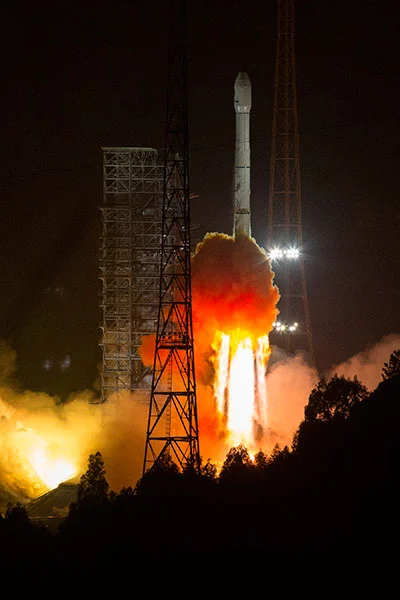
A Chinese-made communications satellite became the first "export" of such a spacecraft to an Arab country when it was launched by China on Monday for Algeria, signifying a significant advancement in China’s space industry and a deepening of its strategic partnership with North African nations. The successful deployment of Alcomsat-1 underscores China’s growing capabilities in the global satellite market and its commitment to fostering international collaboration in space technology.
Historic Launch and Bilateral Relations
The historic launch took place at the Xichang Satellite Launch Center in the southwestern province of Sichuan at 12:40 am local time. A powerful Long March 3B carrier rocket, a workhorse of China’s launch vehicle fleet, ascended into the night sky, carrying the Alcomsat-1 satellite. Approximately 26 minutes after liftoff, the satellite was successfully placed into its intended geostationary transfer orbit, a critical step towards its operational deployment. This achievement was confirmed by a press release from China Great Wall Industry Corp, the primary contractor for the ambitious project.
The significance of this mission was immediately recognized at the highest levels of both nations. Presidents Xi Jinping of China and Abdelaziz Bouteflika of Algeria exchanged congratulatory messages on Monday morning, celebrating the successful execution of the launch. President Xi emphasized that the Alcomsat-1 project represents a crucial manifestation of the comprehensive strategic partnership between China and Algeria. He further highlighted its role as an exemplary model of space cooperation between China and Arab countries, predicting its substantial contribution to Algeria’s economic and social development.
In his message, President Xi articulated Beijing’s readiness to collaborate with Algeria to bolster exchanges and cooperation across a spectrum of fields. This deepened bilateral partnership, he stated, is aimed at bringing tangible benefits to both nations and their respective populations. President Bouteflika, in turn, hailed Alcomsat-1 as a remarkable milestone in space cooperation between the two countries, a testament to the profound traditional friendship that binds them. He expressed Algeria’s keen interest in further strengthening cooperative ties with China.
Genesis of a Space Partnership: The Alcomsat-1 Project
The journey to this successful launch began with the signing of the contract in December 2013. The agreement was formally established between the Algerian Space Agency (ASAL) and China Great Wall Industry Corp (CGWIC), the nation’s preeminent space contractor operating within the international market. This marked a significant commitment from Algeria to leverage Chinese expertise and technology for its burgeoning space program.
Alcomsat-1 itself was meticulously designed and manufactured by the China Academy of Space Technology (CAST), a subsidiary of the China Aerospace Science and Technology Corp (CASC). The satellite is built upon the robust DFH-4 satellite platform, a domestically developed and proven design that has been a cornerstone of China’s satellite development for several years. This platform is known for its reliability and adaptability, making it suitable for a wide range of mission requirements.
Technical Specifications and Capabilities of Alcomsat-1
The Alcomsat-1 satellite boasts an impressive liftoff weight of 5.2 metric tons, indicating its substantial payload capacity and advanced technological integration. With a designed operational lifespan of 15 years, it is poised to serve Algeria for an extended period, providing essential communication and broadcasting services.
According to Great Wall Industry, the satellite is engineered to support a diverse array of public services. These include crucial applications such as television broadcasting, enabling wider access to media and information; emergency communications, vital for disaster response and national security; remote education, bridging geographical divides and expanding educational opportunities; and satellite-based signal augmentation, enhancing the accuracy and reliability of navigation systems.
Fu Zhiheng, a vice-president at China Great Wall Industry Corp, expressed confidence in the capabilities of Alcomsat-1, asserting that its technological sophistication and performance are on par with leading Western communications satellites. This assertion underscores the significant strides China has made in developing competitive and high-quality space technology. While not elaborating further, Fu also hinted at the existence of other ongoing contracts between CGWIC and various Arab nations, suggesting a broader trend of China’s increasing engagement in the Middle Eastern and North African space sectors.
Strategic Implications and Future Prospects
The successful launch of Alcomsat-1 carries profound strategic implications for both China and Algeria, as well as for the wider landscape of international space cooperation. For China, it represents a crucial step in its ambition to become a global leader in the commercial space sector. The export of a sophisticated communications satellite signifies a tangible demonstration of its technological prowess and its ability to compete with established players in the international market. This success is likely to pave the way for further "Made in China" space assets being deployed by other nations, particularly those seeking cost-effective and reliable solutions.
For Algeria, the acquisition of its first communications satellite is a transformative event. It marks a significant leap in its national infrastructure development, enhancing its capacity for communication, broadcasting, education, and disaster management. This self-reliance in space technology can bolster national sovereignty, improve the delivery of public services, and stimulate economic growth through the development of related industries and skilled workforce. The satellite’s capabilities in remote education, for instance, could be particularly impactful in connecting underserved regions and improving educational outcomes across the vast country.
The collaboration also deepens the already robust China-Algeria comprehensive strategic partnership. Beyond the technological exchange, it fosters mutual trust and understanding, laying a foundation for expanded cooperation in other areas, such as infrastructure development, trade, and cultural exchange. As President Xi noted, this project serves as a powerful example of how space cooperation can be a catalyst for broader bilateral engagement and mutual benefit.
The broader impact on China-Arab space relations is also noteworthy. The success of Alcomsat-1 is likely to encourage other Arab nations to explore similar partnerships with China. As a continent with growing aspirations in space technology and a significant demand for advanced satellite services, the Arab world presents a key market for China’s space exports. This trend could reshape the global satellite market, introducing a new dynamic of competition and collaboration.
A Chronology of the Alcomsat-1 Project:
- December 2013: Contract for the Alcomsat-1 satellite is signed between the Algerian Space Agency (ASAL) and China Great Wall Industry Corp (CGWIC).
- Design and Manufacturing Phase: The China Academy of Space Technology (CAST), part of CASC, designs and manufactures the Alcomsat-1 satellite based on the DFH-4 platform.
- Pre-Launch Preparations: The satellite undergoes rigorous testing and integration at the Xichang Satellite Launch Center in preparation for its launch.
- Monday, December 11, 2017 (Local Time):
- 12:40 am: Long March 3B carrier rocket carrying Alcomsat-1 successfully lifts off from the Xichang Satellite Launch Center.
- Approximately 12:40 am + 26 minutes: Alcomsat-1 is successfully deployed into geostationary transfer orbit.
- Monday Morning: Presidents Xi Jinping and Abdelaziz Bouteflika exchange congratulatory messages on the successful mission.
Supporting Data and Context:
The global satellite market is a rapidly expanding sector, driven by increasing demand for telecommunications, Earth observation, navigation, and scientific research. According to industry reports, the market for commercial satellites is projected to grow significantly in the coming years. China’s entry into this market as a provider of complete satellite systems, beyond just launch services, is a strategic move to capture a larger share of this global industry.
The DFH-4 satellite platform, upon which Alcomsat-1 is based, has a proven track record. It is designed for a variety of applications, including broadcasting, communication, and remote sensing. Its modular design allows for customization to meet specific client needs, making it an attractive option for countries seeking tailored satellite solutions. The 15-year lifespan of Alcomsat-1 is standard for modern communications satellites, ensuring a long operational period and a strong return on investment for Algeria.
The launch of Alcomsat-1 also fits into a broader narrative of China’s expanding role in global infrastructure development, often referred to as the Belt and Road Initiative. While not directly part of the BRI, the cooperative nature of this project aligns with the initiative’s broader goals of fostering connectivity and economic development through international partnerships.
Future Outlook and Continued Cooperation
The successful launch of Alcomsat-1 is more than just a single event; it represents a pivotal moment in the evolving landscape of international space cooperation. It demonstrates China’s capacity to deliver advanced space technology and its commitment to sharing this expertise with developing nations. For Algeria, it marks the beginning of a new era in its technological advancement and national development.
The statement by Fu Zhiheng about other contracts with Arab countries suggests that Alcomsat-1 may be the first of many such collaborations. As China continues to invest heavily in its space program and refine its commercial offerings, its influence in the global satellite market is expected to grow. This could lead to increased competition but also to new opportunities for collaboration and innovation, ultimately benefiting a wider range of countries seeking to harness the power of space technology for their own progress. The enduring friendship between China and Algeria, now further cemented by this technological feat, serves as a promising blueprint for future international endeavors in the vast frontier of space.