Suro Senen
Southeast Asia’s automotive market is experiencing a profound transformation, a paradigm shift driven by the rapid ascent of electric vehicles (EVs). For decades, the region has been the undisputed domain of Japanese carmakers, their brands deeply ingrained in the consumer consciousness and their manufacturing prowess a benchmark. However, this long-standing order is now being challenged by the swift embrace of electrification, posing a critical question for established giants like Toyota and Honda: can they adapt swiftly enough to retain their market relevance?
This seismic shift was the focal point of an online seminar hosted by Greenpeace Japan on June 24. Titled "Indonesia’s EV Market: A New Frontier and Its Implications for Japanese Automakers," the event convened prominent figures in the clean transportation sector to dissect the burgeoning EV landscape in Indonesia and its ripple effects across the wider ASEAN region. Leading the discussion were Aditya Mahalana, a senior researcher at the International Council on Clean Transportation (ICCT), and Achmad Rofiqi, vice chairman of Public Relations & Education at the Indonesian EV Industry Association (PERIKLINDO). Their insights offered a granular look at the forces propelling EV adoption in Indonesia and the strategic challenges confronting traditional automotive players.
The Unforeseen Acceleration of EV Adoption in Indonesia
The narrative of EV adoption in Southeast Asia defies conventional patterns observed in wealthier economies. Typically, the adoption of clean technologies begins in affluent nations before trickling down to developing economies. However, in this instance, middle-income economies such as Indonesia are leading the charge, outpacing more developed nations in their embrace of EVs, as highlighted by Mahalana. This accelerated adoption can be attributed, in part, to the absence of entrenched legacy domestic auto industries. Without the political and economic pressures associated with protecting established combustion engine manufacturing, these nations face fewer hurdles in welcoming affordable green technologies. This streamlined regulatory environment, coupled with fewer import barriers, facilitates the rapid integration of EVs into their markets.
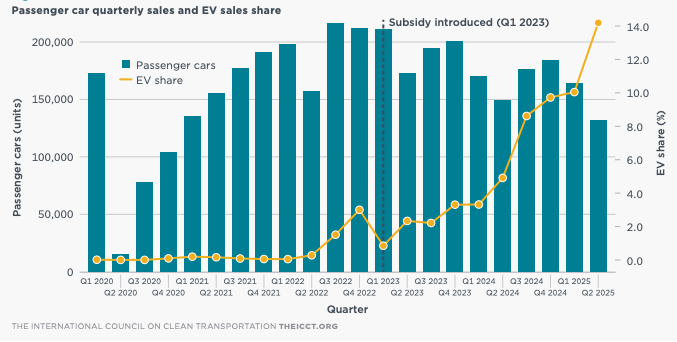
Compelling data from the ICCT’s "Indonesia EV Spotlight: Market Spotlight" report underscores this dramatic shift. In 2020, Indonesia’s EV sales were a mere trickle, fewer than 150 units. By the second quarter of 2025, this figure had surged to over 22,000 units, pushing the nation’s total EV stock beyond the 100,000 mark. More significantly, EVs commanded a substantial 15.2% of all passenger car sales by Q2 2025, a remarkable feat driven by an astonishing 40% surge in sales from the preceding quarter alone. This rapid growth trajectory paints a vivid picture of a market not just embracing EVs, but actively prioritizing them.
Indonesia’s abundant natural resources are a significant catalyst for this burgeoning EV momentum. As the world’s largest producer of nickel, accounting for approximately 40% of the global supply, the nation possesses a distinct strategic advantage in the crucial supply chain for EV batteries, as articulated by PERIKLINDO’s Rofiqi. This indigenous capability not only supports domestic manufacturing ambitions but also positions Indonesia as a key player in the global battery ecosystem.
Simultaneously, domestic demand for EVs is being amplified by a confluence of factors. The introduction of more affordable EV models, coupled with lower running costs compared to their internal combustion engine (ICE) counterparts, is making electric mobility increasingly accessible to a broader consumer base. Furthermore, the expansion of charging infrastructure is addressing range anxiety, a long-standing barrier to EV adoption. By 2024, Rofiqi reported that over 2,300 public charging stations were operational across 300 cities in Indonesia, a testament to the government’s and private sector’s commitment to building a robust EV ecosystem. This widespread infrastructure development signifies that Indonesia’s EV adoption has officially transitioned from the early adopter phase to mainstream consumer acceptance.
New Entrants Rewriting the Rules of the Automotive Game
This accelerated transition is fundamentally reshaping the competitive dynamics of the Southeast Asian automotive market. For decades, legacy Japanese brands such as Toyota, Honda, and Nissan enjoyed a comfortable dominance, built on a foundation of manufacturing excellence, robust dealer networks, and deep-seated brand loyalty. While these brands continue to lead in the conventional ICE vehicle segment, the emerging EV arena presents an entirely different competitive tableau.
The vanguard of this disruption is being led by Chinese automakers, with BYD and SAIC’s Wuling emerging as frontrunners. According to ICCT data, these Chinese manufacturers now collectively account for nearly 60% of all battery electric vehicle (BEV) sales in Indonesia. Their competitive edge extends far beyond aggressive pricing strategies. These companies boast vertically integrated battery supply chains, enabling greater cost control and faster production cycles. They are also at the forefront of integrating advanced digital features and connectivity into their vehicles, catering to the evolving demands of modern consumers. Perhaps most critically, they demonstrate incredibly agile product development cycles, often bringing new models to market within an astonishingly short timeframe of 12 to 18 months, a pace that challenges the more traditional development timelines of established automakers. This rapid iteration and responsiveness to market trends allow them to capture market share swiftly and efficiently.
The Imperative for Japanese Automakers to Pivot Strategically
"The rules of the competition are evolving. Companies that can adapt quickly will be positioned for long-term success," stated Rofiqi of PERIKLINDO, underscoring the urgency of the situation. He emphasized that the current market dynamics demand a fundamental re-evaluation of business strategies for incumbent players.
Japanese companies, undeniably, possess formidable strengths. Their world-class engineering capabilities, a long-standing reputation for top-tier safety, and generations of accumulated customer trust are significant assets. However, to remain competitive and relevant in the EV era, these companies must move beyond defensive lobbying strategies that have, in some instances, sought to delay the transition to electrification. Instead, they have a critical opportunity to lead the region towards a cleaner, more sustainable automotive future by focusing on key strategic imperatives.
One such imperative is the acceleration of EV product development. This involves not just increasing the number of EV models in their portfolios but also significantly shortening the development cycle to match the agility of newer competitors. This requires a streamlined R&D process, a willingness to embrace new technologies, and a commitment to rapid iteration based on market feedback.
Localized strategies are another crucial element. Understanding the specific needs, preferences, and purchasing power of consumers in diverse Southeast Asian markets is paramount. This could involve developing more affordable EV models tailored to local price points, offering flexible financing options, and ensuring that vehicle designs and features resonate with regional tastes. This requires a deeper understanding of market nuances beyond broad regional strategies.
Furthermore, deeper engagement with the emerging EV ecosystem is vital. This includes forging strategic partnerships with battery manufacturers, charging infrastructure providers, and technology companies. By actively participating in and contributing to the development of this ecosystem, Japanese automakers can not only secure their supply chains but also gain valuable insights and foster innovation. This collaborative approach can also extend to working with governments and regulatory bodies to create a more supportive environment for EV adoption.
Rofiqi concluded, "The opportunity for Japanese automakers remains substantial… But maintaining leadership will require accelerated EV product development, localized strategies, and deeper engagement with the emerging EV ecosystem." He added a forward-looking perspective, stating, "The future does not have to be a competition between countries. It can be a collaboration that benefits the entire region." This sentiment highlights a potential path forward where cooperation and shared progress can drive the entire region towards a more sustainable automotive future.

Greenpeace’s Perspective: Linking Market Growth to Climate Imperatives
The rapid market shifts discussed during the webinar hold profound implications for global climate action. For ASEAN nations, the ability to bypass the decades-long carbon lock-in associated with traditional internal combustion engine vehicles represents a significant opportunity to leapfrog to a cleaner energy future. According to the International Energy Agency’s (IEA) global EV forecast, the transition to electric mobility is no longer a question of "if" but "when" and "how fast." Global EV sales are on track to reach an impressive 23 million vehicles this year. This massive shift in transportation is projected to displace up to 5 million barrels of oil per day by 2030, making it an indispensable pillar in the global effort to mitigate the escalating climate crisis.
Erin Eunseo Choi, Climate and Energy Campaigner at Greenpeace East Asia, emphasized the critical connection between market dynamics and climate action. "Indonesia’s rapid EV adoption proves the market is ready," she stated. "For legacy brands like Toyota, it exposes the real risk of the slow-walk strategies favored by traditional automakers. Relying on a defensive ‘multi-pathway’ approach that protects combustion engines and hybrids is no longer viable and is already costing them market share to faster competitors."
Choi further elaborated on the urgency of the situation, noting, "Amid geopolitical oil shocks and severe El Niño events this year, decarbonizing the transport sector through battery electric vehicles is urgent. Japanese automakers must accelerate their EV strategies and set ambitious greenhouse gas reduction targets to achieve substantial cuts in total emissions." Her statement underscores the environmental imperative driving the EV transition and calls for decisive action from all stakeholders. The current geopolitical climate, marked by volatility in oil markets and the increasing severity of climate-related events, amplifies the need for a rapid shift away from fossil fuel-dependent transportation. The choices made by major automotive players in the coming years will have a lasting impact on both their own market positions and the planet’s ability to avert the worst consequences of climate change. The momentum is clearly with EVs, and the question for legacy automakers is whether they can pivot quickly enough to be part of the solution, rather than becoming casualties of the transition.

 Basiran
 Pevita Pearce